Smooth is Slow!

The common advice that smooth is fast is just plain wrong. It’s the worst advice you can give to a beginner… totally useless and, in fact, misleading.

The idea that it is necessary to be smooth to be fast is probably an illusion, possibly caused by looking at a car driven by an expert from the outside. It ignores what’s happening on the inside.

From inside the car, the driver should be making constant, rapid and sometimes even violent corrections. If not, the car is not being driven on the limit. The expert autocross driver doesn’t look smooth from an in-car video or to a passenger nor does it necessarily feel smooth to the driver himself. After a 60-second run the driver may well be huffing and puffing from the exertion and from having his breathing interrupted by high lateral-G forces.

Now, if the car looks herky-jerky from the outside, then the tires are probably being shock-loaded beyond their capacity, grip is being sacrificed and the positioning is not correct. All such faults are most likely the result of not looking ahead, not due to a lack of smoothness. So, if looking from the outside is what people mean by “smooth is fast” well, okay, but it’s so misleading as to be useless. To look smooth from the outside, and therefore to be FAST, look ahead. Do not “try” to be smooth. There is no more colossal waste of time in autocross than “trying” to be smooth. It can only slow your reflexes, make you late and make you fail to transition rapidly enough. All things that make you SLOW.

All that said, it is true that we do get smoother as our car control skills improve, as we look farther ahead and as we better anticipate what the car is about to do next. That type of smoothness only comes with experience. Forget about it. Learn to drive on the limit, smooth or not, and you’ll get fast. You can be smooth in your old age.
Drag Racers Rule

Learn to launch and cross the start line at the highest possible speed to save time. Maximum acceleration before the start light is important to increase the average speed to the first feature, not only in Pro-Solo, but in many regional and even some National Tour events. Maybe it’s not supposed to be that way. Get used to it.

Many people setting up courses mistakenly think that a short distance from the staging point to the start light reduces the advantage to the higher power car. Therefore, they design very short starts. I don’t think they’ve thought this through. It’s true that a long, straight start will allow the higher power-to-weight ratio car to reach a high speed. So, people tend to think that the shorter the start the better. But, even a short straight start gives a big advantage to a car that’s powerful and can get that power to the ground.

So, what’s done at most National events is a longer start that has a kink or turn right before the light. Either that or a short but severe 90 degree turn between the staging point and the start light. The severe 90 start still gives an initial advantage to the high-power car, but at least that advantage occurs as the cars accelerate after the clutch has been fully engaged and after the start-light is crossed, not before it. Either way, but especially with the longer start with a kink, the low-power car and the high-power car can only negotiate the turn or kink at about the same speed, because lateral G capabilities vary much less within classes than power-to weight ratios. So, they both cross the start line about the same speed.

Straight starts, long or short, give the advantage to the experienced drag-racer with the stout clutch, which is not what autocross is supposed to be about. Since this is the way it is, learn to launch fast, my friend. When you come across a real “national” type of course with a longer, kinked start then you can take it easy on your clutch.

Grip-it & Slip-it!

There’s grip on the other side of slip, I was advised by a fellow corner worker (and much better autocrosser) one year at the SCCA Dixie National Tour event. I want to explain what I think he meant and then add to it.

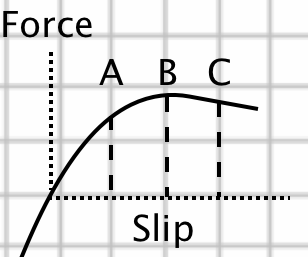
The figure shows the typical shape of a modern high-performance street tire’s lateral force vs. slip angle curve, starting from the transition section and continuing some distance beyond the peak.

slip

As autocrossers, we couldn’t care less what happens to the left of line A. But, take a look at B to C after the peak. Not much of anything happens, really, except the tire keeps on gripping after the peak is reached, even as more and more of the contact patch starts to slide. Look how gradual the decrease. That’s the grip on the other side of slip.

What does this mean to us as autocrossers who don’t care about tire wear? It means we don’t worry about exceeding the peak! If we operate anywhere in the range from A to C we are doing well. The tighter around the peak, the better.

Now, another thing to notice: Look at the graph and estimate the average Force value between A and B. Now do the same for the average Force value from B to C. Which one is greater? The average Force from B to C is higher. If we have to choose between A-B or B-C, B-C has the higher average grip level. We will be faster there, going around a corner, on the other side of the peak.

There’s one drawback to operating beyond the peak in the range B-C: some folks will accuse us of over-driving. My answer? “Yeah, I know. I’m working on it.” Then I just keep on grippin’ & slippin’.

No Corners, No Straights

Autocross courses have no corners or straights. At least not an SCCA National-type course. An autocross course is fundamentally different from all the various race tracks around the world. What is such an autocross course like then, the type you will have to master to reach the highest levels of the sport? A good autocross course is a ribbon path of varying width and varying radii, where width and radii alternate, blend and morph in rapid succession.

When you walk the course be aware of how the “track” width changes, in concert, or not, with the radii change. See that morphing ribbon out there among those orange cones! Then, plan the fastest path through it. Sometimes you have a choice of line, where the track is wide, and sometimes you don’t. Sometimes a wide-open track indicates or allows a “straight”, if you choose to make it so, and sometimes that’s the course designer playing with your rigid mind. Sometimes a cone is not only the limit of the course but is a distraction trying to suck you in, to make you think, “Hey, that’s the edge of the ‘track’ so I’d better be close to it. Use up all the track, they say.” Well, yes, the course extends to that cone, but the proper path may not lie anywhere near it.

Thinking in terms of corners and straights within a path of essentially constant width will hold you back. Stop doing it. I’m sorry to have to tell you this, but Autocross is much more complicated than that.