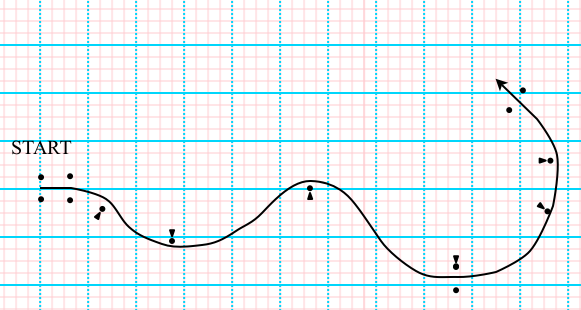
Slalom vs. Slalom

I’ve always assumed that there are parallels to be found between downhill ski competition and autocross. I never bothered to look into it, until now.

Full disclosure: I never became anything more than an intermediate recreational skier. So, you ski-racers out there can comment and tell me where I’ve got it all wrong.

Four main types of ski-racing events seem to exist at the world-championship level. The event called Giant Slalom (GS) most closely parallels autocross, I think. It runs about 1 second between gates, basically the same as an autocross slalom. The distance between gates varies a bit and sometimes there are two gates to pass on one side, but there are ranges for proper course design based on vertical drop. From Wikipedia, based on a formula: “… a course with a vertical drop of 300m would have 33 to 45 direction changes for an adult race.”

Maybe we could learn something about standardized course design for national autocross events from ski-racing.

The second type of event, Slalom, is shorter in length than GS with faster transitions and only about .82 seconds (I saw this number somewhere) between gates. I think this was the first type of ski-racing of the four to be established. Slalom transitions are faster than most, but not all, cars can achieve.

Of the two so-called speed events, Super Giant Slalom (Super-G) I’d say is most similar to Solo Trials and the Downhill is more comparable to road racing. The speed events have gates set farther apart, thus allowing higher velocities, are longer, have big radius turns and not much in the way of quick transitions.

From my brief reconnaissance of the sport, ski-racing technique has evolved rapidly over the last 20 years and maybe much longer. Much of this change has been driven by the evolution of equipment, in particular the advent of scalloped (side-cut) skis. As equipment got better humans have had to adapt their technique to take full advantage.

The ski-racing authorities have imposed limits on the equipment to keep things from getting out of hand, to keep things (somewhat) safe. They’ve had to impose minimum ski length and side-cut radii for each of the four types, for instance. They’ve had to change these requirements more than once. We call those “take-backs” in autocross, of course.

Something vaguely similar to equipment limits is happening in autocross. As power-to-weight ratios go up along with lateral-g’s in the lower prep classes, the courses at most venues have to necessarily get tighter to keep the maximum speeds in the safe range.

In general,  however, I’m not sure we can say that autocross evolution has been much driven by equipment evolution. While street tires have increased rapidly in performance, and street cars certainly handle better straight off the showroom floor than ever before, there have always been race tires and race cars at a much higher level of performance. That’s where most evolution due to technology has occurred. Someone with more knowledge than me will have to discuss whether better race tires have caused evolution in the classes where pure race tires are used.

Not that I think autocross is static. Far from it. I think it has been evolving fairly rapidly over the last 15 years or so. I think the best drivers of today are faster than those of 25 years ago. The reason? One word: data.

It’s almost comical what some people considered gospel 25 years ago. Data has cleared away a lot of the rubbish, the old wives tales, and the many ideas borrowed from the more mature sport of road-racing that just don’t apply to autocross. I think data is still driving autocross (and, for that matter, road racing) evolution today.

So, most of the talk/forums/instruction in ski-racing deals with human technique, and rightly so, especially since there are significant physical dangers in the sport, but there is some thinking about line and course strategy.

For instance, “high and early” vs. “low and late” discussions about apexing gates are common, especially with respect to the best line for beginner vs intermediate vs expert. Most teachers seem to recommend completing about 2/3rds of the turn prior to the gate, except for an expert skier who may do more of the turn after the gate. I’m sure the reader will recognize the direct parallel to autocross. I’ve done quite a bit of related data analysis elsewhere in this blog. Turning high and early is equivalent to late apexing in most peoples’ minds (not mine… I think that phrase should be banned from autocross as it is almost invariably misused) or, more properly, “back-siding the cones.”

I was particularly struck by the thoughts of Bob Harwood in an essay entitled The Road Not Taken- A philosophical approach to line and tactics, published on-line at modernskiracing.com.

Mr. Harwood writes “…what Bode [Miller] has taught us is that the old myth of one right line, the high line, is simply not true. Bode has learned that if he rocks his weight back a bit at the apex of his turn, he can ski a lower, tighter turn and still carve. Bode is able to bend the tail of the ski with more arc to carve a small radius turn with a high degree of confidence. Bode also has an amazing ability to shift his weight forward at the end of a turn so he can initiate the next turn smoothly and not get caught on the back of his skis at the start of the next turn. The end result: Bode’s balance and skills let him ski a lower, straighter line with less chance of DNF-ing than a more tradition skier…”

Sound eerily familiar? Race car driving has often been boiled down to the aphorism “The driver is simply a manager of shifting weight.”

Example: I recently co-drove a BS S2000 at the last two regionals of the year. I’d never autocrossed an S2000 before. The first event I wasn’t particularly fast. I focused on an efficient line and not spinning. (I spun anyway. But only once.)

Several places I took too slow of a line and dropped out of VTEC, which you really don’t want to do in an S2000 if you can help it. By the end of the day I had managed to get a feel for how much I could slither the rear of the car and yet not spin. I managed to beat the owner by a small amount but we were both down in the standings… I PAXed 17th of 112 and 8th of 9 in Pro, down from my average position.

In between events I watched a particular video (here) over and over again. This video shows a split-screen comparison of the best runs of Geoff Walker and co-driver Matthew Braun in an STR S2000 at the 2014 Wilmington champ tour.

Geoff Walker is one of the guys from an adjoining region that I’ve always considered quite fast. I’ve been trying to match him for years. He trophied in STR at Nationals in 2013, one of the very toughest of classes.

Matthew Braun is simply one of the fastest autocrossers alive with multiple Solo National Championships and podium trophy positions. Lately he’s been 3rd in SSR in both 2015 and 2016, having been the SS National Champion in 2006, 2010 and 2012 and the A-Stock champion in 2003, just to name of few of his accomplishments. I’ve been lucky enough to meet him on occasion.

Walker was driving great, by my standards. As far as I can tell he only makes one slight mistake in the entire run, getting a little bit late in the first slalom. That’s it. Everything else is just perfect. Perfect, until you see what Braun does on the same course.

I see a consistent difference between the two. Braun takes a slightly smaller radius at each offset cone. He then rotates the car while going past and is able to get on the throttle earlier as a result of the car being pointed in the new direction sooner. He walks away from Walker with a higher average speed (and possibly a shorter distance traveled) at every point in the course.

Braun and Miller: Both take a tighter radius by controlling weight shift. Braun manipulates weight over, and lateral forces at, the rear tires and gets them to slide at just the right spot and rotate the car during a tighter radius turn. According to Harwood, Miller manipulates his body weight, bending the rear of his skis more, allowing him to carve tighter at the apex and take a more direct, and thus faster, downhill line. The parallelism between these techniques is striking to me.

Cause and effect are often difficult to sort out in autocross, but the 2nd event in the S2000 I beat the owner by a much larger margin, took 2nd of 6 in Pro and PAXed 6th out of 74. This is about normal for me, maybe even better than normal.

axsm033

The Really Weird Thing About Modern American Autocross – Part 1

The really weird and wonderful thing about Modern American Autocross, particularly as opposed to road-racing, and to a greater extent than Rallycross, is that often the driver must decide where the track is and what path to take. This seems to take a peculiar type of brain-power, or at least gobs of experience, in addition to driving skill.

I’ve talked about having to choose the track and path in one of my early posts titled No Corners, No Straights. Now I’m going to try to use a little brain-power to analyze the question:  what radius to take around an offset cone?

It’s also true that the drivers in American autocross are themselves pretty weird, and pretty wonderful. By and large the srsbsns autocrossers are fantastically friendly and helpful to the others coming up in the sport and they share a very strong, fiendishly intelligent camaraderie with each other. This sets a certain tone of friendly challenge where the most common thing is four guys in the same class donate parts, grab tools and pitch in to repair a competitor’s broken car in grid just so they can beat him! A lot has to do with the amateur nature of the sport and the type of folks it attracts. Some people think it strange that we race for  a $3.50 trophy, or maybe a Tee-shirt, but they are missing something important. A lot of the sport’s amateur charm is only possible because there is no large monetary prize at stake.

Of course not everyone in the sport is so cool all the time. For example, I see a clear difference between the srsbsns autocrossers, who I define as those with a burning desire to get to the top echelon of the sport, whether they are there yet or not, and the business-serious drivers. Some of the bad-feeling controversies of late in the sport seem to me fueled by the latter. Not exclusively, by any means, and certainly not in every case. (Those fiendishly intelligent racers are often very quick to tell each other when they are being stupid.) But, by business-serious I mean those that have somehow contrived to make a living in a manner connected to autocross. They used to be just srsbsns racers, but now have a significant monetary stake in what happens so have become business-serious as well. That always skews things, both for individuals and for institutions. (Witness big-time college football.) But, I digress.

I’m going to go out on a limb and assume that historically there has been a movement within American autocross course design. (I could be wrong about this historical movement, but you’ll get my point just the same.) The movement I’m thinking about has been along a continuum from “specified-track” course design to “unspecified-track” course design. Most of us have seen what I call a “specified-track” design one time or another, or at least as a section of a course. This is where two lines of cones are set out to create what looks like the borders of a road-course, like this:

"Specified Track" Course Design

“Specified-Track” Course Design

In a specified-track course, the width of the course is more-or-less constant and there is little choice of line. There are a few clubs around that still do this, but not many. The majority in the sport have moved on to a more challenging type of course design and use specified-track components sparingly, maybe for safety purposes or for variety.

In unspecified-track course design the cones may be few and far between so the choices of path become almost infinite. The driver must decide what line to take based on either knowledge, experience or both. Here’s the same course as above, but with less of a specified track:

Unspecified Track Course Design

Unspecified-Track Course Design

Say you are running the course above. As you approach the pointed cone in the very middle and have to turn right, what radius do you take around it?  Assume it’s a 90 degree angle from approach to departure. Unlike the way it’s drawn above, most people would say, first of all, that you should get the turning done by the time you pass the cone. That makes the cone the exit of the “corner”, not the apex, allowing you to accelerate early down to the gate at the lower right.

Here’s the situation I’ve created in order to analyze this question, except I have you turning 90 degrees left around a pointer cone & gate:


time in curve 1

3 Possible Paths from A to C Around Gate at B

Imagine you are in your car at A. You have the choice to take the small 10′ radius turn, the medium 25′ radius turn,  the big 50′ radius turn or anything in-between. Which path is best? How wide do you take the corner if there is no specified track width to create a limit?

It is commonly believed that the proper path and corner radius is influenced by the acceleration capability of the car. Dennis Grant was a strong proponent of this school of thought. (See his Far North Racing website, the Autocross To Win section.) In a car with a high  power-to-weight ratio that can also get the power down (think Super Street Modified, for example) it is believed you should tend to “drive diamonds” which means tight radii around the cones. In an H-Street econobox that can’t get out of it’s own way you should “maintain momentum” and take a wider arc, so they say. I wanted to see if I could prove the truth of this and get a feel for how much it matters. I’ve never seen such a proof in a book or anywhere on-line.  I’m sure there’s a simulator out there that could crank this out in an instant, but I don’t have access to one. I’ve worked the problem out with a combination of spreadsheet and  graphics. I’ve set it up like this:

-At A all cars are traveling 50 mph and automatically orient toward the chosen radius. They continue at this speed until they must brake for the turn. All cars brake the same (1.0g) and corner the same (1.2g). This is not quite true across the autocross classes (the classes with aero and slicks corner much harder, for instance) but it’s a simplification I had to make.

-Each car brakes at 1g in a straight line until it hits the tangent of the chosen radius. So, a big radius means you have to brake earlier, reducing the time spent at 50 mph. But, a big radius also means you brake less and later because the speed in the curve will be higher, which means you are going faster at B when you hit the gas again. A big radius also means the car will travel a longer path. See how complicated this is?

-The car then travels around the chosen radius at a constant speed dictated by 1.2 g cornering capability. Again, the bigger the radius, the faster the speed and the longer the path.

-At B each car accelerates at it’s capability, from the constant cornering speed dictated by the radius, in a straight line for 75 feet.

-I calculate the total elapsed time from A to C for cars with 2nd gear acceleration capability from .1g (maybe an HS econobox) to .6g, maybe an STU Corvette, for radii that vary from 5 feet to 55 feet.

Results in the next post!


Never Late-Apex!

(I suggest you read the post below and then read the update here.)

Well, almost never.

While the late-apex cornering technique is a staple of road-racing and track-day driving, it has almost zero applicability to autocross. Why? Autocross almost never has an acceleration zone long enough to make up for what you give up in the corner for the late apex. Occasionally, yes, you will want to late apex, but not very often. Autocross is mostly made up of connected curves of varying radius. Usually it’s best to simply take the shortest path from one to the next, as Piero Taruffi stated in the first-ever scientific book on race-car driving in 1959. He was right then, he’s still right.

Late-apexing is done on track for various good reasons, but the only one related to saving time is to increase exit speed off the corner by “lengthening” the straight. The increased exit speed is carried down the ensuing straight whose average speed is now increased, reducing lap time. This is the only occasion to use a late-apex: when the length of the ensuing straight is long enough to save more time than lost in the corner.

Be careful not to confuse late-apexing with the technique of “back-siding” the cones. Back-siding a cone is not late-apexing. Back-siding a cone is a result of the racer deciding where the beginning and end of the corner are and on what radius. When he tells you he plans to backside a particular cone, it means he has decided that that cone is on the minimum radius but not at the apex of the “corner” he has imagined out there among the orange cones. When he passes it he plans to try to run over the base of the cone with his rear tire, meaning he is wrapping around it in order to be going in the best direction toward the next feature. By definition, therefore, the backsided cone is not an apex in the road-racing sense because the car continues to turn hard well past it.

Now, I suppose one can be perverse and “decide where the corner is” and decide to late apex it and decide that the cone marks the late apex or is at least within shouting distance of it. In that case I admit that you have sort of backsided the cone and pulled off a late apex simultaneously. Good luck with that. Please go back and read the title of this post again.

Be aware as well that designating an offset cone as your corner exit and deciding you want to be accelerating at that point toward the next offset cone is also not late-apexing. (I plan a later post on that subject, complete with diagrams and spreadsheet calculations. I know: You. Just. Can’t. Wait.) How you performed that corner, what path you took, etc. determines whether you late-apexed it or not, not what you were doing as you passed the cone marking the exit. Did you take an extra-long, small-radius, time consuming path that allowed you to increase the length of the straight you created toward the next cone, rather than get to the cone on the shortest, fastest geometric radius? Then you did, indeed, late-apex that baby. You were probably wrong. And slow. 2019 Update: Adam Brouillard in The Perfect Corner has shown that the car that takes the “extra-long, time consuming path” never catches up to the car that didn’t, no matter how long the straight that follows.

Remember that in good autocross course design, the exact location of the corner and even it’s radius is to a large extent at the discretion of the racer to decide. Yes, most of us have seen courses completely lined on both sides with a zillion cones, all marking a path 12 to 20 feet wide. Unfortunately, some organizations still do courses like that, but the top levels of the sport have moved beyond such drudgery. People who always race on such courses will never get FAST at high-level autocross. If they should attend an event where the path is not dictated to them, or even if it has only one or two sections not dictated to them, they become lost, dazed and confused. It’s not the heat, it’s the course.

This is one reason why autocross is so challenging and so rewarding. Every course is different and full of “corners” that the racer has to look ahead and “find” before he can even analyze and then drive them! This may also be why road-racers typically have a hard time adapting to autocross if they didn’t start with autocross. On a track the “corner” is more of a fixed, known quantity. There is great skill in figuring out how to take it at ever greater speeds, how to pass someone in it, and how to not get passed in it. Plus, the same corner is different in different conditions. However, the skill of “deciding where the corner is and what it looks like” doesn’t get developed.

All Those Books On Cornering Are Wrong

Most books present racing cornering in three stages: the approach, where (after braking is completed) the car transitions from an infinite radius (straight) down to the minimum radius for the corner, the middle stage on a constant, minimum radius that (mercifully) ends at the apex, and the exit on an increasing radius, accelerating and tracking out until straight again. This is a nice, neat theory, perhaps first worked out by Piero Taruffi in his book “The Technique of Motor Racing” in 1959. If you think this concept has relevance to autocross racing, best get it out of your head.

As Taruffi goes on to say (after spending many pages working out the geometry of the three stages of every corner) the three-stage method is not the cornering method used by the fast drivers, not even in the 1920’s when he was coming up, much less the 1950’s when he wrote the book and certainly not now in the 2010s. So, put this concept into your head instead: the FAST way through a section of smaller radius has only two stages: Stage 1 is a different type of approach, which ends at the apex, followed by the exit stage as before. The Stage 1 approach is done by turning in later and while traveling faster, then transitioning into a trail-braking slide to scrub off speed, with the path radius constantly getting smaller (and the car slower) until a minimum radius is finally reached at the apex. The second stage, the exit, is done by accelerating on a line of increasing radius just as in the three-stage description. This method allows you to delay your braking and, in fact, to use less braking. Your average speed from turn-in to the apex is higher and the car is pointed better for the exit. It requires a very high degree of car control skill to execute. It requires you to not care about the life of your tires.

I know you want to ask, “Why don’t road-racers corner this way all the time if it’s so fast, Fool?” Probably for two main reasons. Two-stage cornering 1) causes rapid tire wear, and 2) is more prone to error, which is often positively dangerous on a track because an error can easily send you directly off the corner or off on the exit. For road-racers in qualifying, tire wear is no issue, so the fast ones do it. (Somewhat modified this technique is also used to execute passes at corner entry. Fernando Alonso is particularly good at it.) For Time-Trialers going for a fast lap or two per session, tire wear is no issue, so the fast ones do it. For autocrossers, tire wear is a given, there is zero danger, so the fast ones do it.