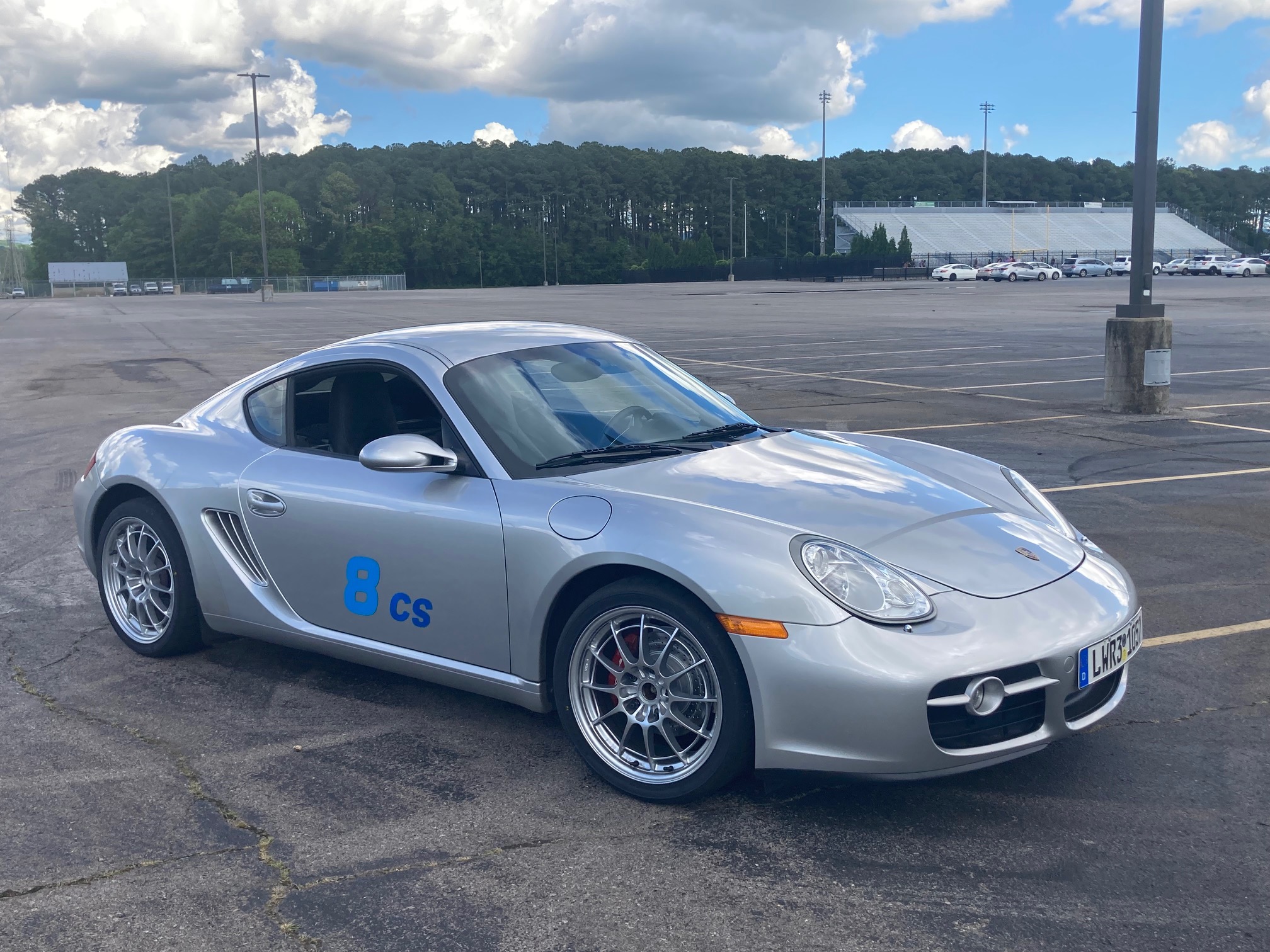
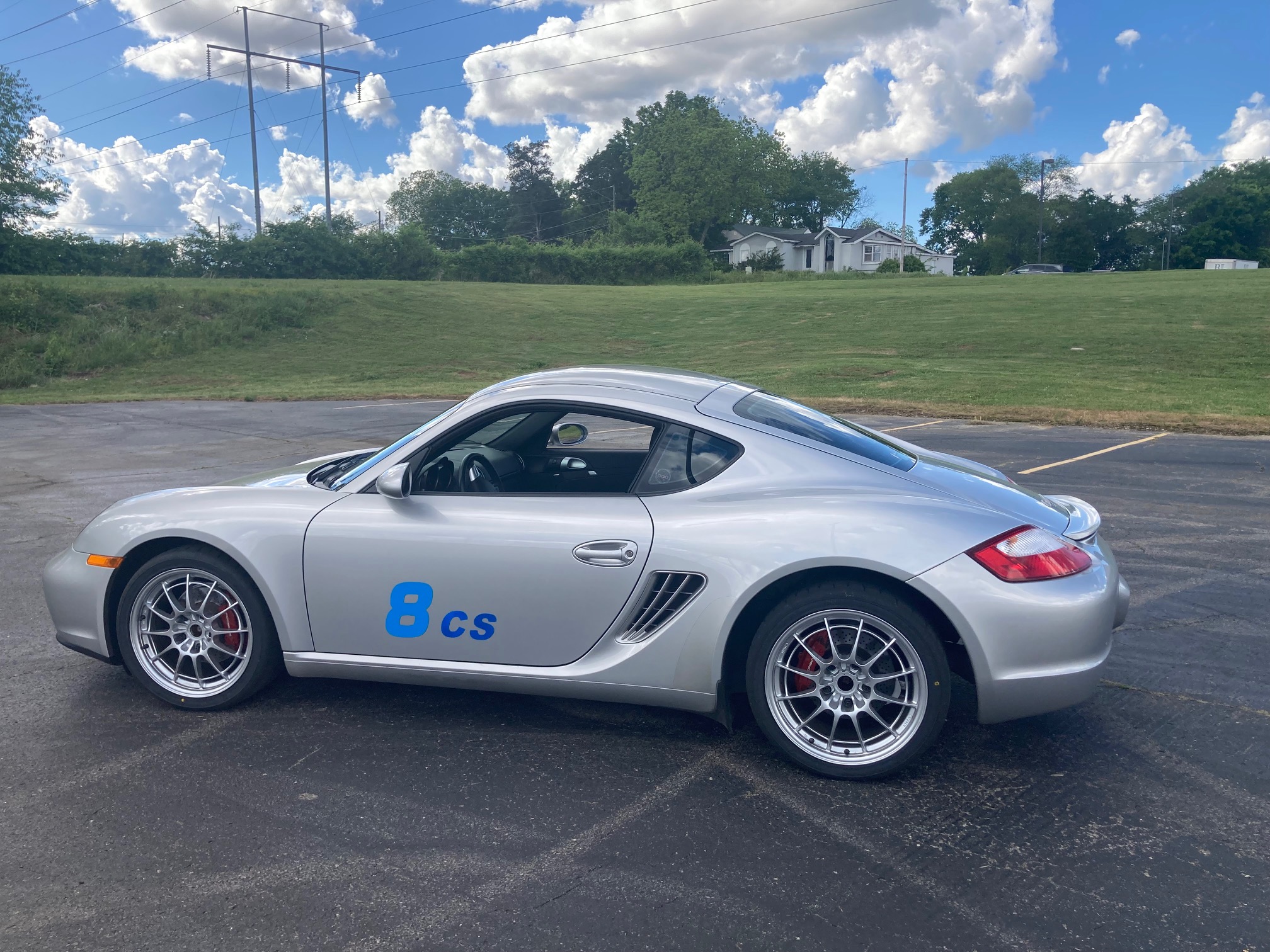
987.1 Cayman in C-Street: 5th & 6th Events

I put a pair of 295 Yoks on the rear as a fit check and went to my local TAC 6 event with no other changes, including the same tire pressures. It was a disaster, but at least the tires fit!

Way too much oversteer tendency meant that I could not aggressively trail-brake into corners without losing the rear end, which I proceeded to do time after time. If I beat people that’s usually where I do it: on corner entry. I placed a disappointing 4th in C-Street and 22nd overall of 114.

I learned a lot by comparing my data to the winner of CS who was kind enough to give me his data. In return I created a set of charts analyzing the differences corner by corner. Besides my driving mistakes, the data showed that the Cayman has a very slight acceleration advantage over the ND Miata in both 1st and 2nd. Meantime, the Miata seemed to have a slight grip advantage, but that may be due to the limitations of the Cayman oversteer situation. At least I hope so, because this entire enterprise is predicated on the Cayman having a grip advantage inspite of its weight. It may be that I’m running into the reality that lack of front camber is always going to limit peak cornering grip to less than the Miata.

The next event was with the Alabama Region of the SCCA at Barber Motorsports Park outside of Birmingham. Prior to the event I dialed in a healthy amount of toe-in in the rear to cure the oversteer. It worked. The rear was now super-stable and I won CS in front of two ND drivers that beat me the weekend before at TAC 6. I won by over half a second on a 43 second course.

It was too much toe (5/16″ total) because the car would now push powering out of a corner. This car had never done that before. It was also really hot. I had a co-driver (who will drive with me at Bristol) and we confirmed again that you can overheat Bridgestones on a hot afternoon with six runs if you don’t water early.

The Barber Proving Grounds surface is very smooth with consistently high grip. This meant that the present lack of damping wasn’t so critical, i.e. the car wasn’t bouncing badly as is likely to happen at Bristol.

Back home I fabbed a string setup in order to produce an accurate alignment. (I didn’t feel like leaving the car all day with the kids that work at my local alignment shop like they insisted. That’s two shops that can’t figure out how to make an appointment system work, so I decided to do it myself.) Initial results were that the front tires are both pointed to the right!
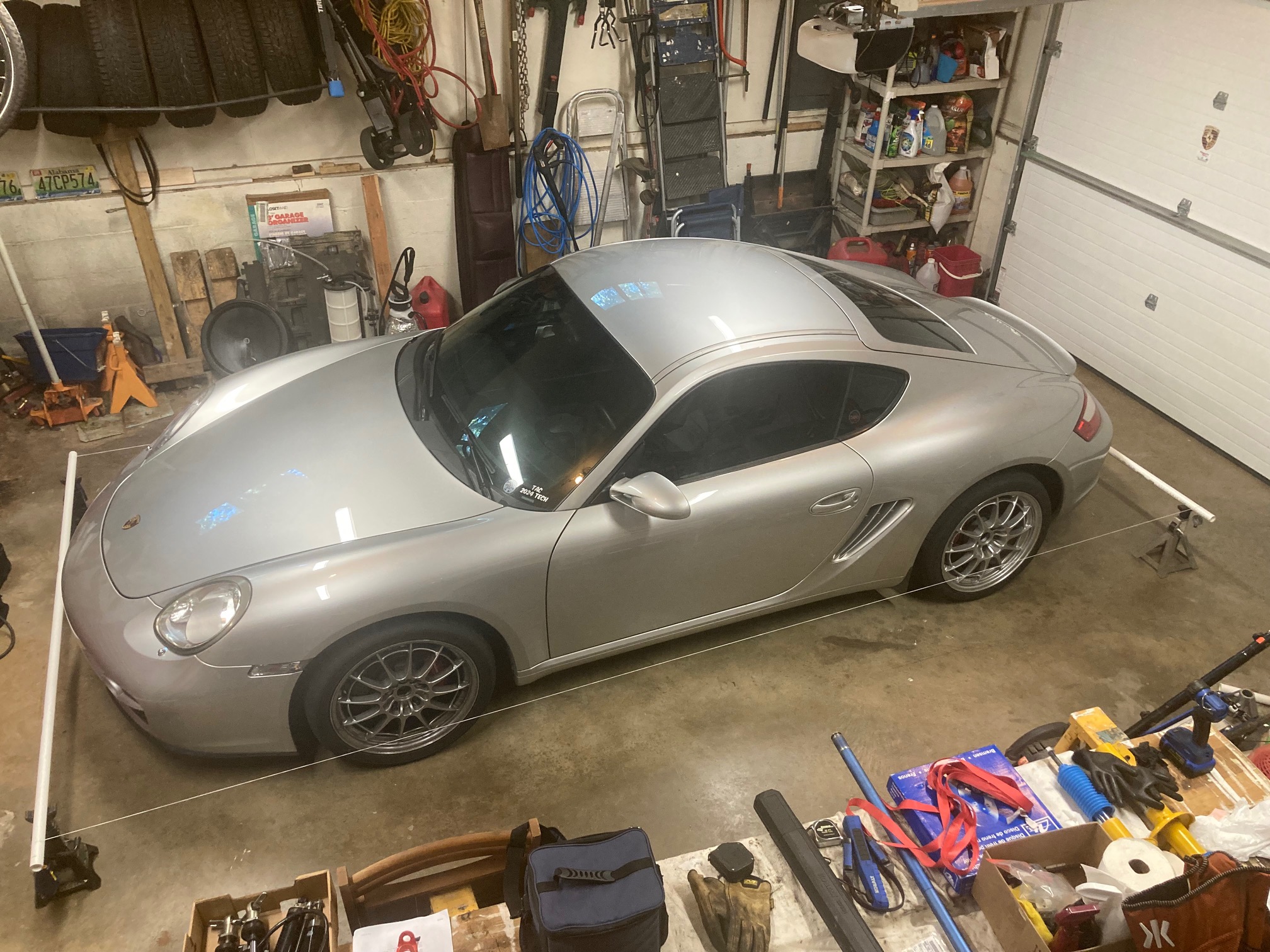
String Alignment Setup

It took only a single iteration on the strings to get what I wanted. The car is now at zero front toe while straight on the axis, and 7/32nds (measured across 19.5″) total toe-in in the rear, split equally to each side and straight on the axis. (7/32nds = 0.32 degrees per wheel) I know that this is more toe-in than most people use for these mid-engined Porsches. It may get reduced later. But, I like to be very aggressive on trail-braking into corners so rear stability when the rear gets light is needed, as least for my confidence. I’ve driven other Caymans with minimal toe-in and they did not give me the confidence I needed when braking hard while turning.

This is the setup I plan to run at the Bristol Pro-Solo and Tour later this month.
987.1 Cayman in C-Street: 3rd & 4th Events

We had a two day event this weekend. The bad part was that there was rain both days. Not much good for testing. However, both days I got one or two runs with substantially dry sections where I could get a feel for the high lat-G behavior.

In Grid Sunday

The runs were encouraging. Immediately before these events I installed the Tarett 5-hole front anti-roll bar and a new set of bumpstops one full-step up in durometer from the last event.

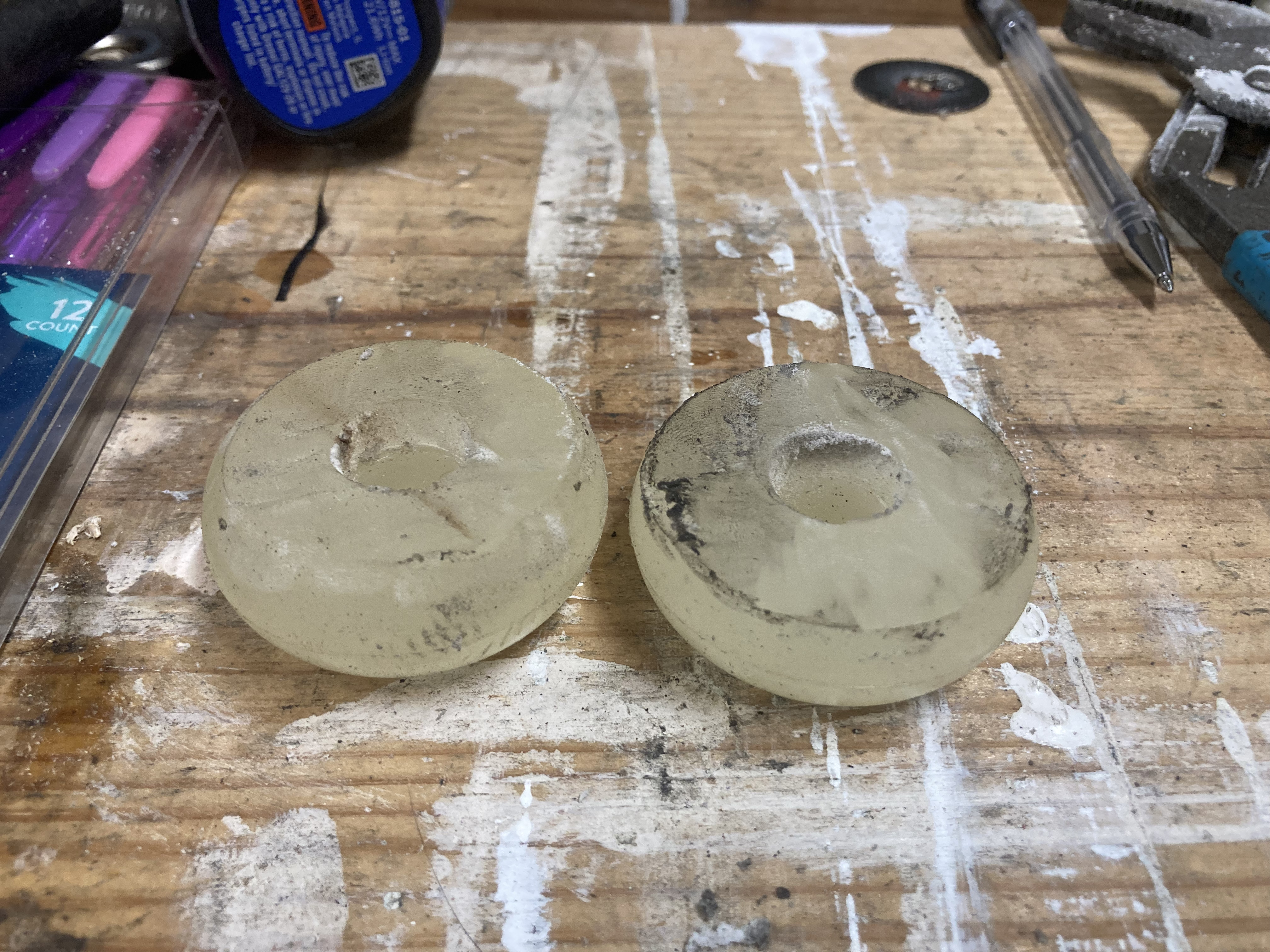
New Rear Bumpstop Stack- (Yes, I cut this pair a little short)

The car was definitely stiffer in roll and a little more bouncy than last time. The stock struts are really not up to the job with these high spring rates, but the car is still controllable, to my great surprise. I calculate the present natural frequencies at 2.10Hz front and 2.45Hz rear. I made a wild guess and set the front bar to the middle hole, planning to adjust it in between events if necessary.

I’m carrying a front spring rate of 505lb/in, which is 155 from the metal spring and 350 from the bumpstop. The rear is 745lb/in, 228 from the metal spring and 517 from the bumpstop. However, there is some uncertainty in these numbers. (For comparison, KW Clubsport coil-over springs are 400F/685R. They also have bumpstops that look pretty tall, but I have no idea what their rate is.) Note: when people normally talk about Porsche spring rates they rarely add the stock auxiliary springs (bumpstops) into the mix. When an aftermarket setup eliminates the bumpstop contribution and compares their new spring to the stock spring the result may be a misleading comparison.

I had also maxed out the rear camber and reset the rear toe to zero. I’m sure the thrust angle is wonky, but I’ll get that taken care of at an alignment shop soon.

How it Drove
The car was well-balanced in both wet and dry conditions with big grip as before. It’s very encouraging that the balance didn’t change noticeably from a wet corner to a (sort of) dry corner. In spite of the difficult wet/dry/wet conditions as rain showers came through I never spun and never hit a cone. I went off-course once when the car hydroplaned straight through a deep puddle when I needed to be turning. External observers stated that the car seemed to have only very minimal roll in the corners. I think I may have been approaching the speed of the Miatas in the slaloms as I learned to trust the car and ask more of it. I hope to get some Miata data to compare to. Transient response seems very good, but not sure if it’s at Miata level.

Results
Day 1 was mostly very wet, so I didn’t expect to make much of dent in the swarm of Miatas. I managed 4th of 13 in C-Street and 8th overall of 110. I was closer to the fast guys in CS in the wet than I expected. My previous experience is that a big weight difference is next to impossible to overcome in the wet, even if the amount of tire is proportional. 600lb is a big weight difference.

Day 2 we got drying conditions for our final 4 runs. I had been in the lead of CS all day, both for Day 2 and the two days combined, partly because of others’ cone trouble. In his last run of seven one of the drivers ahead of me on day one got close enough to take first for the 2-day total by 0.007s.

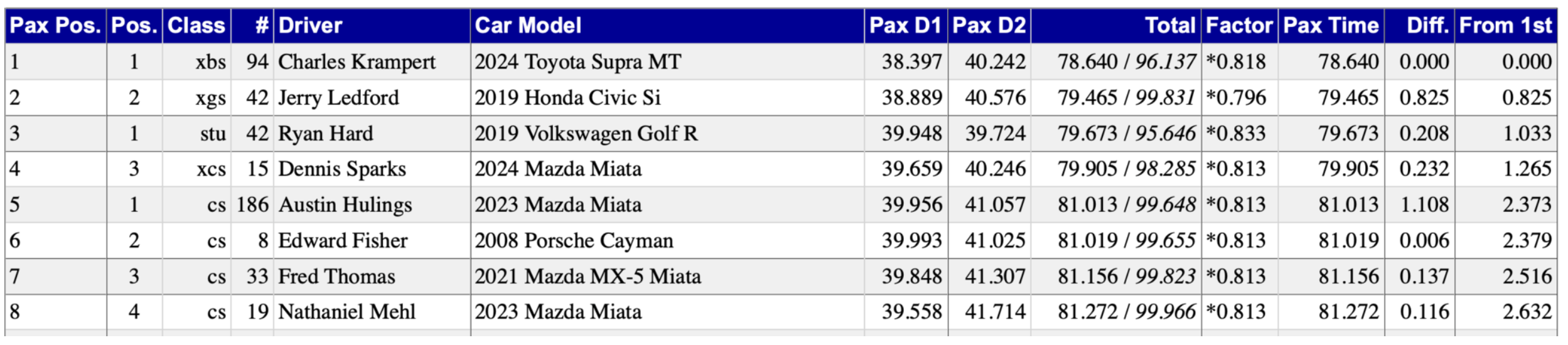
So, I ended with the fastest time in C-Street on day 2 and taking 2nd for the two days combined. Over the two days I was 6th overall. Six of the top 10 overall were C-Street drivers, with 2016 D-Street national champion Dennis Sparks leading the way in Pro class in his 2024 Miata in 4th. I’d been pretty close with him both days until he threw down on his last run and jumped ahead by a second. Dennis trophied in CS at 2022 Nats. He told me he thought it was great that I had developed an alternative to the Miata for CS. The top 8 overall positions for the two days combined are shown below. Each of the drivers in positions five through eight have now placed first in C-Street in an event this year. Note that those four were within 0.269s over two days of driving, fastest times for each day added.

2-Day Event Overall Results

Plans
Except for the alignment I have no plans to change the car before the upcoming Bristol Pro-Solo and Tour events, other than some maintenance items. Instead, I’ll be working on the driver in two local events before Bristol. In the meantime I’ll be trying to figure out how to proceed with the too-long Bilstein B6’s. As mentioned in the previous post on this topic, the front struts are too long when fully extended as compared to the stock struts. I have a friend that can turn down the standard bumpstops I’ve been using so that they will fit inside the B6 lower housings. That means buying some examples and testing them after machining to determine the real spring rates. But the big thing is to either find a substitute shorter shock shaft, get the shafts shortened and re-threaded or have a spacer installed interior to the front struts to make them legal.

987.1 Cayman In C-Street: 2nd Event

In between the first and second autocross I made the first suspension change: stiffer bump stops.

The difference was amazing. Ten seconds into the first run I knew that, if I continued to develop the car (and the driver) it could be competitive in C-Street against the ND2 Miatas. So. Much. Grip!

The new bump stops made a huge difference. Less roll, faster response, balance that moved toward oversteer and the biggest thing: more grip. The extra grip comes from not losing as much camber because the car rolls less. A major weakness of this car is insufficient static negative camber in the front. Well, if you don’t lose as much then you don’t need as much and peak grip is increased.

The car was easy to handle. It’s somewhat bouncy now, especially on this bumpy site, since the stock damping is now a bit insufficient for the new spring rate. I was 2nd of 11 in C-Street against the same crowd where I was 5th of 10 last time. And I was 7th pax overall of 109, a huge move up from 22nd in the first event.

I think I was a little conservative on the bumpstops. The plan is to go up one durometer step and add an adjustable front bar. The Tarett hollow 5-hole front bar has already arrived.

I’ll show you what I did.

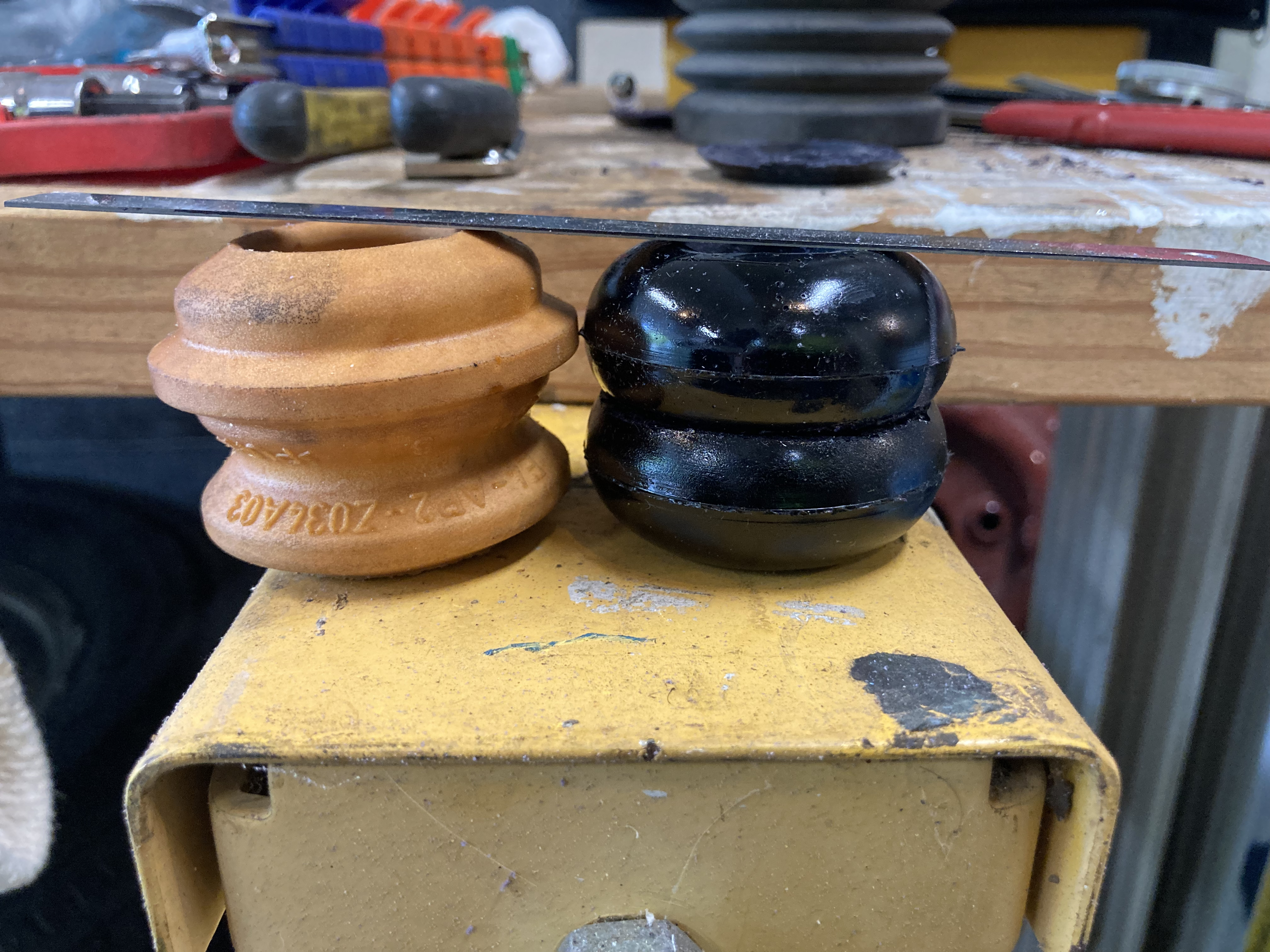
Height Comparison: Stock Porsche vs. new stack of 3 donuts plus 2 spacers run in event 2

In the picture above you see the stock front bump stop on the left. The rules states that any alternate design cannot increase the length of the strut at the point of contact. Since I’m still using the stock strut that means that the height of the new bump stops cannot be more than the height of the old.* They can be shorter, however.

These donut-type bump stops were bought from ReSuspension. They sell a wide variety of types and stiffnesses. I like these and used this type on my 944 back in the day because the shape creates an initial soft-ramp of the spring rate as they flatten out. Since then I’ve used others that are pure cylinders, but a different material, and they seem to work equally well.

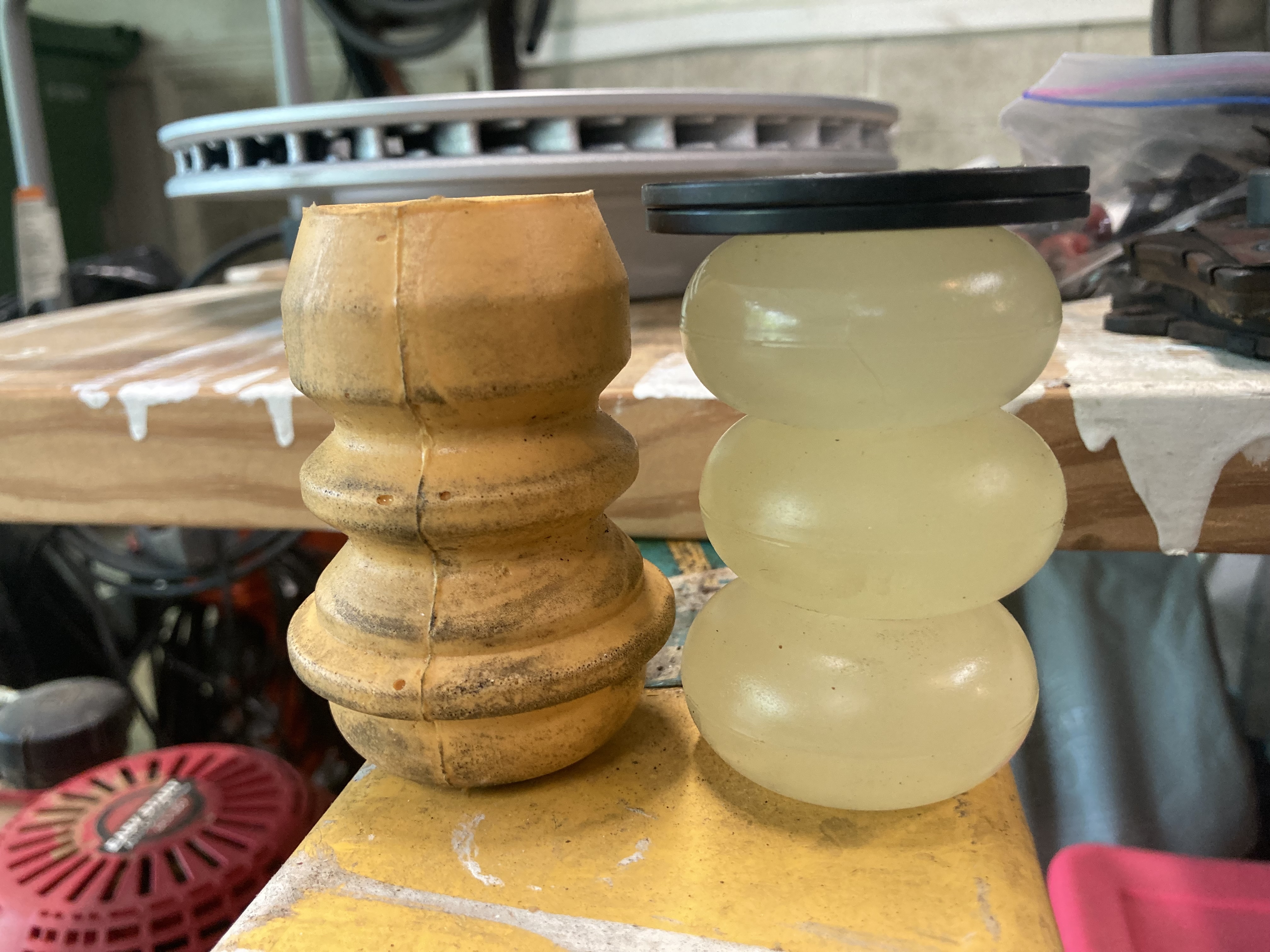
Rear Bump Stop Comparison

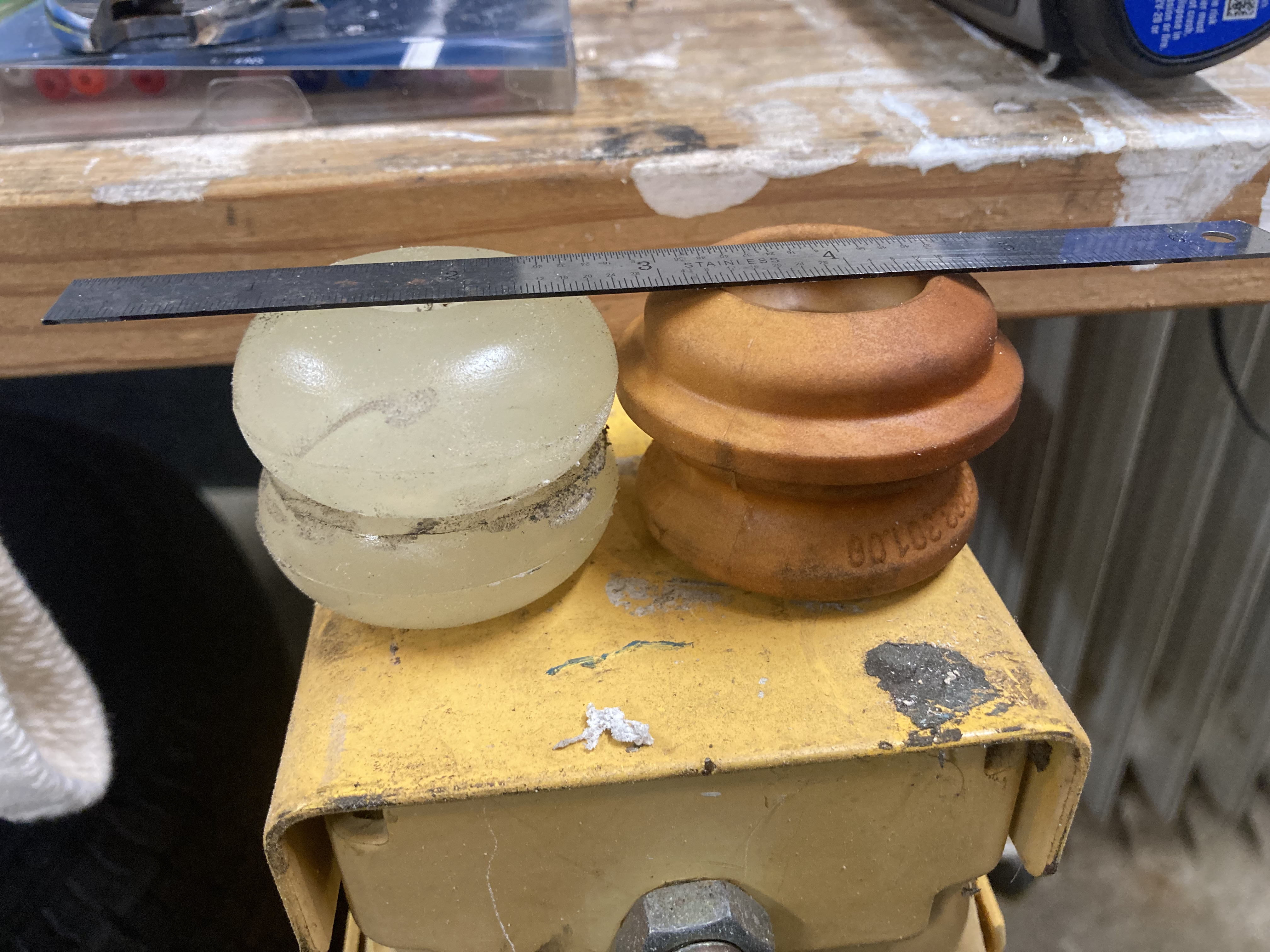
In the above picture the new bump stop vs the stock Porsche for the rear is shown. Two of the donuts as-molded were too tall, so I had to trim them.

Rather crude trimming of donuts for the rear

The holes in all of these is 0.625″ which is smaller than both the front and rear shaft diameters, and the diameters are not equal front and rear. So, I had to open the center holes to get them to slide onto the shafts.

ReSuspension provides technical data on these donuts for a single and double and triple stacks. I use this information to calculate the resultant total spring rates front and rear. It’s possible to mix and match various durometers to get a range of spring rates. However, the trimming affects the spring rate that these stacks actually produce. Determining how much will require direct measurement. For instance, shortening the rears should have made them exhibit a stiffer spring rate, based on how much I cut off something like 15%. As I go further I plan to figure out a way to measure the rates. All that’s really needed is a press, calipers, and a load sensor of some type. (Bathroom scales?)

Next event I’ll have a similar arrangement except with donuts one full durometer-step stiffer. The calculations indicate that this will push the balance even further into oversteer. I hope to counter this with the new front bar, which I also hope will tend to keep the inside rear tire down better. In this event I had issues with spinning the inside rear due to the lack of an LSD.

*For any aftermarket strut the allowable height of the bump stop could be more or less, depending upon the design. The supplied bump stop might not be legal. In fact, the allowable bump stop height for an aftermarket strut almost certainly will not be the same as stock or what is supplied. You must understand the geometry, measure precisely and determine what’s what. No supplier has any obligation to meet SCCA rules. I’ve already run into an issue with Bilstin B6 struts that I’ve purchased. By my measurements the as-delivered fronts are not legal in SCCA Street-class.

987.1 Cayman In C-Street: 1st event

2008 Cayman Is Now In C-Street

I’ve sold the Corvette.

The replacement autocross car is a 2008 Cayman, 2.7 liter model, to be prepped for and run in C-Street. I appear to be in a significant minority of autocross racers who think this a competitively-viable plan! C-Street is presently spec-ND2 Miata. I’ve driven that car in a couple of events. It’s definitely a very fast autocross car, often raw-timing B-Street, but it’s not perfect.

The non-S Cayman is one of a group of cars moved down from B-Street this year. Those are the turbo 4-cylinder Supra, the 2006-08 BMW Z4M, the 4th-generation Corvette and the Cayman. I believe that the only one of these four that’s shown up so far this year at a national event was a Corvette at the Red Hills Tour. It didn’t do well, but I have no idea of the skill level of the driver. I hope to take the Cayman to the Bristol Pro-Solo and Tour July 4th week.

The general consensus is that the only one of the four that might be competitive is the Supra. This may very well be correct, but I have no interest in owning that car. I’ve always wanted to own a mid-engined Porsche and my performance-predicting spreadsheet indicates that the Cayman is the one that can be the most competitive with the ND2. On paper. Not counting certain intangibles.

I ran the car in its first event on fresh tires this past weekend. In summary, I believe the car shows promise but driver and car must both evolve to be threat to the ND2 in C-Street.

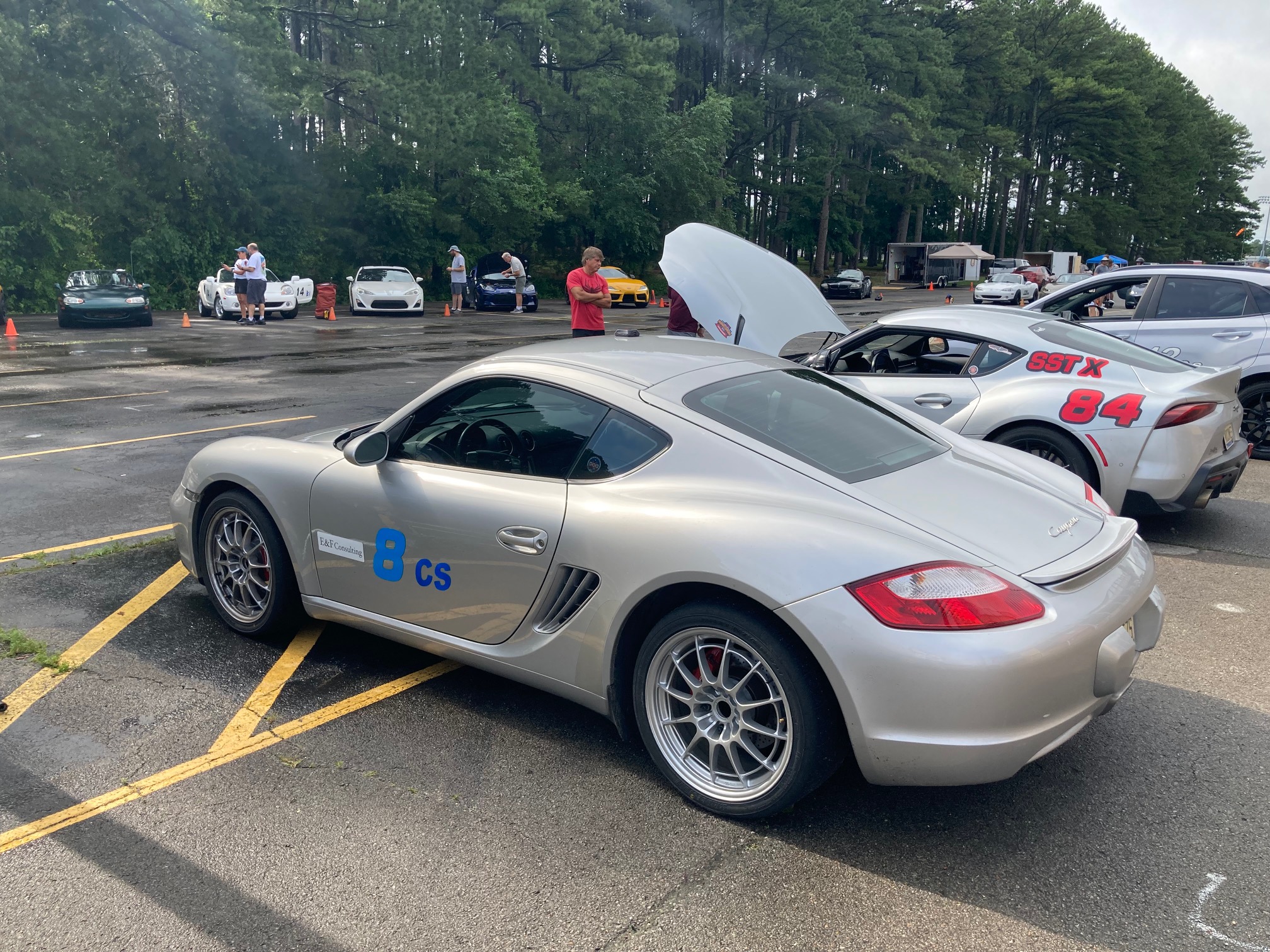
The car was run stock except for 255/285 Stones on 8.5” and 10” rims. I’d maxed the front camber to about 1 degree in front with healthy toe-out. I left the rear as I received it at 1.5 degrees with very slight toe-in. There seems to be a little more camber to be had when I look at the eccentric.

Handling was very balanced. At times I was 4-wheel drifting in decreasing radius corners. Elsewhere I was power-sliding out from an apex. Not necessarily fast, but these antics happened naturally while hustling my chosen line. Great fun, very controllable, no understeer. I very much like the mid-engined, short wheelbase dynamics and how fast the car rotates. Steering precision and feedback is fantastic. As expected it is not as stable under braking as a Corvette or ND2 due to rear toe instability over bumpy surfaces inherent in the strut geometry. Like the ND2 it’s easier to drive than the Corvette thanks to not having to manage big torque. On the other hand, it sometimes seems to take a long time to get from one corner to the next. I was looking for some reading material or contemplating the meaning of life and autocross which are, of course, the same thing.

I started tire pressures at 30F/34R. Grip was not great… it felt like too much pressure. So, I dropped one psi each run and it felt better and better. I ended up at 26/29 and the grip was fantastic, probably also because the tires were coming into their own. AT LEAST a match for the ND2 when it comes to grip.

Lack of an LSD was only a problem when launching at the start and then turning hard at the light with full power in 1st gear. I had to drive smoother to stop that and optimize speed at the light but I was able to do it. This issue may go away when the front roll stiffness gets increased as planned. I never had inside wheelspin in 2nd gear… just not enough torque from the little 2.7 liter engine!

First run I had a problem with stability management kicking on (though nominally turned off) when one tire would begin to enter ABS activation. (This is the way non-Sport Chrono cars work.) This went away by the 2nd run as I lowered pressure and got more grip, plus I was driving better. 

The car was slow in the long slalom when compared to the ND2s I’ve driven lately. To be expected with stock springs, bars and shocks, I guess, and it’s wider. Also, I’d replaced a disintegrated front bumpstop the day before the event with the one I’d bought for reference. Just weaving down a city street I can feel that the side with the new bumpstop is stiffer than the other, even though the old bumpstop on the other side is intact. The roll is snubbed earlier and the car turns faster. This shows how much these Porsches depend upon good bumpstops for proper handling. And, I hope, also how much things will be improved with stiffer ones.

So, how did I place? We had a CS class of 10. Five are what I’d call fast. I was 5th. The four above me all paxed in the top 10 out of 125 drivers. Also in that top 10 (and not in CS) were two multi-time national champs, 2 more Nats trophy winners and at least one other that could win a Tour if he ever went to one. I paxed a slightly disappointing 22nd with a significant error on my fastest run.

I’ve done the calculations and ordered aftermarket bumpstops last night. I’ll play with those first on the stock shocks and then maybe with Bilsteins once I get them. I’ve ordered a manual-hydraulic spring compressor to make things easier and safer to do all this strut assy/disassy. Sway bar decision to follow. If all is good except for some lack of damping then shock valving will be the final step. At least that’s the plan.