Autocross Training Stages- Part 1

Frequently when we see great performers doing what they do, it strikes us that they’ve practiced for so long, and done it so many times, they can just do it automatically, But in fact, what they have achieved is the ability to avoid doing it automatically.

When we learn to do anything new-how to drive, for example-we go through three stages. The first stage demands a lot of attention as we try out the controls, learn the rules of driving, and so on. In the second stage we begin to coordinate our knowledge, linking movements together and more fluidly combining our actions with our knowledge of the car, the situation, and the rules. In the third stage we drive the car with barely a thought. It’s automatic. And with that our improvement at driving slowed dramatically, eventually stopping completely. 

By contrast, great performers never allow themselves to reach the automatic, arrested-development stage in their chosen field. That is the effect of continual deliberate practice-avoiding automaticity. The essence of [deliberate] practice which is constantly trying to do the things one cannot do comfortably, makes automatic behavior impossible.

From Talent Is Overrated: What Really Separates World-Class Performers from Everybody Else, by Geoff Colvin, 2008

You must walk the course, you can’t ride it! (Except at walking speed, with prior permission, in cases of physical impairment.)

Stage 1: Training the mind to learn the course prior to the first run

When we learn to autocross we go through stages. Unfortunately, there is not yet a firm consensus of what those stages are and how to best train for the transition through them. However, I have certain opinions on the subject.

This will not be a surprise to anyone who knows me!

I think three stages can be usefully identified and trained in order. I’m not sure how many posts it will take to get through them, but we might as well get started.

One caveat: The stages that we use to break down the learning of any skill are never absolute. They are a creation intended to support the design of a particular method of training. Hopefully it is a training method that was developed by someone with experience and skill. Since the training method is by nature designed not all designs will be equally effective, though any two different designs may be equally effective as long as they’re each followed faithfully.

In the art of Taiji that I practice there are commonly thought to be three basic stages. I heard a teacher remark that, while we are actually learning bits of all three stages almost from the beginning, it is important to focus on each stage in order. He referred with sadness to certain schools that basically skip the first stage and begin and concentrate on stage two, either by choice or ignorance. It’s not that one cannot make progress in stage two without stage one, but the progress is limited and the art is forever incomplete without mastering the stage one skills. I think autocross is similar, and one of the problems for beginners is that you tend to get all sorts of advice from well-meaning people, but the advice may come from what really should be different stages. This makes it difficult to figure out which advice to listen to and focus on.

One thing is for sure: we cannot be fast when the course is a series of constant surprises. Most beginners soon realize this, but may not know what to do about it. It takes them many tries at the course before it begins to click. In the beginning it may take more runs that you get in the day, so you never get to the point where you drive the course with confidence.

This is a problem unique to American autocross. The course is different at every event and we don’t get to practice it. We only get to walk it. Every run is timed and we only get a few runs. Only the fastest run counts.

I’ve heard (and read) many advanced drivers say “seat time is all you need.”  

Seat time is needed, of course. But it’s not enough if you wish to get fast, fast.

Beginning with a club that offers at least six runs during a day (and hosts many events each season) is very advantageous because it may take that many runs to develop what a more advanced person would still call only a basic knowledge of the course.  But, that sixth run may be the only one that’s really fun that day if it’s the only one where you aren’t worried about getting lost, even momentarily.

The mind can only do so much. If your focus is on recognizing the features within the course as you’re driving, then it can’t be on other things like surface composition, slight camber changes, grip changes, etc. So, we need a good way to quickly nail down our knowledge of the basic course layout so that we don’t have to focus on it as we drive. I call this learning the course.

Learning the course is a mental skill that requires development over time. The good news is that, as far as I can tell, anyone with normal mental capacity can become very good at it. The mental operation will become easy or at least easier. Like anything else it takes practice. But, what type of practice? Well, that’s why we do a course walk, right?

Do you think walking the course aimlessly is going to do the trick? Or, worse, walking the course distractedly? Or, even more depressing, how about walking the course with great focus, but focussed on the wrong things? None of these are likely to produce a good outcome anytime soon.

Now there are levels and levels for this sort of thing. The amount of detail that can be registered during course walks can vary tremendously from person to person. This is no different than expert-level achievement in any field. Experts always see more and remember more. You want to be an expert, right? OK, let’s go!

So, how do we get started training the mind to learn the course? We walk the course in a deliberate practice* sort of way. I recommend two disciplines. First, walk the course as many times as possible with mental focus. Your focus should be on imagining driving it at each point, at each step you take. Remind yourself to look ahead at each point in the course. Deliberately gaze way ahead and take in the view from each point. Decide where you should be looking at each location, both the direction and what items you will focus on, what cones you will wish to pick out and clearly see at speed and then do it.

Second, stop walking from time to time and draw the course, piece by piece, section by section, multiple times. You must have a pad and pencil with you as you walk. Break it down into sections. Once you have the sections, think about the transitions between sections. Don’t even try to connect it all together into one whole. It’s not necessary to be able to imagine driving the entire course in one continuous sequence. Save something for year five!

These two disciplines, walking with a particular focus and drawing the sections, are not necessarily “fun” in the normal sense of the word. They require mental work. You can’t be talking to your friends as you walk. (At least not the first few years.) You can’t be listening to someone else describe how they are going to drive the course. While that may be a very good thing to do from time to time, or on one of your multiple course walks, it will not help the training if you’re talking or listening on every course walk.

A caveat: Do not try to memorize the course. Walking the course with focus and drawing it is enough to make it seep into your subconscious. Not much will be surprising when you drive it. That’s all you need, because, we do not want to drive from memory. That would be too automatic as described in the quote from Talent Is Overrated, above. Every run is different. You must continually strive to drive faster each run, continually testing for the limits of traction, continuously improving your line. If you never feel the tires slide you’re not doing it right. Local conditions are always changing throughout the day. Your knowledge and feel for the course continually improves run to run. Your physical, emotional and mental states are constantly changing from moment to moment and, on some days, will affect your driving speed more than big changes in local conditions. Humans are not (yet) robots.

If you do these two things for 25 events, which is usually about one year for the moderately obsessed, you will probably be ready to focus on stage 2. But, don’t ever stop walking the course with focus and continue drawing the course for at least 50 events. Maybe that’s two years, maybe it’s five or even 10.

Examples

Below is the course map for our last local event in 2023. I’ll go through it as I would as a beginner, creating meaningful sections that I can remember and then string together. That’s step one. Then step two is to think about key transitions, or set-ups, between sections.
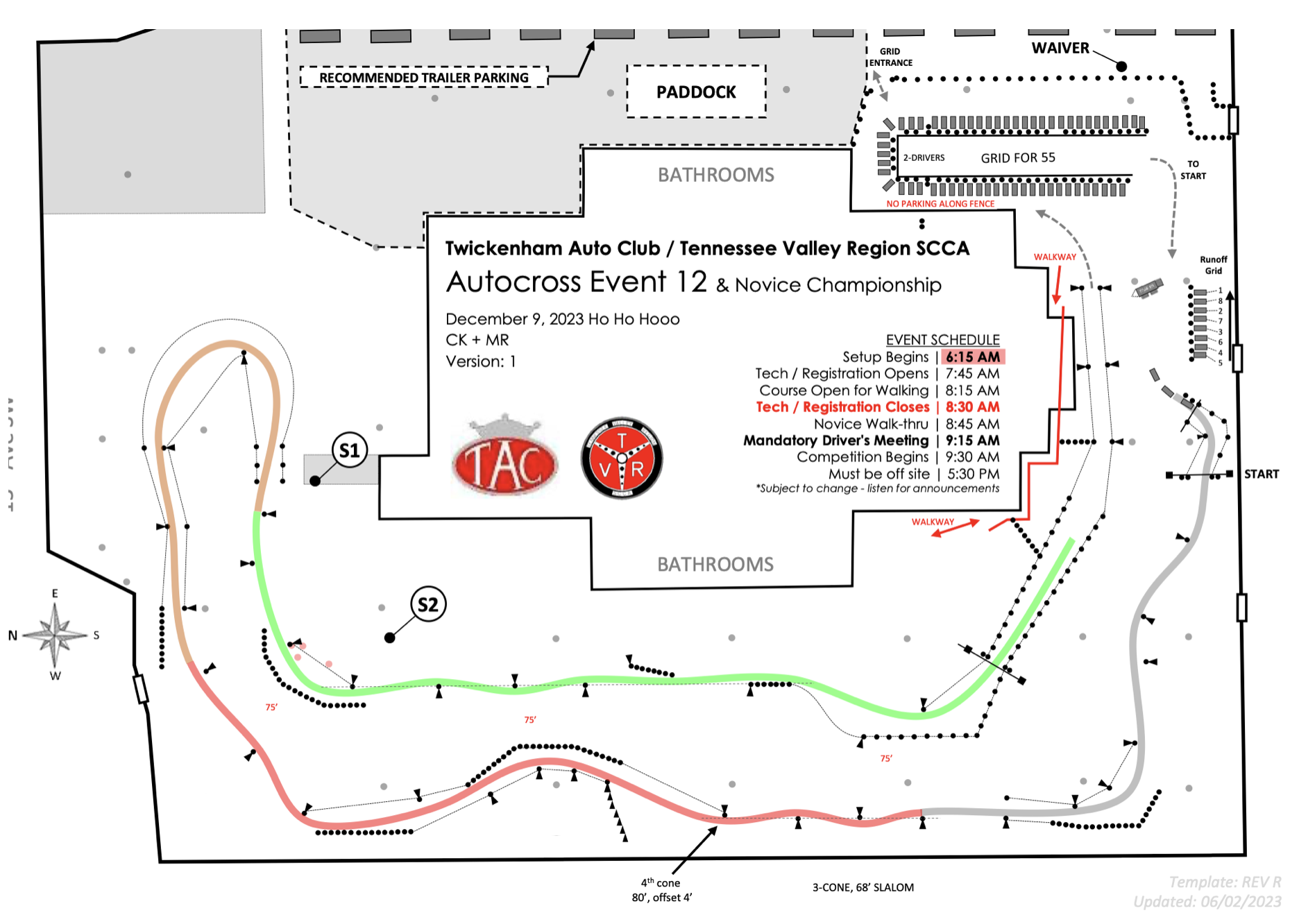
Section 1: Turning start into offsets

Section 2: 90-right into accelleration zone

Section 3: Slalom into the Hump

Section 4: Offsets into decreasing radius turnaround

Section 5: Fast 90-left into increasingly fast slalom

Section 6: Weird offset into a short finish

I suggest you read the names above and see if you can follow along on the map.

I reduced the whole course to six sections and six section names/descriptions. You don’t want too many… most people can remember about five to seven items, such as pieces on a chessboard. The funny thing is, the “items” can be single things or meaningful groups.

Non-chess experts, when shown a board with 20 to 25 pieces taken from actual games and then asked to recreate it, were found to be able to place only 4 or 5 pieces correctly. Chess Masters could generally recreate the entire board. They don’t remember 25 individual pieces, however. They remember five to seven recognizable groupings that have meaning within the game.

If the chess pieces were placed randomly, the chess experts could not remember any more than non-players. Similarly, if you try to memorize each turn in order within an autocross course… well, it’s basically hopeless.

When you first start autocross none of the course features mean anything to you, so remembering even five to seven groups will be difficult. You will, however, immediately begin to hear or read about named features, such as turnarounds, slaloms, offsets, decreasing and increasing radius corners, etc. You need to pick up on the lingo and ask people what the heck they’re talking about!

Here’s the map again, as I mentally separated it into 6 sections, numbered and with red-dashed dividing lines.

It doesn’t really matter how short or long each section is. What counts is that each one has a clear meaning to you as described by the words.

Part of the way I broke up the sections has to do with being able to see (when driving) all or most of the next section from the entry of that section. I think this is very helpful.

Another factor in how I broke the course into sections has to do with key setup points. For instance, between 1 and 2 I want to remember to stay tight left at the end of 1 (arrow) in order to be in a good position to enter 2.

I include the “acceleration zone” with the 90-right because it will remind me to add gas (arrow) as soon as possible coming out of the corner.

Similarly, at the end of 3 I need to remember to set up near the cone wall for the first turn cone of section 4 (arrow).

I include the decreasing radius turnaround as part of the section 4 description because what that means to me is that I must carry a lot of speed into the turnaround, only gradually slowing until the apex.

And then at the end of 5 the words “short finish” remind me that there is no setup for an acceleration into the finish because it comes up so soon. Therefore, I want to carry huge speed into section 6, brake and jerk the wheel hard right at the end of the last wall of cones (arrow) and continue to carry as much speed as possible around the last cone until I (hopefully) just barely miss the cone on the right side of the finish line. I anticipate that the car may be gradually slowing down the entire time in this section.

Here’s another example: the course map for the event previous to the one above. Please ignore the fact that “autocross” is misspelled!
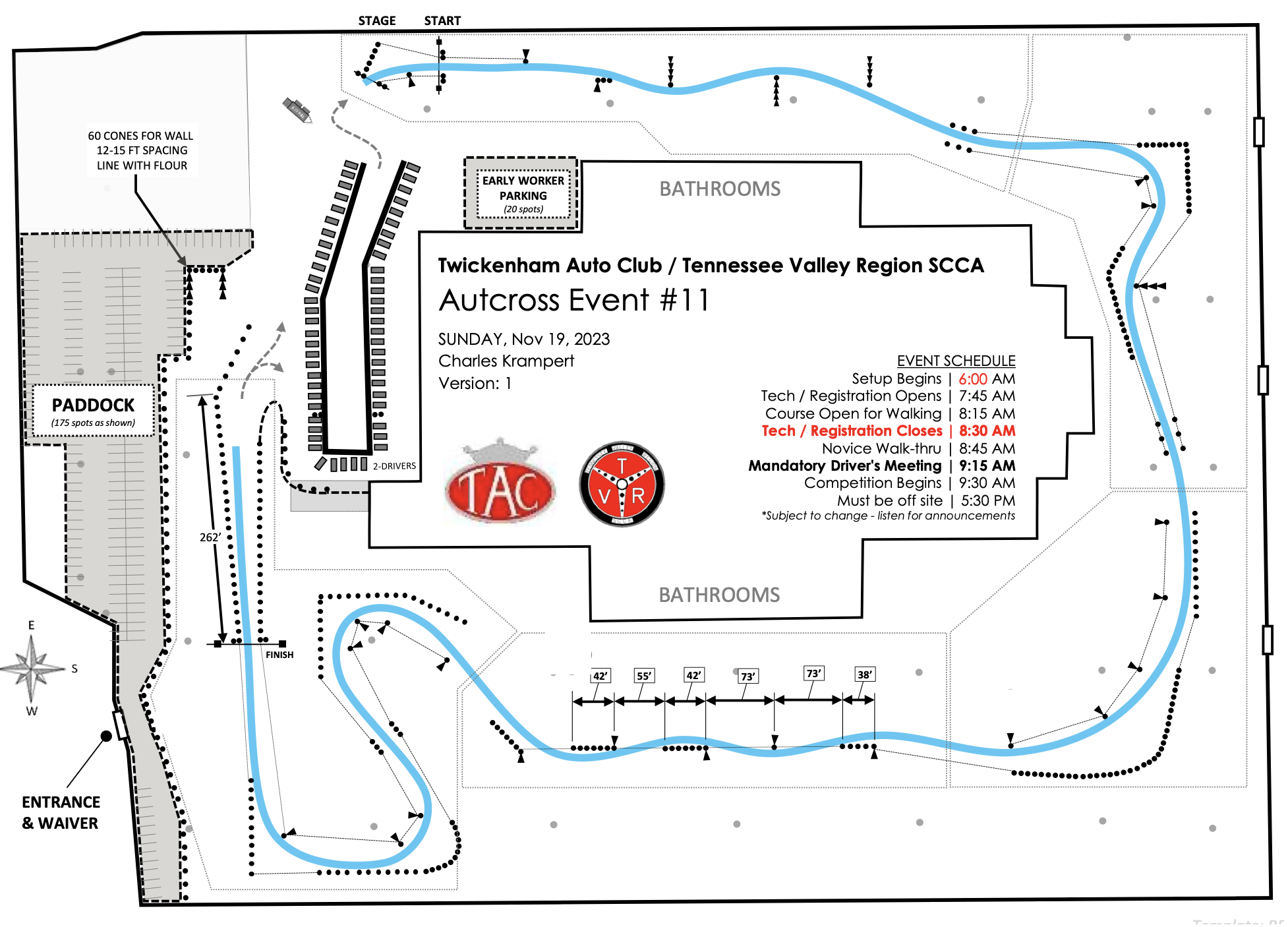
Maybe you want to divide it up yourself? If so, go ahead and do it mentally before looking at how I did it.

Here are my sections descriptions.

Section 1: From Start, accelerate into a series of offsets

Section 2: Accelerate into a 90-right

Section 3: Turn left into a long acceleration zone

Section 4: Super-fast right sweeper into odd-spaced walloms

Section 5: 180 turnaround

Section 6: Two hard rights into the finish

…and the sections are illustrated below.

Once I have the sections in mind, I then decide about the setups in the transitions from one to the other. These are:

Between 1 and 2: get on the gas as early as possible after the last offset cone, but then brake early for the turn

Between 2 and 3: Exit the 90-right very tight in order to carry the most speed around 3’s left turn

Between 3 and 4: Carry speed like I’m insane knowing I can always lift to tighten the radius

Between 4 and 5: Backside the end cone of the first wall in the walloms

Between 5 and 6: Don’t fail to move the car left to set up for the first of two right turns

That’s basically how I mentally approached this course. This means I’m not driving one corner at a time. I’m driving one section at a time, with a key setup point within or at the end of each one.

The next installment for Stage 1 will cover the key driving skills that I think need to be understood, practiced and then developed within the first year of autocross. These will include developing a steering method, learning to shift some weight to the front before turning, trail-braking, coordinating steering and throttle after the apex, and learning to always be setting up.

*Deliberate Practice is a term first coined by psychologist K. Anders Ericsson to describe how people actually become experts in any field
Why Shocks Can Affect Car Balance

A friend of mine went to a Test & Tune event recently and used the opportunity to experiment with his shock absorber settings. He’d been running them full stiff in competition. He decided to start the day full soft and work his way stiffer.

At full soft the car became very loose with dramatic oversteer on corner entry. The oversteer/understeer balance gradually changed as he stiffened the shocks. He was working all four corners together, simultaneously making the “same” change to each shock.

He asked me this question: “How does [adjusting] damping change a car balance like this?”

Here’s my answer.

A basic tenet in structural design is that when a load travels through two (or more) paths, the load preferentially and proportionally follows the stiffer path(s). So, changes in stiffness alter the proportioning of load, say transient cornering loads, from one corner or one end of the car to the other corner or end. Since shocks only create forces that oppose motion, roughly in proportion to how fast the shaft is moving, they become variable, non-linear stiffness elements in the load paths, parallel with and additive (bump) and subtractive (rebound) to the steel spring stiffness. The forces they produce are the dominant effects that shocks have on car handling balance, not energy absorption, i.e. not “damping,” but we will talk about both. 

The cornering load can preferentially go to one end of the car or the other. If it can’t be resisted by the tire patch at that corner, then that corner starts to slide.

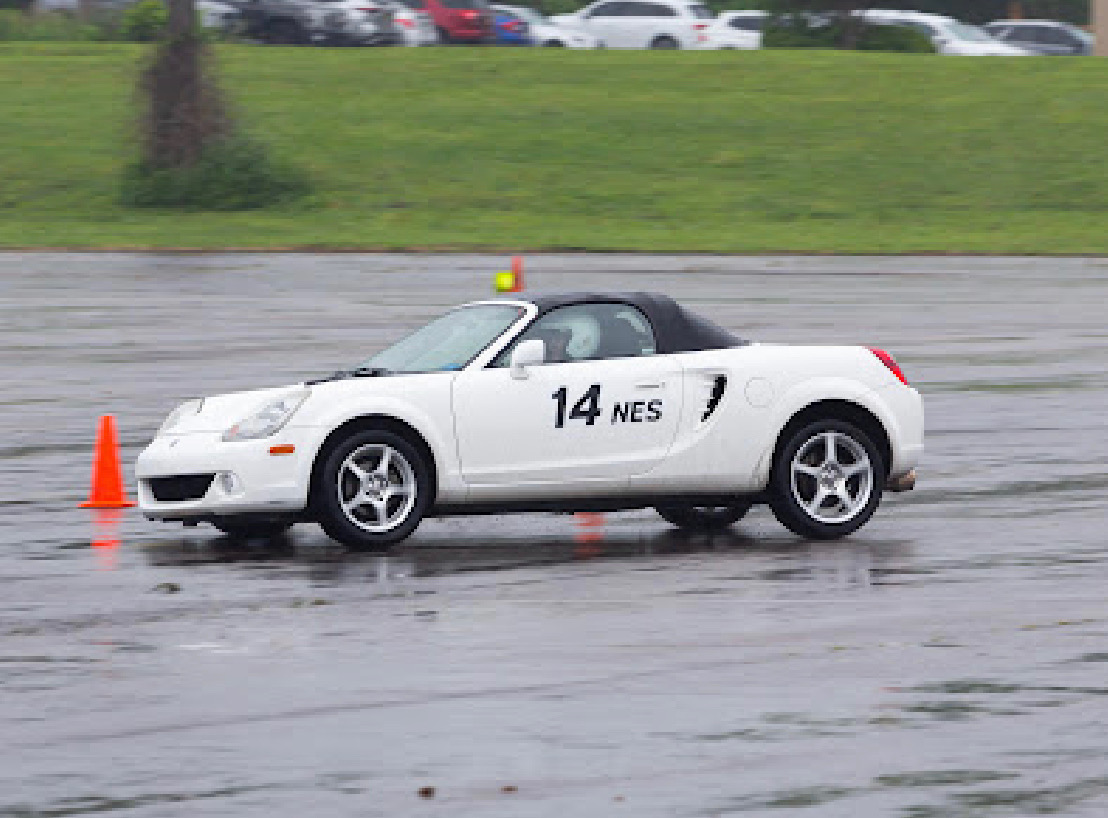
Cornering At Speed In The Wet. So much fun!(?)

However, shocks act mostly only during transients when the shock shafts are moving, say during corner turn-in. Steady-state cornering balance is not significantly affected by shock settings because at that time the shocks have stopped moving and are not producing any force.

Now, this last is not strictly true in reality. The shock shafts are always moving to some extent because no surface is completely flat and smooth, plus the damned driver keeps turning the steering wheel, even if only in small, short motions! This is part of why shock valving has a significant effect on the total grip even on relatively smooth surfaces. During steady-state cornering when the shocks are not moving the understeer/oversteer balance at the limit is mostly determined by front-to-rear tire grip differences, weight distribution, spring stiffnesses and anti-sway bar stiffnesses.

That said, the first key point I want to make is that the front and rear shocks are usually not valved the same and generally not acting through the same geometry and motion ratios. So, even though you may think you are changing all four the same amount, say 2 clicks each, it’s not actually the case that the damping change is equal at each shock or wheel. The oversteer/understeer balance at the limit is almost certainly being altered even though you think you’re making equal changes at each shock. Of course, if you change just one end, the effects on car balance are increased. 

My second key point is that while shocks do absorb energy, perhaps more importantly they affect the timing of energy delivery to the tire contact patch. Let’s talk about energy absorption first and timing second.

When a car turns into a corner there’s a finite amount of momentum created by the turning action. The shocks on both sides of a turning car absorb some of the kinetic energy associated with that momentum by doing work (force x distance, converting kinetic energy into heat) and they also alter the distribution of load around the four corners by being stiff elements in the load path. Most of the kinetic energy is not absorbed by the shocks and ultimately becomes either temporarily stored in the outside springs (and it’s going to come back out!) or transferred as load to the tire contact patches. If you soften the shocks less energy is absorbed leaving more to hit the tire patch, since the amount of energy stored in fully compressed or fully extended springs is always the same. Soft shocks will allow a faster peak roll motion, in terms of degrees of roll per second, which can affect what happens at the tire patch later when the roll motion is finally snubbed at the end of the roll. All rolls must end.

When the shocks are set stiff they generally absorb more energy early in the roll (both the compressing and the extending shocks) and slow the roll by opposing it with force. This actually transfers load, lateral load (not weight!) to the tire patches sooner in the cycle, thus improving transient response by speeding up the transfer of lateral load to both tire patches, left and right. Theoretically this can act to reduce load shock to the tire patches at the end of the roll and thus help prevent the tires from losing grip. There is literally nothing worse than a car that’s so soft and has so much suspension travel that everything seems fine on turn in until the roll gets snubbed at the end and suddenly all hell breaks loose.

Sometimes Shock Bumpstops Can Be Used To Stiffen A Car In Roll (Maybe not this one… it seems a little tired.)

On the other hand, shocks stiff in rebound but not compression act to resist roll only by pulling vertical load off the inside tire patch as the car begins to roll and the shock extends. This can also cause the car to lose grip very early in the turn if inside tire grip is the limiting grip variable. So, if you have a Koni Yellow, for instance, which is adjustable in rebound only, and you crank it up to full stiff, you do not increase the compression damping on the outside tires during turn-in. You only increase the rebound damping on the inside tire, the one with the shock that is extending. The weight pulled off the inside tire still becomes load on the outside tire. (Where else could it go?) My point is that the effects of rebound and compression damping are complicated and not identical opposites.

If stiffer shocks create forces that oppose roll while speeding up lateral load transfer, that necessarily means that lateral load transfer occurs early while the car is at a lower state of roll than otherwise and therefore the tires have not yet given up all the camber they will when full body roll is achieved.

Maybe you should read that last sentence again. I just wrote it and I’m going to read it again! I’ve never seen that fact in print before. Anywhere. It basically defines a mechanism for an increase in grip during the turn-in transient that is due to the shocks changing the timing of lateral load transfer with respect to “weight” transfer, not the amount of lateral load transfer and certainly not the amount of “weight” transfer.

And all this happens in about a second in a slalom.

Maybe we need a diagram.

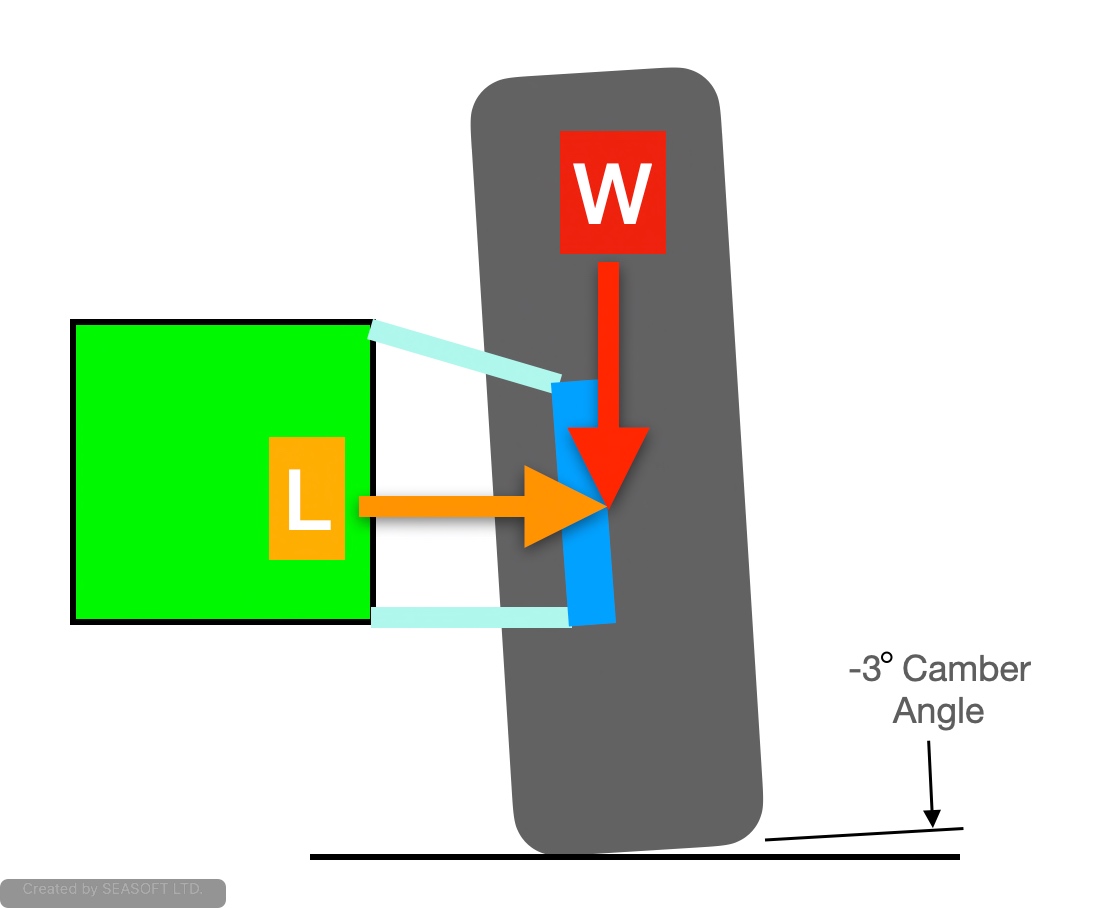
Force Diagram At The Wheel Hub

In the diagram we have two forces shown acting on the tire: W stands for weight and L stands for lateral load. Just for fun and so you can develop an eye for it, the wheel in the diagram is actually tilted at 3.6 degrees of negative camber. (I meant it to be 3 degrees, but something happened.)

When we initiate a turn we get an immediate increase in L, the lateral load, and the stiffer the shocks the faster and earlier that load transfer… hopefully while some of that negative camber still exists, because that’s when tires are most capable. If we don’t have much damping force from the shocks then the full lateral load may not hit until the car is fully rolled, at which time we are left only with the final camber state, which in Street class cars can often be positive instead of negative. (Tires don’t like that.)

But when people talk about weight transfer across the axle, they are probably thinking about something different. They are thinking about an increase in W.

When the body rolls, “weight” is transferred from one side of the car to the other, right? Well, that’s a vague way of talking about it. Yes, if you could put a scale under the tires while cornering it would say that “weight” has shifted, but really it is vertical load W that has increased, due to body roll, on one side of the car at the expense of the other side. That load increase is directly related to how much additional spring compression has occurred on one side, balanced by extension on the other side.

It’s also very possible that if the shocks are too stiff at the shaft speeds produced by turn-in they can shock the tire patches too much, too early and cause one end of the car to give up grip during the turn-in motion. However, this effect is somewhat in the driver’s control because she determines how fast she turns the steering wheel. All production car shocks and springs as delivered that I’ve ever slalomed are so soft that the driver can turn the wheel as fast as humanly possible and not create an immediate problem before you must turn back the other direction. At least on a dry surface. Sure, if you turn the wheel fast enough and far enough you can induce understeer in just about any production car. They are designed to do that. On purpose.

In any case, these dynamic effects are complicated and not well-understood by most casual autocrossers, automotive journalists and even some racing mechanics and engineers. Many books and articles about tuning car handling with shock changes are incomplete in their explanations and over-simplify the situation, offering various rules of thumb for tuning the balance with shocks. W in the diagram does increase faster with soft shocks because the car rolls faster. This is almost always a bad thing. So, look at the diagram again. An increase in W does not cause the car to turn. In fact, while increasing the lateral load capability of that tire, it decreases peak capability for turning because the inside tire is now lacking in vertical load and the sum of the two capabilities is less than if no weight transfer occurred. (We prefer to minimize weight transfer across the axle if at all possible. Usually the best way to do this is to lower the center of gravity while increasing the track width. Notice how wide and low most supercars have gotten in recent years? Much wider than necessary to hold two occupants comfortably, side by side.) An increase in L is what causes a car to turn and a fast increase in L allows a car to change direction quickly, with or without a significant increase in W.

If you take anything away from this post it should be this: the speed of lateral load transfer to the tires is a different effect from the speed of “weight” transfer to the tires caused by body roll and only one causes a car to turn. Both are highly influenced by shock absorber performance.

Grip Ingredients

One of the novice passengers I took on one of my runs last weekend (I was a novice coach) remarked on how much grip the car had.

He said, “Wow, you’ve got good tires!”

I answered, “Yes, I have good tires.”

What I might have told him, if it had been a more appropriate time and place, is that the grip a car produces and that you feel from the passenger seat is the result of a host of factors, not just the tires themselves.

So, I started thinking about it and came up with the following ‘grip ingredients’ list. The first five are well-known. The last one is maybe not given enough attention.

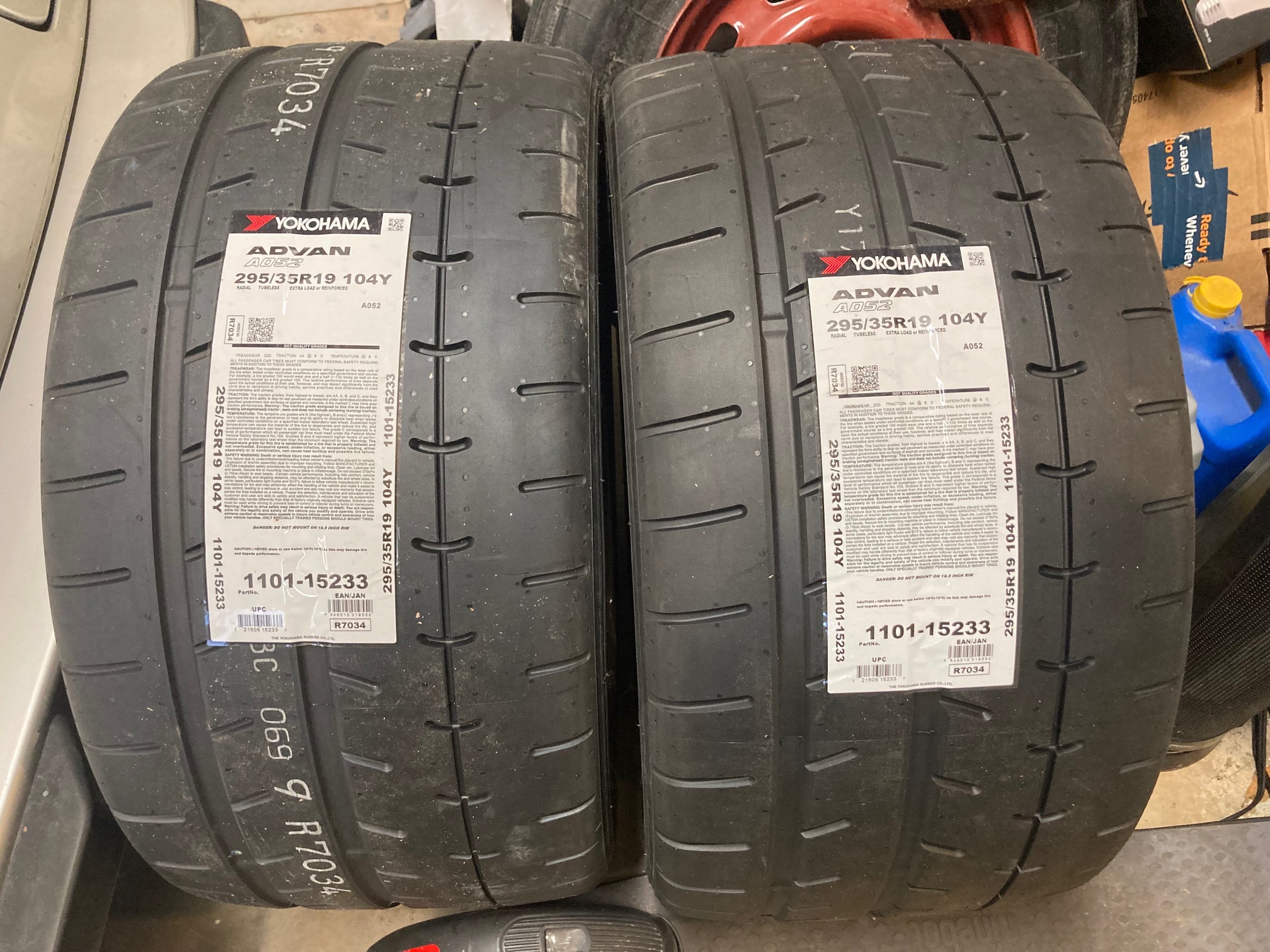
  1. Tire type. Yes, you have to have sticky autocross tires. There are only a handful of suspects, though the list changes from year to year and you must keep up-to-date. Right now I’m on Bridgestone RE71RS in the front and Yokohama A052 at the rear. The Falken RT660 seems to have fallen a small step behind. The new, 2023 version of the Nankang CR-S has tested well and is getting a try-out by some autocrossers. That’s the entire, current list, folks.
  2. The tire width you choose has to be matched to the rim width. Not too wide, not too narrow. How do you figure that out? Your own testing plus the testing experience of others. Depending on how much money you have to throw at the sport, this may take one year or several. Or no time at all if you have a good example to follow. If you want to run an ND2 in C-Street you have lots of good, free data that will get you there with no effort at all if you can simply find one national-level competitor and get their advice. If you are running a Lotus in STU you’re on your own, buddy! I have 275mm on 8.5″ rims in the front and 295mm on 10″ rims in the rear. Some will say that a 275 is too wide for an 8.5″ rim. I did enough testing in years past to clearly show that 255mm was not sufficient in the front of either a C5 or C6 Corvette on an 18″ diameter rim. I can’t tell much difference between a 265 and a 275, but I think the 275 delivers slightly more lateral grip though it’s not as sharp-feeling. Even if it doesn’t give any more grip, it works well on my car, being slightly taller. I run the 295 Yok because it puts down power the best, even though it’s really too tall, being a 35 aspect ratio rather than a 30. I’ve run 305 and 315 Falken 660 tires on the rear. The 315 was not faster than the 305 and neither gives better lateral grip than the 295 on my 10″ wide rim so I suppose they are too wide for the rim. (And the Falkens, though having incredibly sharp responses, are not good at putting down big power.) You have to prove these things to yourself, given your specific car and setup.
  3. Proper alignment. For most Street-class cars this means all the negative camber you can get, plus experimenting with toe, front and back, as part of the effort to get the car balanced so that both ends are contributing their maximum to the total grip in a sweeper. (Often this also includes anti-sway bar changes as well.) The car only sweeps as fast as the weakest end. If that means slight oversteer at the limit, so be it. If that means understeer at the limit, learn to drive with it. If you are not in a Street class then you can modify hardware to increase camber. This provides more options that have to be worked out via testing, or, once again, you may be able to find someone with relevant experience who will share and give you a starting point.
  4. Proper inflation pressures. After significant testing I use 30psi front/28psi rear on my C6, given the tires mentioned above, on asphalt, but +/- 2 psi from these figures makes little difference. On concrete I increase by 1psi. In the wet I decrease by 1 psi. Do these small changes make a difference? I’m not sure, but I feel better about it! When I got the car I was advised that I needed about 5 psi more than I run now with the tires I was using. Testing showed that didn’t work for me and my car. This past weekend it was really hot (95F) and I got distracted and didn’t check pressures after the first run in the afternoon. Halfway through the second run I’m wondering what’s going on. Then I realized my oversight. When I got back to grid they were 6 to 7psi too high and that was plenty to degrade the grip to a perceptible extent.
  5. Proper tire temperatures. Again, only testing can really tell you the story. The RE71RS tires on the front of my car can definitely be too cold at ambient or over-cooled with water. They seem to work best with 1 run of heat in them so that the surface is slightly warm to the touch, then I don’t let them get any warmer. The A052s in the rear you cannot ever allow heat to penetrate into the carcass. This requires spraying after every run except in extremely cool conditions. You only learn this stuff by letting them get too hot at a race or test session and watching your times get slower though you are driving better. Nothing is more frustrating or puzzling until you realize what’s happening.
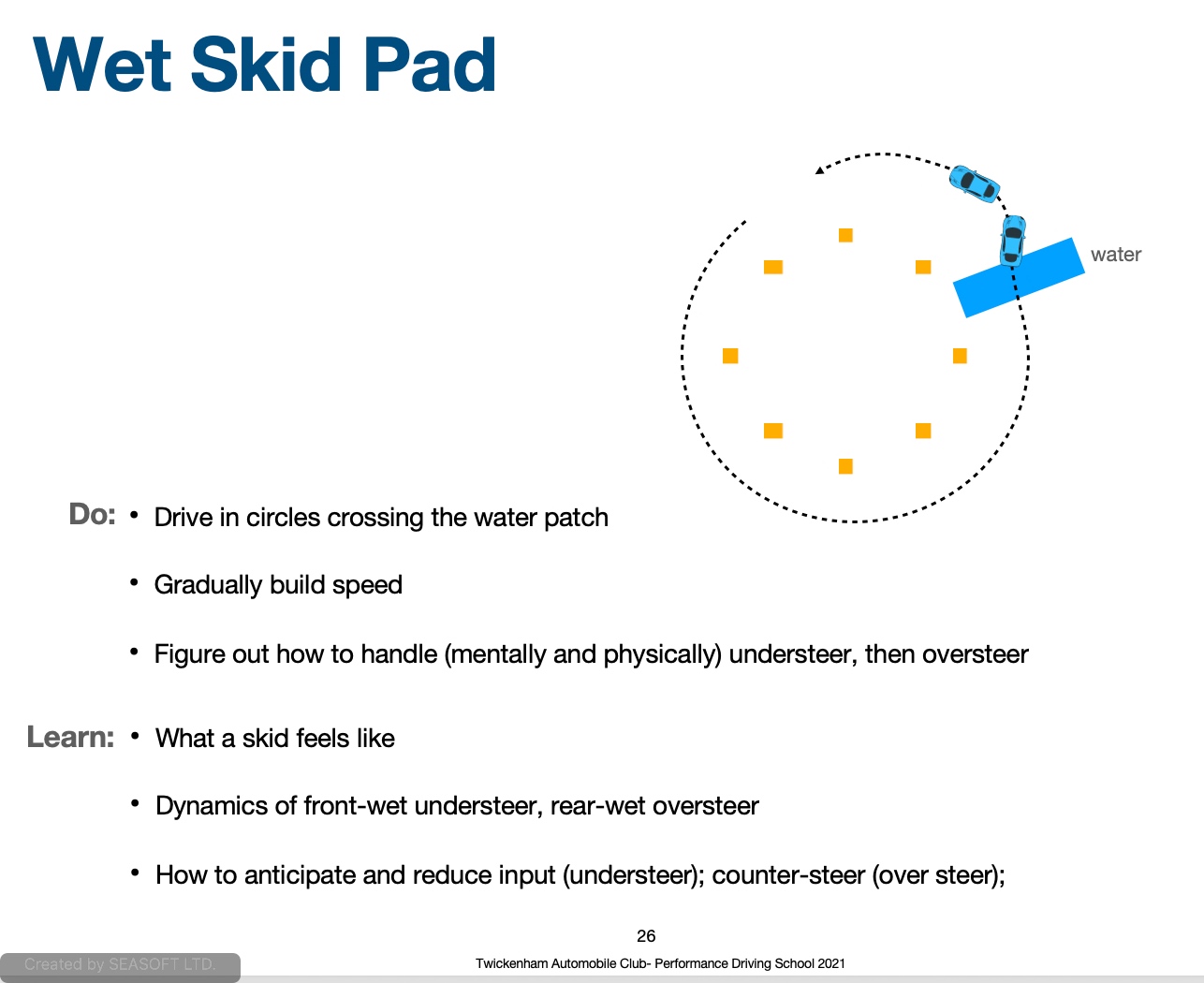
  6. Sensitivity to the tire contact patches. OK, this is the final thing I want to say and some of you may find it sort of nutty. But, here goes. When it comes to being able to maintain a car at maximum lateral grip in any kind of corner or sweeper it’s the driver’s sensitivity that’s key. Without sensitivity to the information primarily coming through the steering wheel into the palms and fingers and secondly through the car into the body through the seat, you cannot maintain the car close to the traction limit. To do this one must be controlling the turn rate very precisely to keep the tires from going too far over or too far under the maximum grip slip angle at the tire contact patches. Precise control begins with sensitivity. You must very quickly adjust if the tires deviate one way or the other which means you must feel it early. Too much under the peak is just slow. (Mario Andretti: “If everything seems in control then you’re just not driving fast enough.”) Too much over and you lose control (and lots of time) in a slide or push. But, you have to consistently go over the peak by a small margin. Otherwise you can’t know where it is! We must always be testing and challenging this limit, this peak. Now, to increase your sensitivity start with your driving posture. Nothing is worse for sensitive control than two hands in a death grip at the top of the steering wheel. Drop your hands to 9 and 3 (or below), relax and sink down in your shoulders and elbows and don’t grip the wheel any tighter than necessary. Relax until you can feel the weight of your arms hanging from the shoulders and stretching the neck muscles. This will feed blood into the hands instead of constricting flow. Sensitivity follows the blood. Practice this during all normal driving, then focus on it during some autocross runs. Never allow the shoulders to hunch up. Also, I love the partially wet skid pad drill we do in our local driving school each Spring. Nothing teaches sensitive control like hammering around a skid pad where the grip at each end of the car changes every second. After a few laps you’ll never be the same dull, clumsy driver again! Similarly, nothing trains sensitivity like autocrossing in the wet. Take every chance to run in the wet at local/regional events… don’t avoid them! Skin is waterproof!

2023 Season Started- Intuitive Line Optimization

At Our Local Site Milton Frank Stadium (Photo Ashley Eyles)

In Lincoln at Nats last year I was asked by a well-known autocross blogger & teacher why I hadn’t been publishing much lately. I told him I only write when I think I have something new and interesting to say. This was the truth… it’s always been the case. And there will be a new idea contained in this post, as always, but I’ll get to that in a moment. In the meantime, there’s something else.

The Plan

Even before Nats last year I’d determined to make a big push to improve my driving, both the mental and physical aspects. When it comes to line theory I figure I know enough. When it comes to car setup for Street class, I figure I know enough. Silver Ghost is handing better than ever now that I have RE71RS tires on the front and A052s on the rear and revalved shocks that eliminate the 20% too stiff mistake I made the first go-around. Plus, I verified that the Corvette is quite the different animal with Yokohama A052 tires on it. I no longer think that it’s fully competitive in BS without the increased ability to put down power that the Yokohama tires confer.

My plan for this year has been to attend as many local/regional events as I can manage with specific objectives in mind. As I put it in the Nationals wrap-up post last year: …you must make the most of each run you do get to really develop a disciplined, decisive and consistent driving style that eliminates big mistakes entirely. I plan to make the most of a lot of runs this year.

Things have gone well so far. I’ve done seven autocross days in 2023 for a total of 57 runs. However, my plan to go to the Red Hills tour, the first national event of the season, was stymied. I started feeling poorly just before the event and just after confirmed exposure to a bad case of Covid. I cancelled at the last minute. Turns out I just had a cold and would have been fine at the event.

To make up for the loss of Red Hills I plan to add the Peru tour this year, not previously in the plan, followed only two weeks later by the double event at Bristol. As for going back to Nationals this year, I’m on the fence. Last year’s event left a decidedly bad taste in my mouth. I’ll let my rate of progress and the tire situation weigh heavily on the decision to spend the time and money. Going to Nats last year without Yokohamas on the rear of the C6 was a colossal mistake, but not for the reason I assumed it might be before-hand. Turns out it was the Yokohama compound’s aversion to picking up OPR that made the most difference, not the ability to put down power, which is the advantage at Tours and locals. Neither course last year needed power. I probably never used more than 200hp and 70% torque. The courses were just sweeper after sweeper, not transient-heavy (which would have favored the Falkens) and no digs. All that mattered was grip and grip depends mostly upon weight to tire ratio and the tire compound. I tried my best to get the Yoks last year based on the strong recommendations of others, but it didn’t happen. The lightest, least powerful car in the class won and can do it again if the courses this year are similar.

Breakthrough

I had a type of mental breakthrough at an event a few weeks ago. I achieved a mental state during the third run in the morning that I’ve been intentionally aiming toward for some time. I found myself dispassionately watching this ‘other’ person driving. I was able to watch myself scanning ahead, feeling everything coming through the points of contact between myself and the car, feeling every bit of grip or lack thereof, watching my mind racing to analyze the line at each point on the course, how far off I was from my planned line at each location, whether I was on the gas early enough, observing the rate of brake application and the rate of torque application, whether or not and how close I hit each planned apex, and observing and modulating that key balance between aggressiveness and smoothness that is so important for driving fast and at the limit without hitting cones.

Driving Solo

Something different this year from the last couple of years is that I’m driving alone. The initial thought was for the low heat tolerance of the Yokohama tires. I’ve heard many complain about how they could not get the tires cool enough between runs with two drivers in really hot weather. Driving alone makes that problem much easier to handle, if not eliminating it altogether. Spray once right after each run and you’re done, even on a hot day.

Yokohama A052 Tires- Worth Their Weight In Gold And Almost That Expensive

Another key reason for driving alone is to give myself more time between runs to analyze data. I’ve never done much between-run analysis before, always spending lots of time after each event analyzing data, but not so much during the event. (At Nats last year on Thursday and Friday the entire time in between runs was spent cutting OPR off the tires. And that was with at least two other helpers, sometimes three, including my co-driver.) This past weekend I was able to intentionally drive sections of the course differently in the first two runs and then look at the data, decide which approach was faster and successfully alter what I did the next run.

A third reason for driving alone is the sorry state of affairs of SCCA grid work at tours. It seems that the ability or desire to determine a proper split point within run groups has been lost. At no Tour event I attended last year was an attempt made to split the run group to equalize the time gaps between 1st and 2nd drivers. As a result, two different days we got the you’re-the-5th-car notification within 30 seconds of the previous driver pulling into the grid spot. I was made to feel like I was interfering with the event when I complained, requested to be put onto a 5 minute clock and then sometimes refused to leave when told to go until we had our tires watered and the pressures set. To top it all off, twice after receiving the quick 5-car warning and rushing to get the car ready, the grid master then totally forgot about me and never came to my row. The first time I had no clue what had happened. I just proceeded on to the start when I felt like it. I have no idea if I was in the correct order. The second time it was clear that there was a systemic issue so I got out of the car, tracked the grid master down and let him know I’m going back to my car and will proceed to the start line unless he has some objection. (How the 5-car person knows where I am and that I’m in a two-driver car but the grid master doesn’t I never understood. He apologized later… to my co-driver.)

I’m also doing more post-event analysis than ever before by exchanging data files with other people and working up an analysis for each one. For the event this past weekend I got files from four different drivers. It requires many hours but it’s necessary, just as in any other sporting endeavor, to achieve a high level of performance.

Thought Experiment

Speaking of achieving a high level of performance, let’s do a little thought experiment. I’m going to list the capabilities I think one must acquire to reach a high-level in autocross driving, not counting things like car preparation, testing to determine tire pressures and temperatures, etc.

Here’s the list:

-You must be able to walk a course, accurately imagine how it will drive, make a clear plan for how to drive it, and then drive it on the limit on the first try. You must be fast on the first run because the course is not the same if you drive it much under the limit and you only get three tries which means only two chances to figure out what to do differently. This requires a lot of experience and various forms of deliberate practice. With regard to experience: After 100 events do you have 100 events of experience or do you have 1 event of experience 100 times?

-After each run you must be able to remember what you did well, what surprised you that you need to now consider and what was not done so well. You must then develop a clear idea of what you’ll do differently and why in the next run to get faster. Without this you cannot drive smarter, instead of just harder. When I first started autocross I had almost no ability to remember what happened within the last run, what was good and what was bad. I would completely forget about huge screw-ups that I did notice one minute earlier during the run. Sometimes the memory of them would come back an hour later. Very strange. Over time the mind gets better at this sort of thing, but you have to be focused and insist that it happen by getting into the habit of mentally reviewing every run immediately upon its finish.

-You must be up on the latest understanding of what constitutes the most efficient lines for standard corners, chicanes, curved acceleration zones, increasing and decreasing radii corners, one, two and 3-cone turnarounds, the effect of sloping surfaces on the line, etc.

-You must have the tactile sensitivity to feel and then understand what is happening at the tire patches and recognize how the grip is constantly changing from run to run and from moment to moment within a run, along with complete mastery of manipulating weight shift forward and back to optimize turning rate and braking and acceleration performance.

-You must have the car control skills to drive the car at the limit of tire adhesion while maintaining a precise, as-planned driving line that has the tires just barely missing or just barely kissing the key cones without resulting in a penalty. It goes without saying that you can’t slide too much or spin, either.

Do you think that’s a pretty comprehensive list?

It’s not. I left one big elephant off the scale that, I think, is the key difference between good and great autocross drivers and out-weighs many of the necessary-but-not-sufficient points above.

Intuitive Line Optimization

There are just too many variables. Autocross is nothing if not an exercise in multivariable optimization, and no two events are ever the same.

Heck, no two runs ten minutes apart are ever the same.

We don’t get to practice the course like in circuit road-racing and the course layouts are often much more complicated, even unacceptably weird, compared to fixed circuits. (If it was up to the road-racers the course designer would often get locked in a trunk and then they’d go out and “fix” the course.)

There are no course guides on the internet to study beforehand because no one has ever seen the course before. (Well, excepting that one year at Nats…) There isn’t much in the way of standards to guide the course designers, though there probably should be a few more than there are. How clean is the surface? What’s material is it? What type of aggregate is in what type of concrete or what type of asphalt? (Barber Proving Grounds is mostly high-grip asphalt but has one section of even higher-grip concrete. Next week I’ll be there pointing out to the Novices that at one location it changes from one to the other in the middle of a corner and they need to take advantage!) If it’s asphalt has it been sealed? Sealed everywhere or just part of it? How thick is the sealant? Is it the same thickness everywhere or have certain areas been worn down? (Less sealant usually means more grip.) When did it last rain? Is the surface bone dry, a few water molecules per square centimeter, a little damp, full wet, standing water, deep puddles? Will it be the same when you run? Is gravel getting produced on the racing line as the day goes on? Is the surface abrasive and causing the tires to shed rubber that collects into “marbles” and gradually dictates a tighter line as the day goes on, even if it’s not right for your car? Which corners get camber in what direction in this particular course design? Which parts are in the sun, which are shaded? What’s the temperature? What time of day is your class running? Where are the bumps, what kind of bumps are they and how bad are they? How many cars are on race rubber that deteriorates faster than street tires and thus produces more marbles? Where are your tires on the continuum from new to nearly worthless?

There’s not enough computing power in the world to analyze it all even if you had exact data on every variable. This means it’s a perfect job for the human brain.

The best drivers look at and think about all these things and more while they walk the course. If possible they watch other cars run, especially cars and drivers they know are fast. They intuitively alter their plan of attack from the theoretical to match the actual and optimize for the shortest time through the course. They take one run and optimize again. They take another run and optimize a last time. They drive the third and last run on that course and then it’s done and dusted, gone forever.

Silver Ghost 2022 Wrap-up

The year did not start well. First thing I did was to put Silver Ghost into a ditch at a wet Test & Tune. That was in February and caused me to miss the Red Hills tour. I had done the single-course Pro at The Firm in January, though with quite poor results and not yet on Penske shocks. I disliked the course immensely. The design used the edge of the pavement, effectively, as a wall of cones which it directed you straight toward. Except that the penalty for “hitting” a cone in the wall was an off-course spin in the dirt. The percentage of DNF runs was incredibly high. I’d never seen multiple people go 6 for 6 DNFs over a weekend and get no time for either day.

The course also contained what I thought was a dangerous feature that caused me to be extra careful (and slower) in order to not risk the car and my health. To be fair, most people took that feature just a little more conservatively, even if unconsciously. There was only one possible location on that site where you could create a danger and boy did they find it. (The previous year the course had not contained this issue at the location in question.) I’ll never go back to that site for an autocross. (The road-course track itself is fine.)

So, it was the beginning of June before Silver Ghost got into local competition and I could start to figure out the car, shock settings, tire pressures, etc. In the meantime my co-driver and I bought a set of Hoosiers for my Porsche 944 and ran it in CSP in three locals. After Nationals I realized that, thanks to winning those three events early in the year, if we continued running the 944 and I won the remaining four events I could be the local CSP champ, so that’s what we did. And I won CSP.

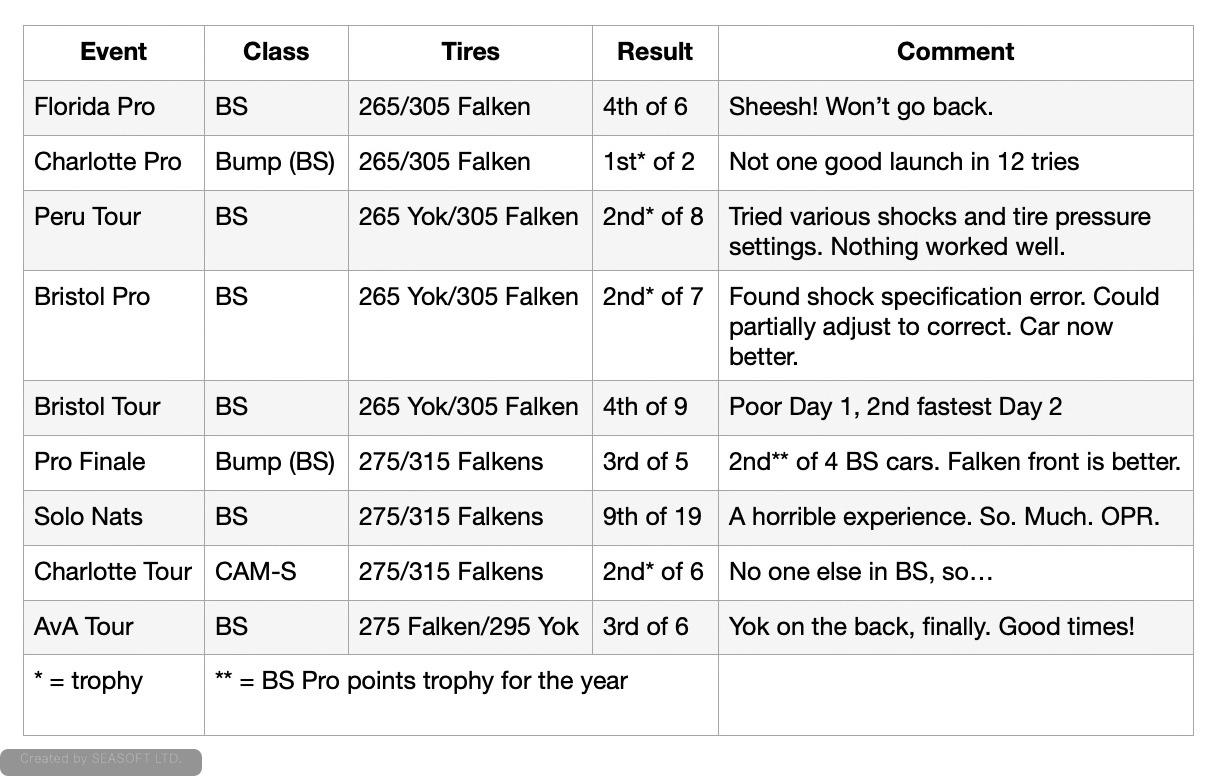
The full national competition history for Silver Ghost in 2022 is as follows:

That makes nine national events I raced in this year, the most ever for me in a single year. I trophied at four events and took a 2nd place points trophy for the year in BS in Pro, but no class wins. Let’s try to fix that next year. With the Penske shocks being revalved to correct my math error and Yokohama tires on the rear it’s definitely the goal for 2023, though I’ll do fewer events.

The “trophies in grid” presentation for my run group at Charlotte, a tradition begun by Scott Dobler (blue shirt on the left)

Lessons Learned in 2022

-Have autocross insurance if your car has any significant value. It’s cheap and you just never know.

-Penske 8300-series shocks are great, but

-Don’t (make a math mistake and) valve your shocks for 108% of Critical. That’s too much damping for bumpy lots, at least for this car and these tires.

-I learned new things about how Dennis Grant’s on-line suspension calculator works which are being input into the Penske revalve happening now

-The car needs just the right amount of toe-in in the rear.

-Let the tires roll over “too much” if the grip is clearly better.

-Yokohama A052 tires on the rear put down power better than the Falkens coming off corners and make the car faster.

-I need to work on my driving discipline: set up as early as possible for the next feature without fail.