180-Degree Turn-Arounds Revisited

In a recent post here we talked about saving time in 180 degree turn-arounds by taking the tightest possible circular path. I feel like I owe it to the reader to expand on that discussion as soon as possible because, really, it left out an important consideration.

Earlier this year I competed at the SCCA Georgia Match Tour in Moultrie. The results are here. That course had three 180-degree turn-arounds, all different, and only one of which was the situation discussed in the earlier post, i.e. with the entrance, exit and path tightly constrained. I want to talk about the first of those three turn-arounds because it was the opposite: both the entrance and the exit were wide open and the path from entry to exit was also unconstrained. That is, the driver was free to go wide on the entrance and go wide on the exit and as deep or shallow as desired. You’ll have to take my word for it that this was the case, because the ability to go wide depends not only on how the turn-around is constructed but also on the course design leading into and leading away from the turn-around. In any case, this is the kind of feature one finds on big, National-type courses.

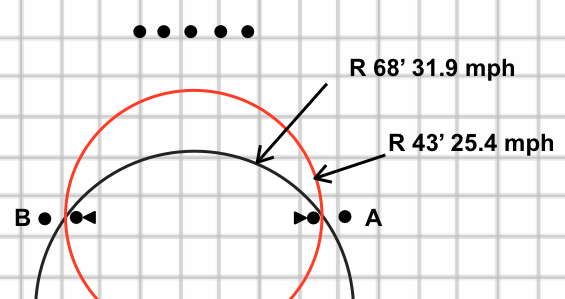
The first turn-around at Moultrie was more like the following figure. You could take any path you wanted from the entrance to the exit, constrained only by a far-away boundary at the rear.
wide180

The red circle is the tight path discussed in the previous post. I didn’t mention it then, but that path takes 3.63 seconds from B to A if the car corners at 1G lateral. What if you enter wide and take the black circle path? That path has a radius of 68 feet. Neglecting for the moment what happens before B and after A, that path takes 2.0 seconds from B to A. Yeah, wow.

The black path is not only shorter from B to A, it’s much faster and that’s why I took it absolutely as wide as I could at Moultrie, as did most other folks.

Of course, that’s not the whole story. Going wide on the entrance costs time. I will stipulate (and you will have to give me the benefit of the doubt) that going wide on the exit did not cost any time, thanks to the higher velocity at the exit, which put the engine at a higher torque point, allowing faster acceleration beyond the exit, with plenty of time to maneuver for the next feature. In any case, let’s say going wide cost .63 seconds. It wasn’t nearly that much, but let’s assume it was. (For one thing, it means I didn’t have to brake as much because the path was going to be a faster one.) Even if it did cost .63 seconds, the wide (black) path still saves one full second over the red “tight” path.

Now we know why we go wide and shallow through almost every “corner” if we can.
Saving Time: Take a Smaller Radius?

Most experienced autocrossers think that, all else equal, a smaller, slower radius takes less time than a larger, faster radius. You know that, right? Are you sure? Let’s make sure and find out exactly how much time we’re talking about.

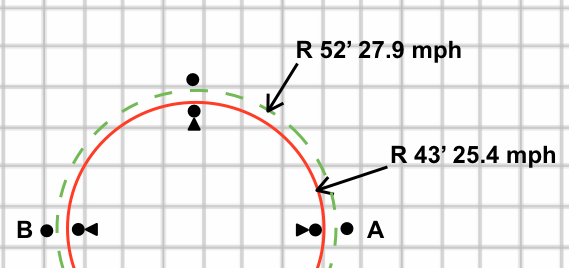
The figure below shows one typical autocross situation, a slow 180 degree turn-around. Let’s assume the car is 6′ wide, corners at 1G and the cones create an 40′ inside radius with a path width of the SCCA minimum 15′. So, the center of the car travels on a 40+3=43′ radius on the red circle and a (40+15)-3=52′ radius on the green path. I won’t bore you with the math, but at 1G the car on the red path travels at 25.4 mph while the same car on the green path travels at 27.9 mph.

radiustime

Given this is a 180 degree turn-around, we are interested in the time difference if we enter at A and exit at B. Once again I won’t bore you with the math. The inner, red path saves 0.37 seconds over the green path. The total time for the outer path is only 4.0 seconds, so the difference is almost 10%.

Hey, you were right!

Why is this? Because the length of the path increases faster than the speed. The red path is 135.1′ while the green path is 163.4′. So, the path distanced increased 21% while the velocity only increased 10%.

Now, if the course designer gave you extra room, and you were foolish enough to take it, you’d lose even more time. For instance, just 10′ more radius allows the car to increase speed to 30.4 mph and add another .37 seconds to the time from A to B.

Another way of looking at this: You know a tighter radius is better, but by mistake you enter the turn-around 5 mph too fast. (30.4 – 25.4 = 5)

You just lost three quarters of a second in this one feature. That’s called “forever” in autocross. Still want to wait to the last possible second to hit the brakes?

Never Late-Apex!

(I suggest you read the post below and then read the update here.)

Well, almost never.

While the late-apex cornering technique is a staple of road-racing and track-day driving, it has almost zero applicability to autocross. Why? Autocross almost never has an acceleration zone long enough to make up for what you give up in the corner for the late apex. Occasionally, yes, you will want to late apex, but not very often. Autocross is mostly made up of connected curves of varying radius. Usually it’s best to simply take the shortest path from one to the next, as Piero Taruffi stated in the first-ever scientific book on race-car driving in 1959. He was right then, he’s still right.

Late-apexing is done on track for various good reasons, but the only one related to saving time is to increase exit speed off the corner by “lengthening” the straight. The increased exit speed is carried down the ensuing straight whose average speed is now increased, reducing lap time. This is the only occasion to use a late-apex: when the length of the ensuing straight is long enough to save more time than lost in the corner.

Be careful not to confuse late-apexing with the technique of “back-siding” the cones. Back-siding a cone is not late-apexing. Back-siding a cone is a result of the racer deciding where the beginning and end of the corner are and on what radius. When he tells you he plans to backside a particular cone, it means he has decided that that cone is on the minimum radius but not at the apex of the “corner” he has imagined out there among the orange cones. When he passes it he plans to try to run over the base of the cone with his rear tire, meaning he is wrapping around it in order to be going in the best direction toward the next feature. By definition, therefore, the backsided cone is not an apex in the road-racing sense because the car continues to turn hard well past it.

Now, I suppose one can be perverse and “decide where the corner is” and decide to late apex it and decide that the cone marks the late apex or is at least within shouting distance of it. In that case I admit that you have sort of backsided the cone and pulled off a late apex simultaneously. Good luck with that. Please go back and read the title of this post again.

Be aware as well that designating an offset cone as your corner exit and deciding you want to be accelerating at that point toward the next offset cone is also not late-apexing. (I plan a later post on that subject, complete with diagrams and spreadsheet calculations. I know: You. Just. Can’t. Wait.) How you performed that corner, what path you took, etc. determines whether you late-apexed it or not, not what you were doing as you passed the cone marking the exit. Did you take an extra-long, small-radius, time consuming path that allowed you to increase the length of the straight you created toward the next cone, rather than get to the cone on the shortest, fastest geometric radius? Then you did, indeed, late-apex that baby. You were probably wrong. And slow. 2019 Update: Adam Brouillard in The Perfect Corner has shown that the car that takes the “extra-long, time consuming path” never catches up to the car that didn’t, no matter how long the straight that follows.

Remember that in good autocross course design, the exact location of the corner and even it’s radius is to a large extent at the discretion of the racer to decide. Yes, most of us have seen courses completely lined on both sides with a zillion cones, all marking a path 12 to 20 feet wide. Unfortunately, some organizations still do courses like that, but the top levels of the sport have moved beyond such drudgery. People who always race on such courses will never get FAST at high-level autocross. If they should attend an event where the path is not dictated to them, or even if it has only one or two sections not dictated to them, they become lost, dazed and confused. It’s not the heat, it’s the course.

This is one reason why autocross is so challenging and so rewarding. Every course is different and full of “corners” that the racer has to look ahead and “find” before he can even analyze and then drive them! This may also be why road-racers typically have a hard time adapting to autocross if they didn’t start with autocross. On a track the “corner” is more of a fixed, known quantity. There is great skill in figuring out how to take it at ever greater speeds, how to pass someone in it, and how to not get passed in it. Plus, the same corner is different in different conditions. However, the skill of “deciding where the corner is and what it looks like” doesn’t get developed.

All Those Books On Cornering Are Wrong

Most books present racing cornering in three stages: the approach, where (after braking is completed) the car transitions from an infinite radius (straight) down to the minimum radius for the corner, the middle stage on a constant, minimum radius that (mercifully) ends at the apex, and the exit on an increasing radius, accelerating and tracking out until straight again. This is a nice, neat theory, perhaps first worked out by Piero Taruffi in his book “The Technique of Motor Racing” in 1959. If you think this concept has relevance to autocross racing, best get it out of your head.

As Taruffi goes on to say (after spending many pages working out the geometry of the three stages of every corner) the three-stage method is not the cornering method used by the fast drivers, not even in the 1920’s when he was coming up, much less the 1950’s when he wrote the book and certainly not now in the 2010s. So, put this concept into your head instead: the FAST way through a section of smaller radius has only two stages: Stage 1 is a different type of approach, which ends at the apex, followed by the exit stage as before. The Stage 1 approach is done by turning in later and while traveling faster, then transitioning into a trail-braking slide to scrub off speed, with the path radius constantly getting smaller (and the car slower) until a minimum radius is finally reached at the apex. The second stage, the exit, is done by accelerating on a line of increasing radius just as in the three-stage description. This method allows you to delay your braking and, in fact, to use less braking. Your average speed from turn-in to the apex is higher and the car is pointed better for the exit. It requires a very high degree of car control skill to execute. It requires you to not care about the life of your tires.

I know you want to ask, “Why don’t road-racers corner this way all the time if it’s so fast, Fool?” Probably for two main reasons. Two-stage cornering 1) causes rapid tire wear, and 2) is more prone to error, which is often positively dangerous on a track because an error can easily send you directly off the corner or off on the exit. For road-racers in qualifying, tire wear is no issue, so the fast ones do it. (Somewhat modified this technique is also used to execute passes at corner entry. Fernando Alonso is particularly good at it.) For Time-Trialers going for a fast lap or two per session, tire wear is no issue, so the fast ones do it. For autocrossers, tire wear is a given, there is zero danger, so the fast ones do it.