An Autocross Season-Part 8: Moultrie Tire Wear and Handling Impressions

Tire Wear

The Falken 660 tires I’m running have a nominal as-molded tread depth of 8/32 inch. After the Moultrie Pro-Solo test event, where I got 60+ short runs and another 40 or so practice starts, both front and rear tires had lost 1/32″ in the center, 2/32″ on the outer edges and 3/32″ on the inner edges. This seems to me a reasonable wear rate on concrete. I was pleased that front and rear were very similar. The rear probably would have been worse except that those 40 extra practice starts were done in either wet or damp conditions which limited the wear rate even though I was having trouble controlling wheel-spin. Below are annotated pictures. Let me know what you think about the wear.

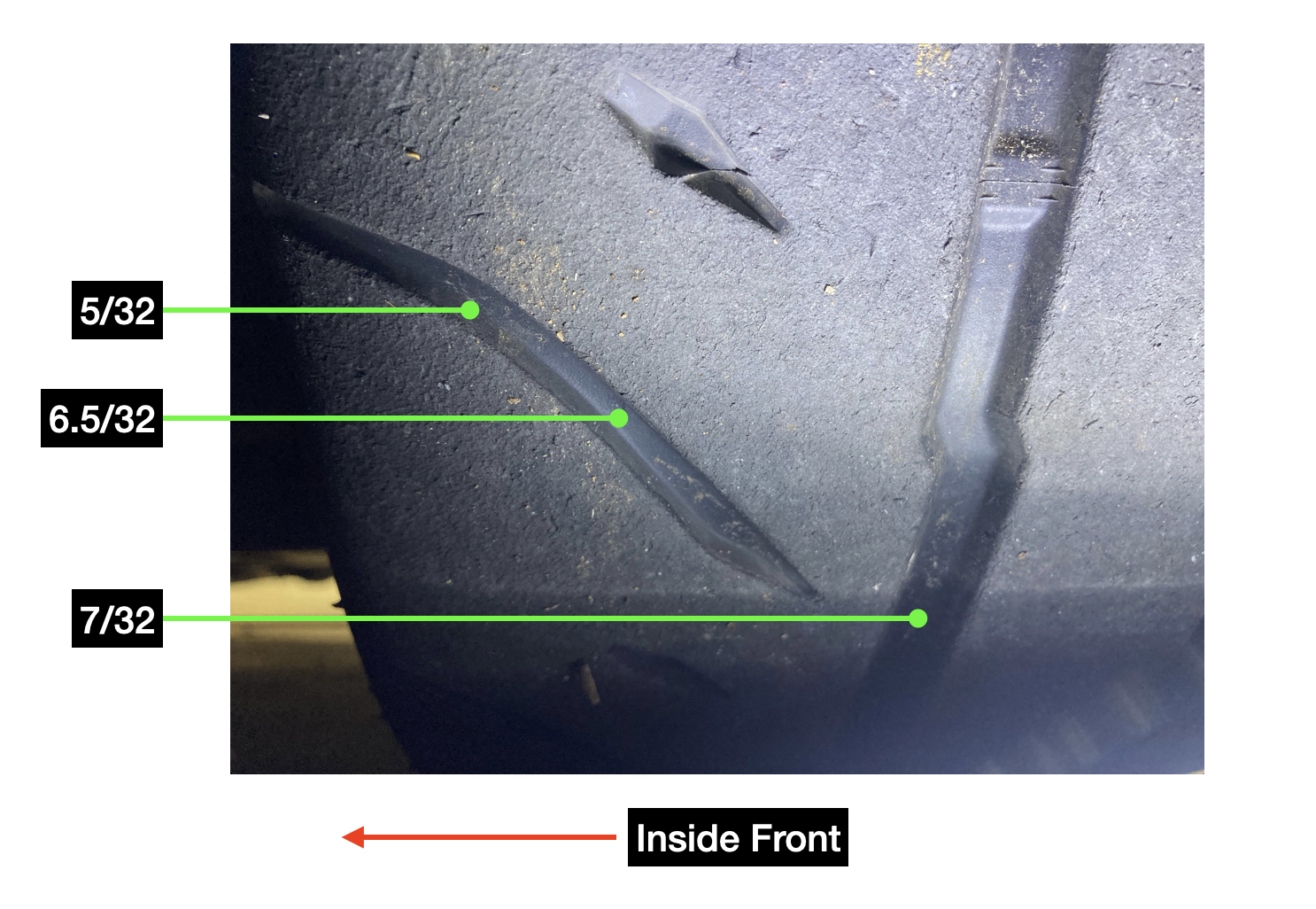
Figure 1- Outside of Front Tire
Figure 2- Inside of Front Tire

As I mentioned the inside of the front tires wore faster than the outside. In warmer temperatures more grip will be created, probably pushing wear toward the outside. At regular autocross courses there will be more long, high-G corners, also pushing wear toward the outside. However, as I will probably be adding air pressure and the Penske shocks will have more compression force the wear rate on the inside may very well stay a little higher. (Toe is not a factor here as it will always be set to zero or near-zero.) This wear pattern, inside faster than outside, is not necessarily an issue.

In a standard corner we theoretically only reach maximum lateral acceleration at one point- the apex, though we should be at the total limit of longitudinal plus lateral from start to finish of the corner. The apex is when wear on the outside edge will be the fastest, but it’s not for a very high percentage of the total time during a run. The apex is the point where we want to maximize the lateral grip from the tire and where our data system can most easily measure it.

Some might advise me to decrease the static negative camber in order to balance the tire wear. While that might work, I think it would be a mistake if you’re trying to win and not trying to maximize tire life. Reducing static negative camber would diminish the peak capability of the tire to produce lateral grip. In this Street-class car with relatively soft springs and rubber suspension bushings, which equates to too much roll and thus camber loss in the corners, we can never achieve enough static negative camber to keep the tire at its best angle (still slightly negative…not perfectly vertical) at the apex of the corner.

This is also why using a tire pyrometer in grid to measure the temperature across the tire and then adjusting camber to even the temperatures is not smart, no matter how many people tell you to do it. (I hope that includes all my competition!) We are interested with what happens mostly at those corner apex points out there on the course. The tire temps back in the pits are of little use to us. I really don’t care what the average heat generated across the tire width is across a run, which is what that tire pyrometer will tell you back in grid.

If you want to measure the surface temperatures in real time during a run with a set of thermal imagers so you can see what happens at those corner apex points, well, now you’re talking about something that could be useful. I think I know what it would tell me: the outside edge heats up really high at the apex because it’s lost too much camber and the edge is really highly loaded and wanting to roll under. The tire is not happy. The tire is screaming, “I need more camber to even out the loading and these temperatures so I can produce more lateral-G at the apex!” The rest of the time, the inside edge is warmer.

Using a tire pyrometer is no doubt useful for road-racing a real race car (with properly stiff springs, sway bars, and without soft rubber bushings) but it makes no sense to me for Street-class autocross where we are trying to achieve peak, momentary capability with tires that we already know are not at the correct angle to the pavement.

What I’m saying applies only to Street-class cars. Once up one preparation level to Street Touring, where you can install properly sized springs and bars, replace the soft rubber bushings with sphericals and even install camber kits then you need to worry about how much camber is too much. Even then a real-time look at the temps across the tire surface in the middle of a corner is preferred. With a 200′ skid-pad you could use a tire pyrometer to quickly check temperature differentials across the face before they cool too much.

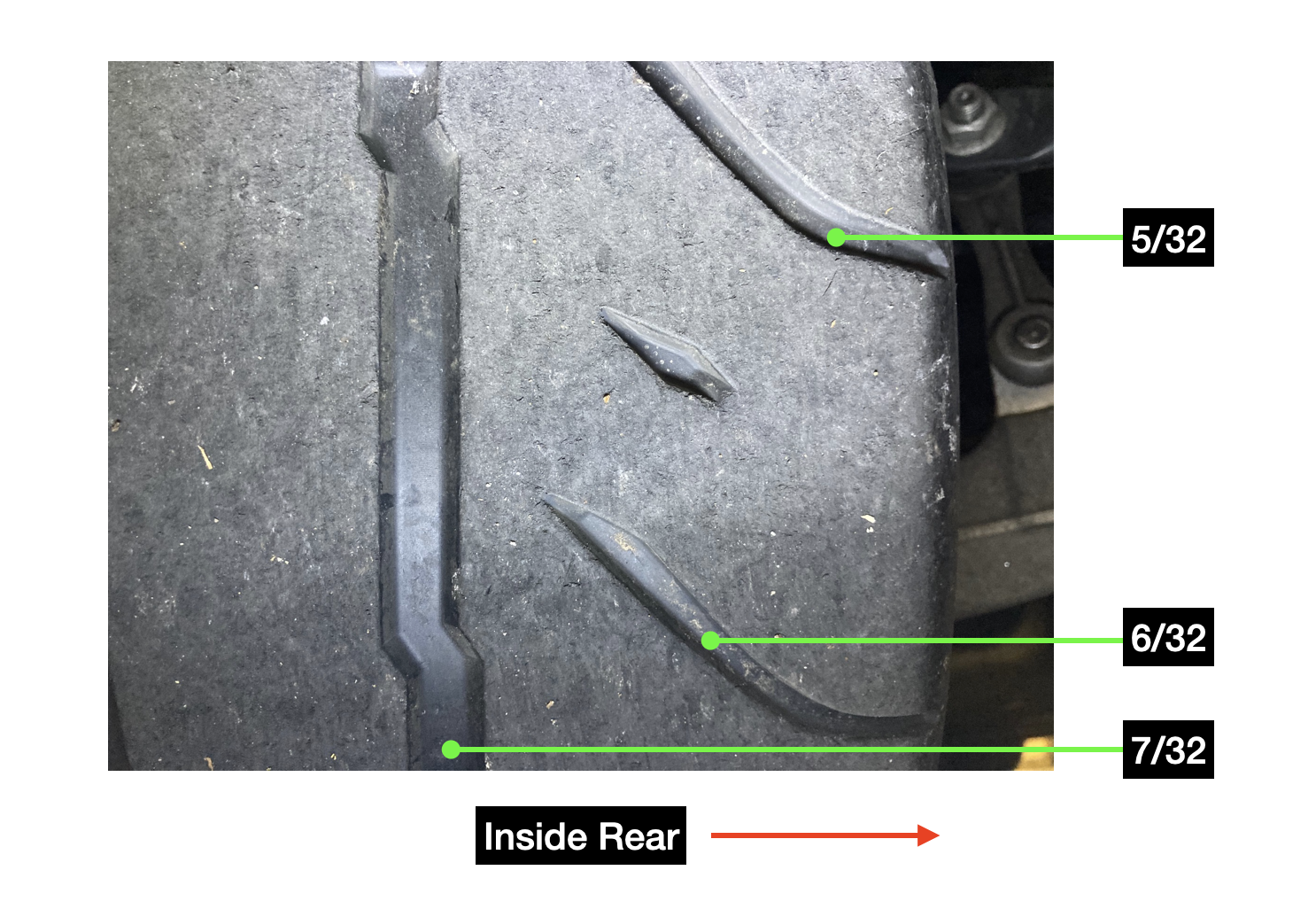
Figure 3- Outside of Rear Tire
Figure 4- Inside of Rear Tire

The rear tires also wore more on the inside than the outside at the Pro-Solo test event, though rear camber is much less than in the front. Especially after this particular test event this makes sense. During launch the inside edges have more load (due to negative camber) so they wear more during wheel-spin. The only time the outside edge is highly loaded is on the outside tire in the middle of a corner when the car is rolled over and pulling maximum lateral acceleration. This is when the outside edge (of only the outside tire) wears fast. Given this it would be very strange if the outside edge had worn faster than the inside unless the course included a lot of high-G corners, which the ones last weekend did not. At the local test and tune in a few days there will be a lot more long sweepers and outside edge wear should be accelerated.
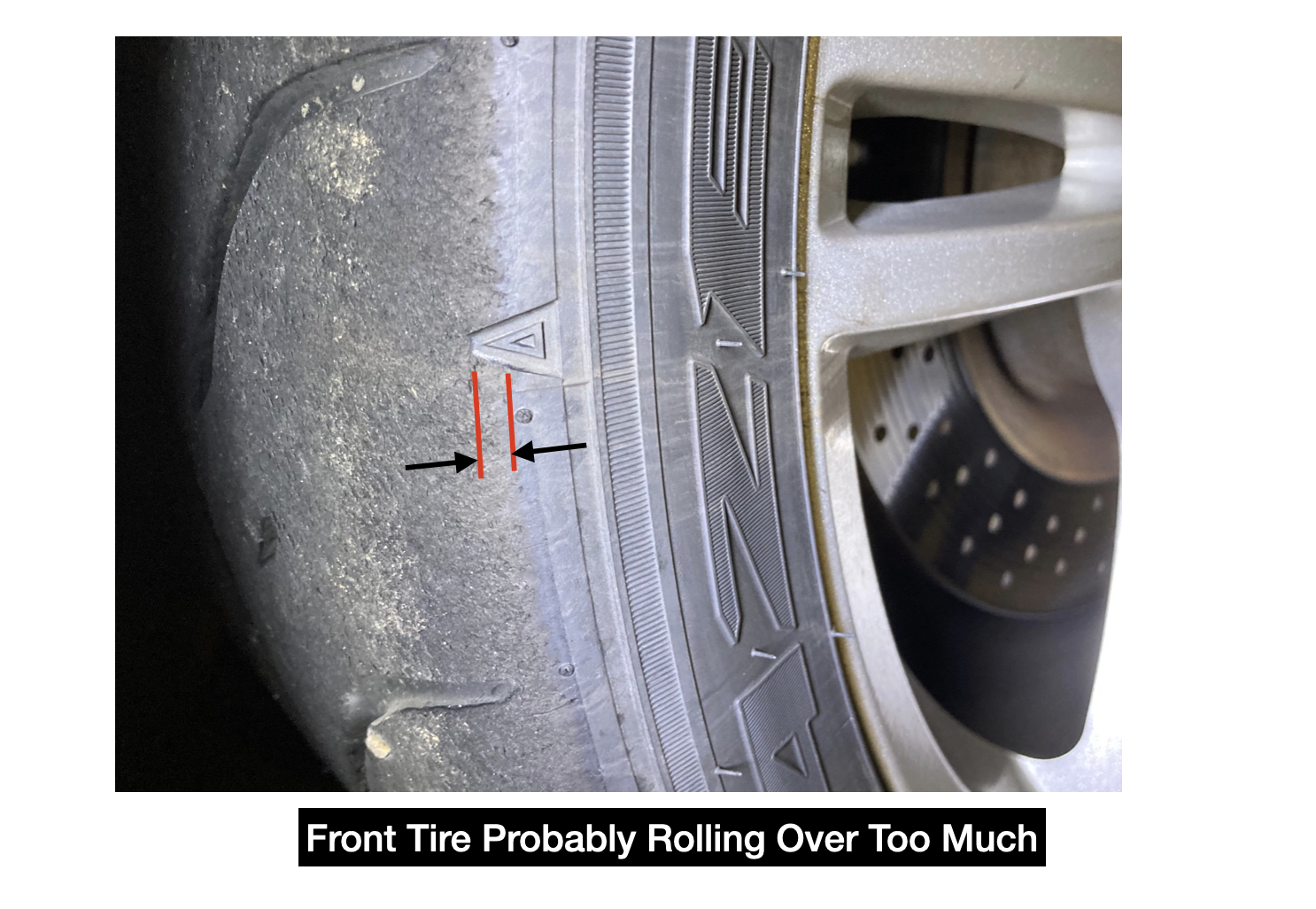
Figure 5- Outer Edge of Front tire

Autocrossers often use the triangles molded into the top of the sidewall to gauge how much the tire is rolling over. The triangles aren’t there for that purpose and they vary in location and size from brand to brand. They just make good reference points.

In Figure 5 you can see where the scuffed surface extends well down from the tip of the triangle. It looks to me like this is too far, meaning that the tire edge was rolling under too much when maximally loaded, even in the cold temperatures. I was only running about 31 psi in the fronts (28 psi in the rear) so almost certainly that will not be enough, especially in warmer weather on high-grip surfaces. These 275mm (10.8″) treadwidth tires are crammed onto only an 8.5″ wide rim, so there is, by definition, a lack of proper sidewall support. (According to the “standard” they need a minimum of 9″ of rim. This is autocross. We don’t need no stinkin’ standards.) More air pressure is probably needed. A friend confirmed this by informing me of the significantly higher pressure he runs for the same tire on a 9.5″ rim on a similar car.

Handling

The handling of the car was good, but not great. Overall the grip level was good, but it’s hard to make conclusions given the very cool temperatures. Also, I have Penske shocks on the way so I don’t want to go too crazy with conclusions or changes until they get installed.

I feel like turn-in could have been crisper. That, plus the indication of too much front tire roll-over, points toward needing more air pressure in the front tires to sharpen the response. The Penske shocks should also improve things because they will produce more compression forces on turn-in than the Konis do.

It was always possible to overload the front tires and create understeer by turning the steering wheel too far, too fast while trail-braking, but when I hit the right balance between speed, braking and steering angle the car turned really well. (I was finding the proper spiral entry path.) It took me until Sunday morning to finally get a feel for that point of balance. I’m not what you’d call a quick study. Thank God for all those runs.

The rear was quite stable. Maybe too stable. I had set the rear toe-in to 1/4″ total. You can always provoke oversteer with enough throttle coming out of a corner, of course (gotta love that LS3 and Z51 gearing!) but in general it did not exhibit any bad habits. No snap oversteer ever occurred. (That doesn’t mean I never got it sideways!) I will reduce the toe-in in the rear very slightly to assist rotation on turn-in and see how that feels.

Up Next: We have a local Test & Tune in three days on our local asphalt parking lot. Next post will probably be after that.

An Autocross Season- Part 7: Moultrie Test

Numbers Installed And Falkens Mounted

I was invited to the Pro-Solo Test down in Moultrie this past weekend. Moultrie is quite close to the site of this year’s Red Hills Tour, way down there in the South of Georgia.

Moultrie Courthouse

After the problems with the Pro-Solo system early last year the SCCA began a crash effort to fix the issues. A few events got cancelled, but an improved system was then fielded mid-year.

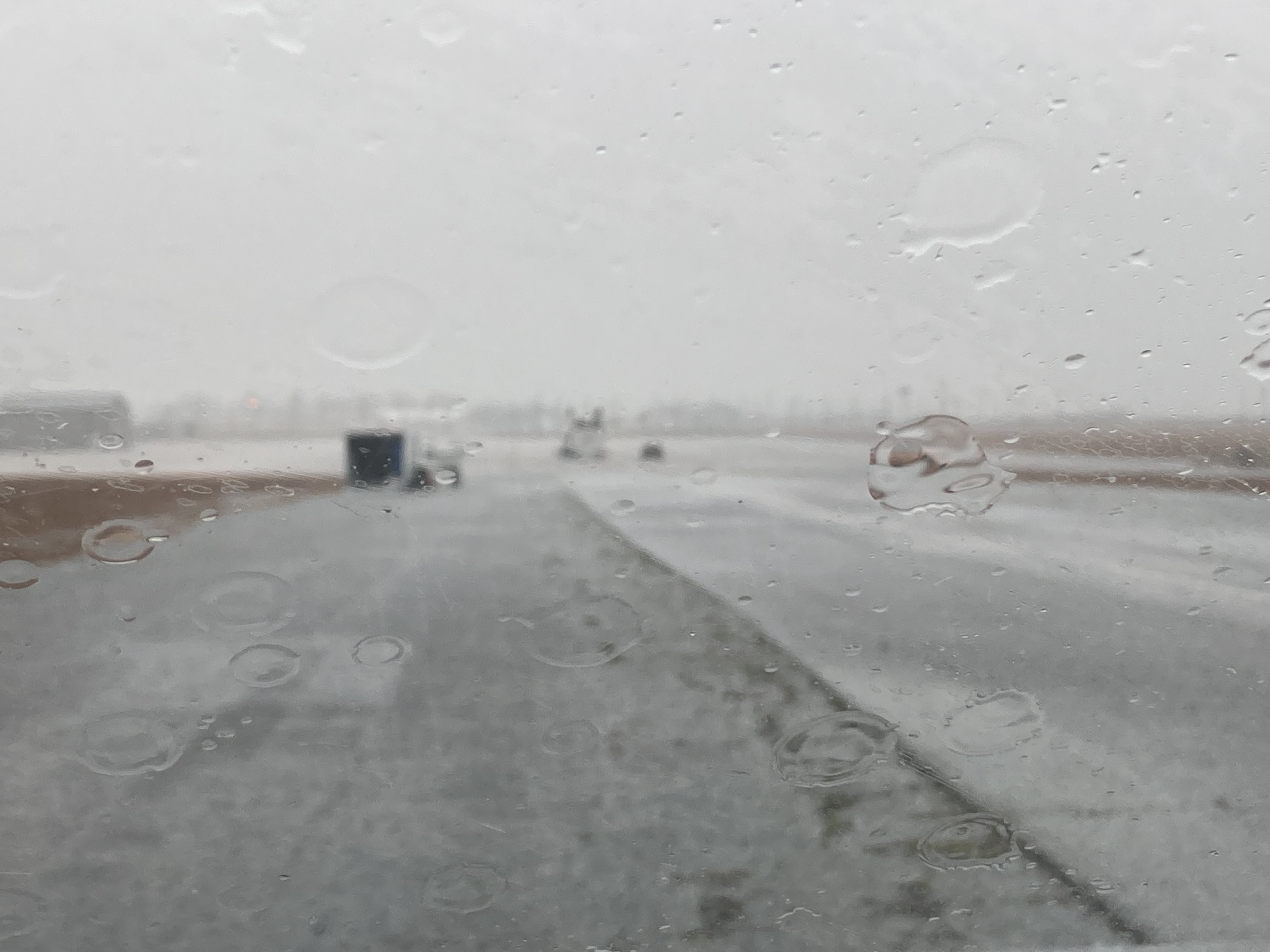
Raining On Thursday Arrival

What I didn’t know previously what that a significant effort has continued since then to further improve the system to make it even more reliable and easier to operate. So last weekend the SCCA ran a test in Moultrie on the concrete pad at Spence Field to shakedown the revised software and hardware implemented since the end of last year and prior to the first points Pro-Solo event in a few weeks in Florida. We did a lot of starts and runs over 3 days, testing single-course, dual-course and challenge modes multiple times.

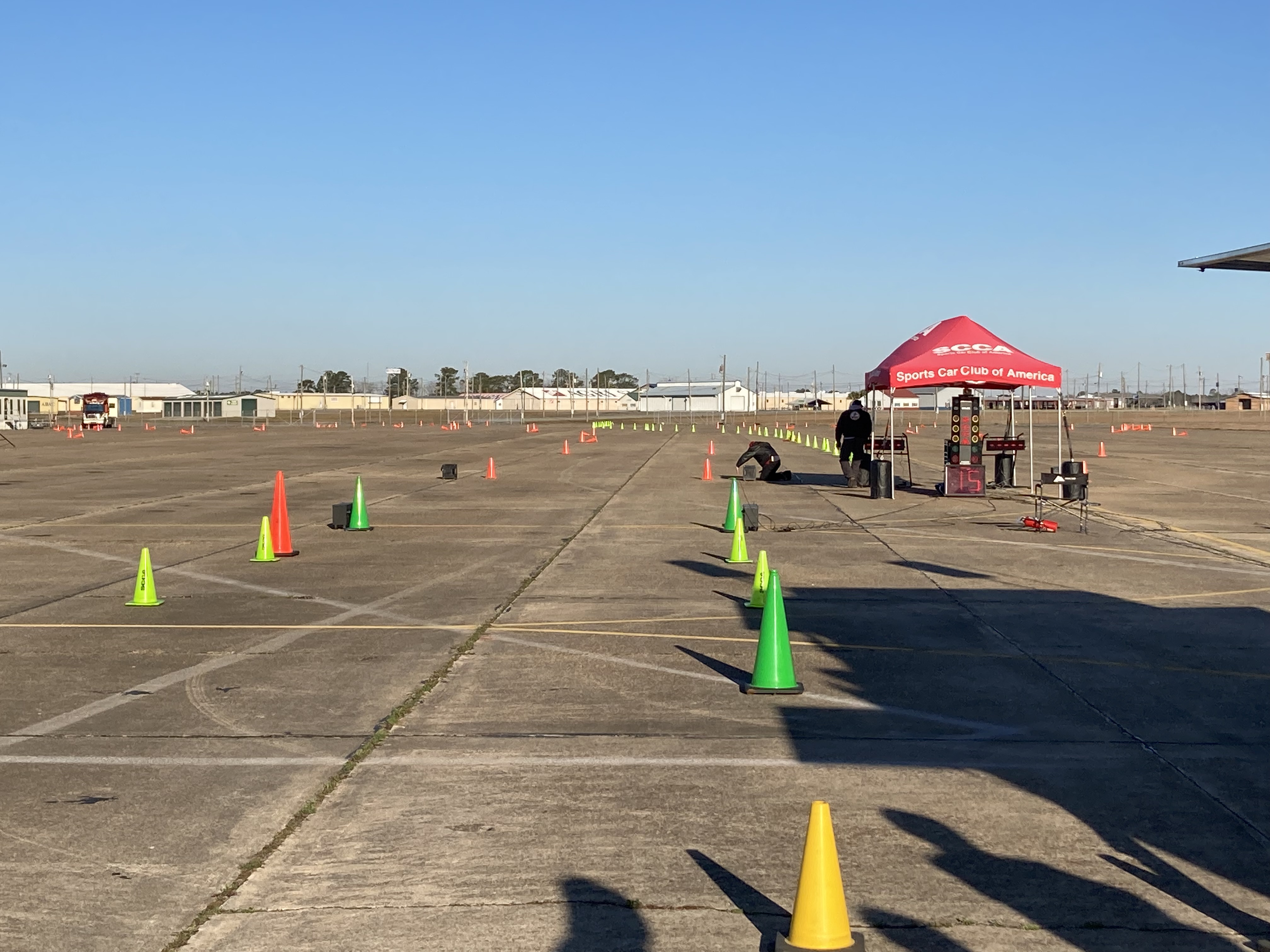
Saturday The Surface Was Dry And Cold

The system worked really well as far as I could tell. I got something like 60 full runs and an additional 40 or so practice starts on Friday which began wet and slowly dried a bit as we went along. (This went a long way to minimize tire degradation as I learned to launch the car.) The Corvette was awesome the entire time. The clutch never overheated and stayed consistant for every run the entire weekend.

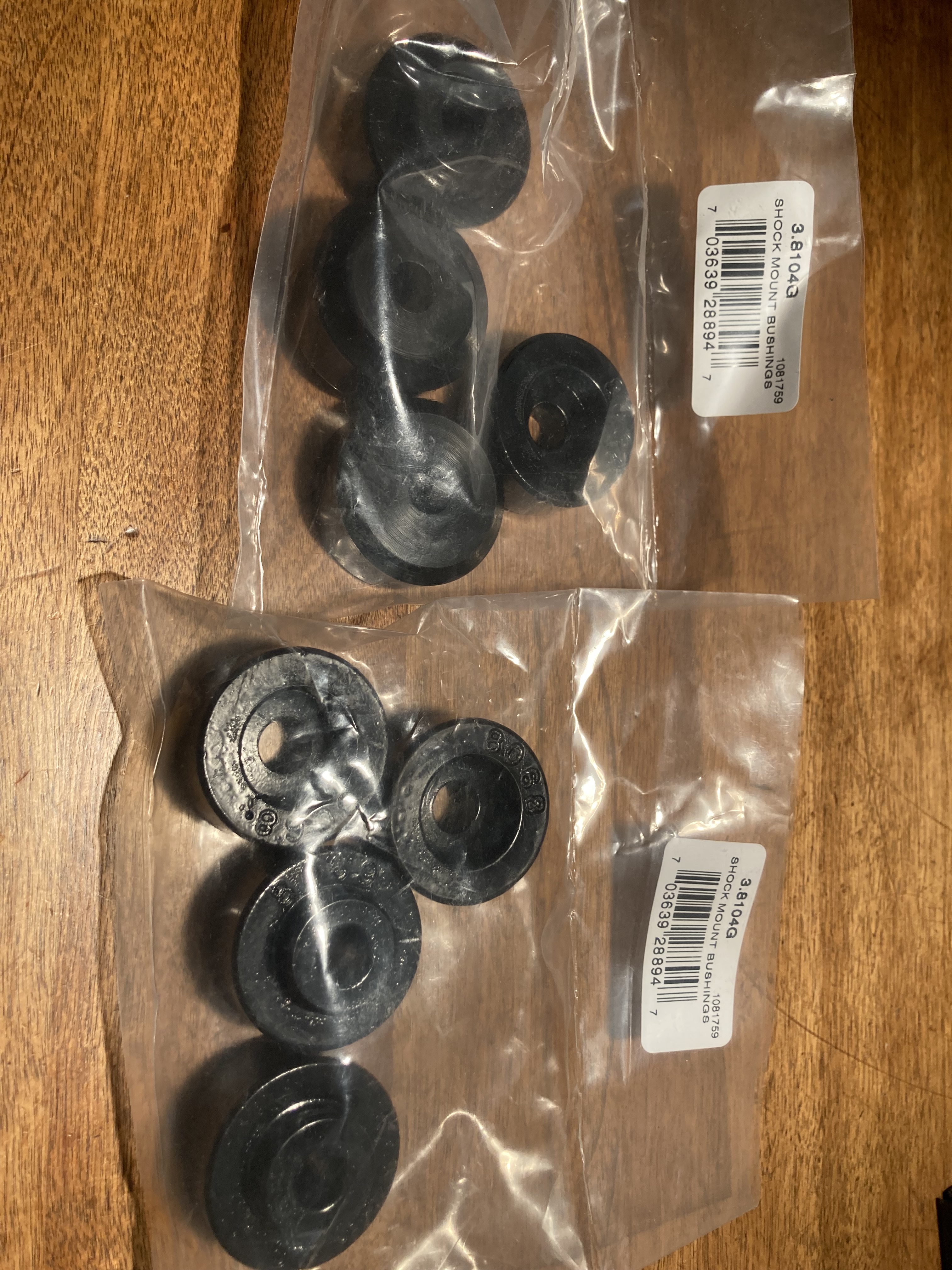
Just before I left I received a set of upper shock bushings made from polyurethane which will be installed with the Penskes when they get here. Some people may not realize that these are legal in Street class. They should make a slight improvement in shock response. The Ohlins I had on the C5 had no bushings at all… they fitted metal to metal at the upper end and transmitted a lot of additional noise into the cabin. The Konis mounted now re-use the stock rubber bushings. I have them cranked down pretty tight to limit lost motion.

Poly Upper Shock Bushings

The two very short courses were not quite identical and that was a good thing. In fact, I wish they had differed even more than they did for additional variety. Both had a tight section that rewarded excellent braking, car control and a good knowledge of the braking understeer point for the front end. These sections also rewarded narrow cars and better transient response.

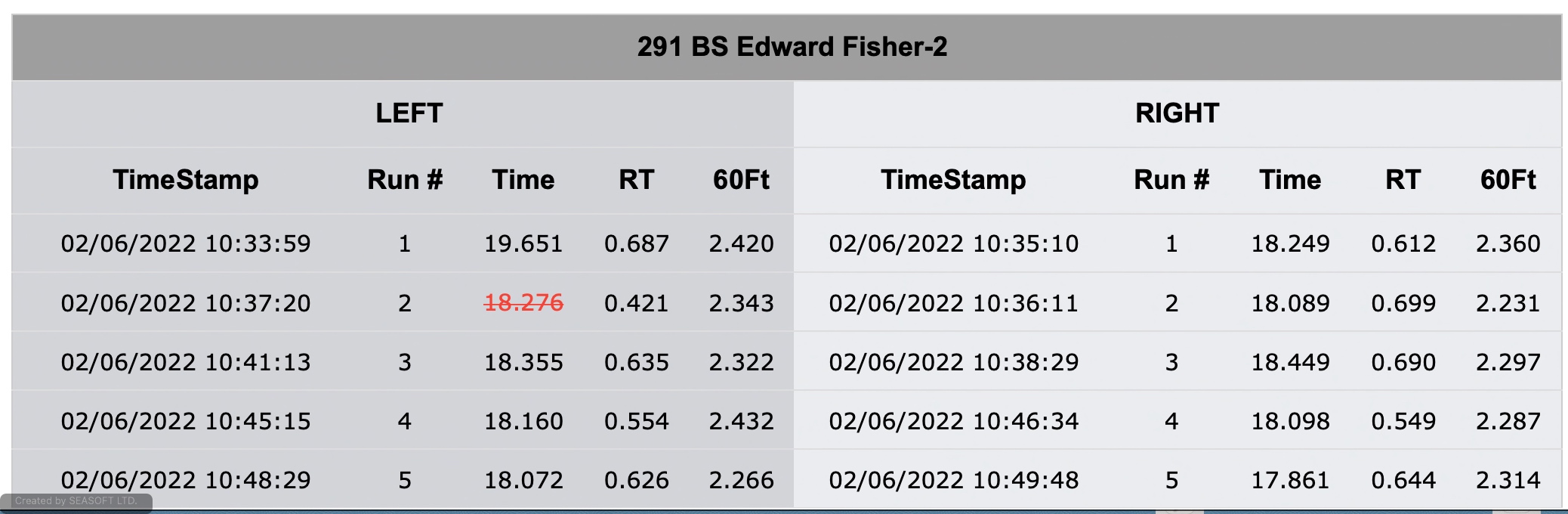
Of course the drag start rewards power-to-weight and forward grip. I think the rear 305 Falkens did a pretty good job of putting the power down once I really tuned into the feeling and sound of incipient wheel spin and could control the application of torque. The Sunday morning session contained my fastest times on both sides and is shown below.

Results From One 10-Run, 16-Minute Session

In the picture above you have, from left to right on the top row, the clock time of the first run which happened to be from the left side, its sequential number in that session and that side, the total time of the run, the Reaction Time, and the time to travel the first 60 feet. Then you have the same data again for the first run on the right side. For those not familiar, the quickest left side time is added to the quickest right side for your total at a competitive event.

The sharp-eyed and clued-in may notice that the clock times look a little strange, i.e. they don’t all swap from side to side like normal as we cross-over behind the start, alternating side to side. This is true. After the second run, which was on the right, I pulled back into the right lane again to even up the lines of cars on both sides and ran my third run from the right side again. Later in the session I did the same thing but on the left side. This could never happen at a real event, but at this informal test things were laid back.

The red, crossed-thru time was a red light run, i.e. I left too early and crossed the start beam before it had turned green, which is 0.500 seconds after the last yellow light. I had been playing around a lot with my launch technique, but by this time I was getting reasonably consistent in the 0.6’s and 0.5’s.

The 60-foot times are a little slow with the best being in the mid 2.2’s. I attribute this partly to the cold conditions which limited grip. In warmer weather I’d hope to be running consistently low 2.1’s, but I’ll have to improve my launches some more to get there. Barry K. cut a few 2.0’s in his mid-engined C8. Donour S., owner of a Lotus Evora he’s taking to STU this year, was consistently in the 2.1’s and sometimes dipped into the 2.0’s. I expect he’ll cut some 1.9s this year in that mid-engined car that has over 60% of its weight on the rear tires similar to the C8. It’s not horsepower that nets good 60-foot times. The car has most of the energy it needs to get started well already present in the engine’s rotating mass. It’s grip and technique that make for good 60-foot times.

You can find a video of the last 8 of these 10 runs on Youtube here.

This concrete site is not big enough to have much in the way of fast sweepers and probably couldn’t hold a real Pro-Solo event, though it could host a single-course event nicely.

Loaded Up For Home

An Autocross Season- Part 6: B-Street Ratings

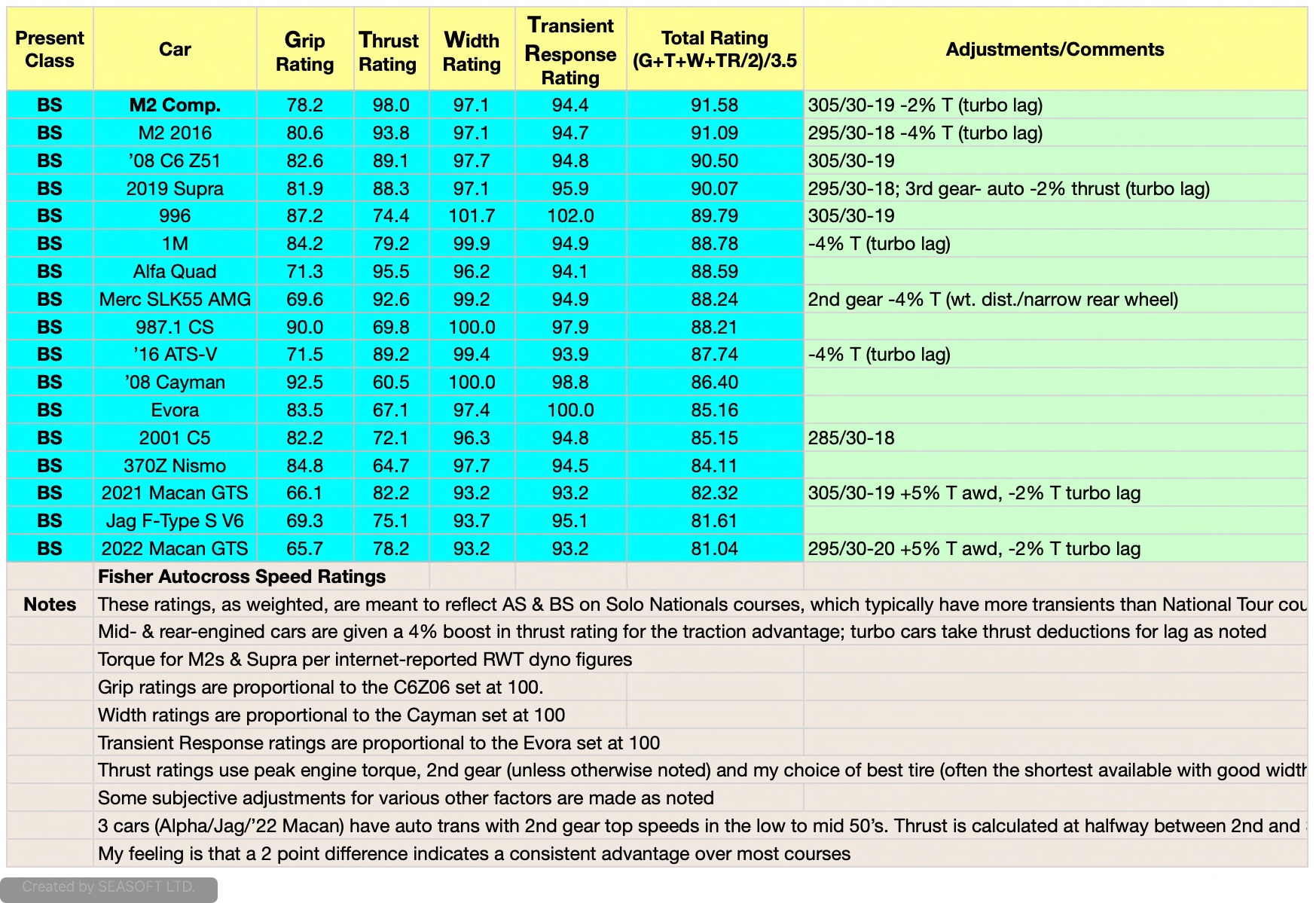
Some may know that I’ve been compiling a rating system for autocross cars for several years. It’s aimed primarily at A-Street and B-Street. Below is the list of BS cars for which I’ve run the numbers.

Fisher Autocross Speed Ratings- B-Street Cars

I calculate four individual Ratings which are then combined per the formula shown in the Total Rating box. First is Grip. This is very simple: weight of the car (with a 200lb driver) divided by the sum of one front and one rear rim width. So, for instance, it might be 3200 pounds divided by 9″ + 10″ which is 3200/19 = 168 pounds per inch of rim width.

Then I normalize all the resulting grip rating numbers for all the cars. This means I pick some car (originally the best one) and make its value equal to 100 and proportionally adjust all the others to suit. Of course, when it comes to grip, less weight per inch of rim is better, so it gets inverted.

You may be asking why there is no car in BS with a grip rating of 100. This is because the C6Z06 in AS got the 100. If you look at the list you can immediately see that none of these cars in BS comes close to the 100 Grip score of the C6Z06. Now you know the basic reason why the C6Z06 is so fast on an autocross course!

A rating value can be over 100. I typically don’t go back and re-normalize everything when a new car is better in some respect than the original car I set at 100. This means that the Total Rating is no longer strictly a 100 point scale. Maybe I’ll go back and change that.

I would love to be able to use center of gravity height in my rating system for evaluating Grip. Unfortunately, that’s not a number that is often published for most cars.

Once I have the individual Ratings, I create a combined Total Rating. Grip, Width and Thrust numbers are added in equally. Transient Response is weighted at only 50% compared to the other three. All of this, while based on numbers, is still, in the end, only a partially objective way of evaluating autocross speed. You will have to decide for yourself how accurate you think it is.

I show the individual Ratings for a reason: it allows you to combine them differently. If you think Grip is 25% more important than Thrust you can revise the total and get your own answer.

I recognize that there are many intangibles in autocross performance that can’t be put into such a system. Some subjective adjustments have already been made and are explained on the chart. For instance, it wasn’t until I autocrossed a 2019 Cayman GTS that I realized how detrimental turbo-lag can be even in a modern car with the latest-design variable-geometry turbo in certain types of autocross features. I penalize the M2C less than the M2 for turbo lag based on the faster-spooling system in the M2C which people have praised as significant over the original M2. In reality it’s very course dependent. In a course with nothing but standard corners linked by short straights turbo lag is almost a non-factor. This is because we do not require instant full torque at the apex of a standard corner. We only require a smaller amount of torque to be ramped up as we open the wheel. But in many linked features we can use instant torque for a very brief time. That’s when we get nothing, or worse than nothing, from a turbo engine.

For the Thrust rating I calculate the theoretical acceleration at peak torque in 2nd gear, unless otherwise noted. To do this I use the weight of the car plus 200 lbs for the driver, 88% of the manufacturer’s rated peak torque (to account for drivetrain losses), 2nd gear and final drive ratios and the rear tire diameter. The proper rear tire diameter is something I spend a lot of time figuring out. I don’t use what came on the car. I find what I think is the best (usually smallest diameter) wide, 200TW tire that’s legal to use on that car. I assume the owner will spend the money on custom wheels if necessary. This often has a significant effect on the ratings.

This Thrust rating is representative of the acceleration performance but clearly does not tell the whole story. Yes, it would be better to integrate the total acceleration from, say, 30 mph to 65 mph using dyno graphs. I simply don’t have the time to collect and process all that data so I leave it to others.

Width is a straight-up comparison using the manufacturer’s stated width, not counting mirrors. I do not go around measuring the actual width on the ground at the rear tires of cars at autocross events. I’d probably get run over.

The Transient Response rating is, well, it’s a little complicated. To my knowledge I’m the first to calculate such an estimated number from internet-available data. I received an inquiry from the SCCA as to how I do it. (I told them.) It’s clearly only an estimate of a very complicated property, but the key thing I came to understand is this: when a car begins the transition from going straight to turning it does not rotate about the center of gravity of the mass, i.e. it does not rotate about the middle of the car. Instead, the initial motion is a rotation about a point somewhere behind the rear bumper for almost all vehicles. Therefore, the initial resistance to that rotation is the inertia about that point, which is located at a percentage of the distance from the rear axle to the CG behind the real axle. Got that? So, I estimate the mass moment of inertia around that point. As the car transitions into the turn the center of rotation moves forward.

This means that the polar moment of inertia value, a property at the CG point and so often bandied about, is a poor gauge of Transient Response. Polar moment mostly tells you how fast the car rotates once already spinning, not how fast a car transitions. Even once fully into carving a turn the rate of rotation about the center of the car is low. A car only rotates once per full revolution around a driven circle, say, a 200 foot skidpad, which requires multiple seconds to negotiate. But the initial turn rate about the initial rotation point behind the rear bumper is very fast and substantially limited by the inertia around that point.

Also of next to no importance is the peak turn rate in degrees per second that a car eventually reaches at the end of the standard step-steer test, a mistake some people (Car and Driver, for one, in their Mid- vs Rear-Engine Debate in 2011) have made. You may notice that the 996, recently moved down from AS to BS, is the only car with a higher Transient Response rating than the Evora, which had previously been the 100 point standard, and which in turn has a higher rating than the Cayman. The Evora, while mid-engined like the Cayman, rates higher because it has more rear-weight bias than the Cayman. Lotus knew exactly what they were doing in designing a car that’s almost universally praised as better handling than the Cayman.

The 996 rates higher than the Evora because it has a shorter wheelbase (even shorter than the Cayman) and even more rearward weight bias, both of which tend to reduce the moment of inertia around the point of initial rotation. 911s have always been more “nimble” than Caymans in spite of having more weight and a higher polar moment of inertia. Car and Driver was unable to figure this out.

Silver Ghost, my C6Z51, is third on the Ratings list, a full point behind the M2C and half a point in front of the Supra. (Note that I think it requires about a two point difference to indicate a consistent advantage, so I think these cars are really very similar in autocross speed.) I’ve used the 305/30-19 Falken as the tire when calculating the Thrust Rating for Silver Ghost. If it turns out that it is possible to use an 18″ tire (ABS issues and availability of a properly small diameter front tire seemingly block its use) the Thrust rating will increase enough to vault the C6Z51 right up there with the M2C. Please note that these calculations necessarily assume that every car can employ every bit of torque produced by the engine at all times, whether or not they have an LSD, enough tire with enough weight on it or a sufficient suspension setup to actually do so. That assumption is clearly not always true.

I took a look at recent, same-day, same-equipment, dyno results comparing the 2022 Supra to the older ones. It’s clear that it has more peak power… significantly more, and in recent BMW fashion the car continues to be seriously underrated as compared to other manufacturers. However, the peak torque, which occurs at a very low RPM, is essentially unchanged. Boost is apparently increased only in the top half of the rev range. Therefore, the Thrust Rating for the 2022 model wouldn’t change much, if any.

If you have questions or want to know more details of how the Ratings are calculated leave me a comment and I’ll do my best to explain. As always, feel free to tell me where I’ve gone off the rails.

Silver Ghost With Her New Falkens

An Autocross Season- Part 5: Silver Ghost Pulls Hard

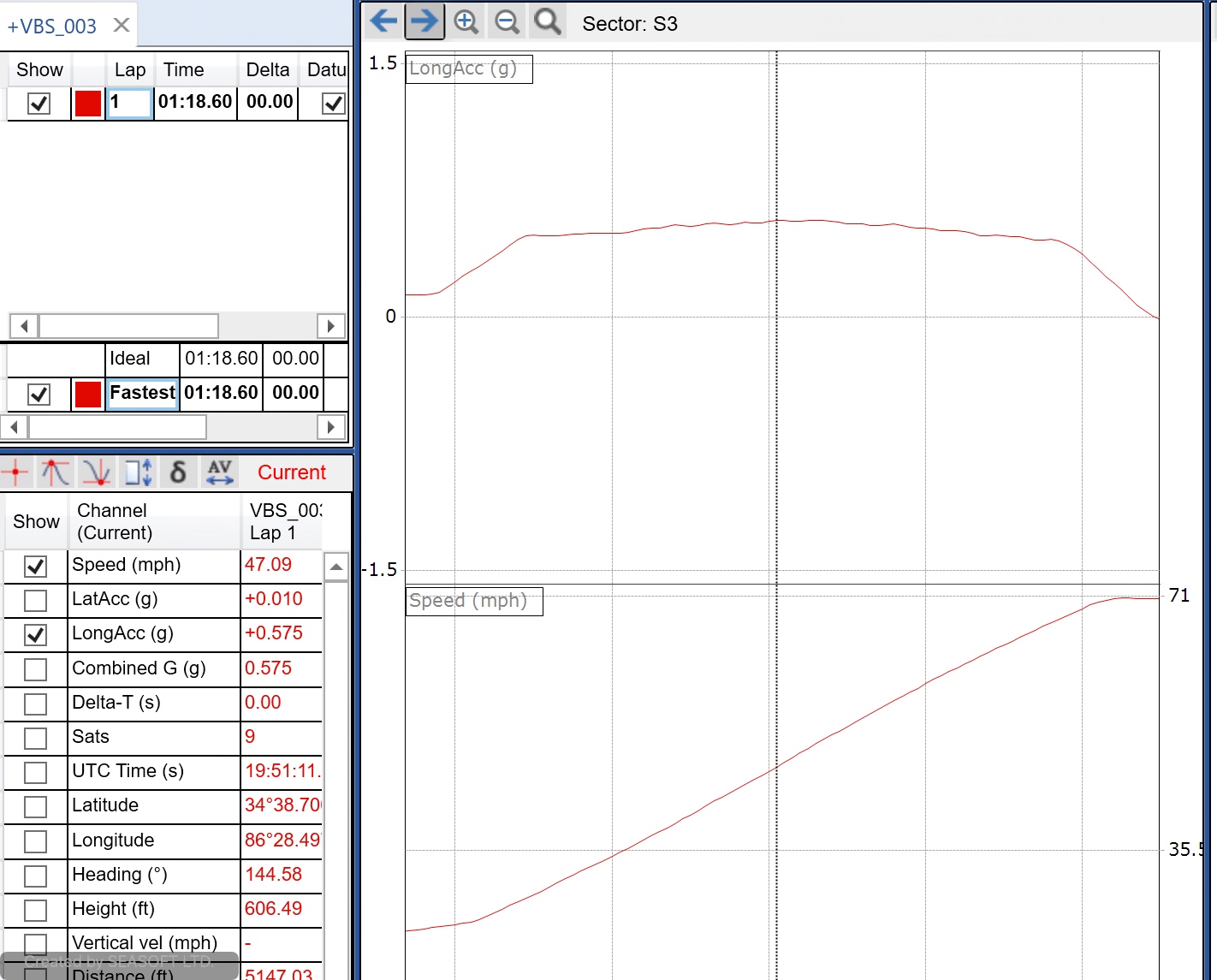
Took Silver Ghost out with the Vbox GPS data collector and performed a pull in 2nd gear now that the slightly smaller race tires (26.3” diameter) are on and she’s burned down to 1/4 gas. Results are shown below.

Vbox GPS Data-Acceleration from 30mph to 71mph In 2nd Gear

This plot is from 30mph up to fuel cut at 71. The peak (at the cursor location) is 0.575G.

This compares closely to two friends, one who has a C6Z06 and one a C7 Grandsport. Recently the Z06 peaked at 0.62G with a 315/30-18 rear tire (25.6″ dia.) in similarly cool conditions. In theory, given the tires employed, Silver Ghost should be matching his peak acceleration. But it isn’t the case.

The C7 Grandsport was wearing an all-season 335/25-20 run-flat rear tire that is 26.6” diameter. He also recorded a peak of 0.62G. In theory he should be beating the Z06 by a good margin, but that isn’t the case either! No doubt, he’ll pull harder when he gets some shorter Hoosiers on there for SSR.

I suspect the LS7 motor in the Z06 is a bit underrated. Also, the measuring equipment used was not all the same, not at the same location, time of day, etc.

The real test will be how well Sliver Ghost puts down power on the autocross course coming off a slow corner. That’s when these Falken 305s and my suspension tuning need to earn their pay. First chance to really evaluate it will be our Test & Tune in three weeks.

I took Silver Ghost on a little trip yesterday, a mix of country and highway roads… no interstate, following a buddy in his Porsche 993. This was his favorite test-drive route. At one point we were detoured around a closed bridge onto a narrow, gravely country road with half our lane washed away in places. That was a little tricky when meeting on-coming traffic. Averaged 25mpg.

As always, let me know if there are things you want to hear about that I haven’t mentioned.

An Autocross Season- Part 4: National Event Plans

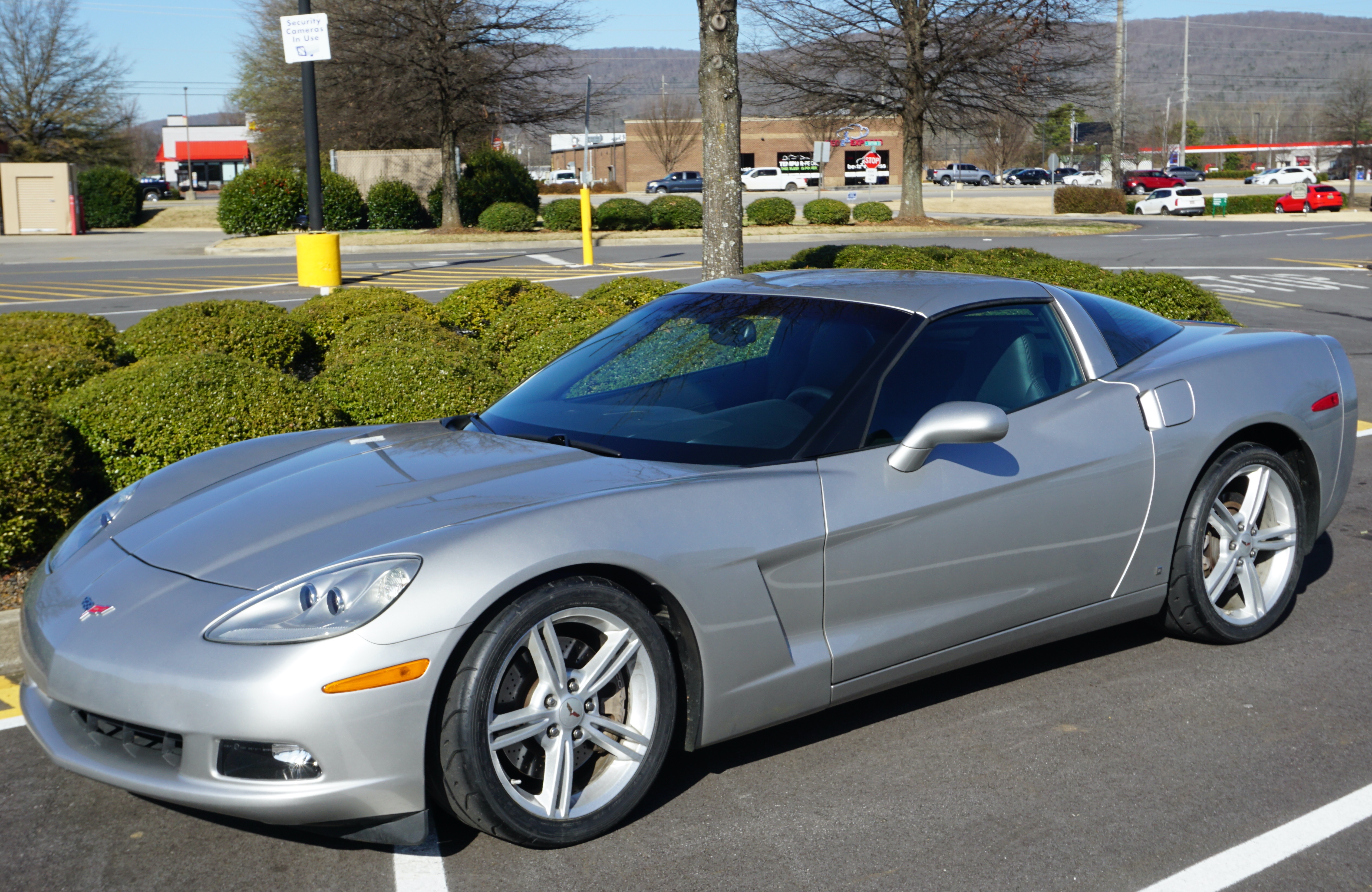
Silver Ghost

I plan to compete in six national events with the Silver Ghost C6 in B-Street this year, not counting Nationals themselves and regional events. Three Solo Tours and three Pro-Solos. The first is in less than a month.

Planned National Event Schedule for Silver Ghost

By the Florida Pro, which is a single-course Pro-Solo event, I plan to have a few more things done to the car. I’ll sand the brake disks and install some Carbotec street pads, my preferred autocross pad. I’ll change the diff fluid, trans fluid and engine oil, putting in my favorites: Miller’s Nano in the diff, AMSOIL in the trans and Redline in the engine. I’ve already installed Brisk Racing side electrode-type spark plugs which were proven in the C5 to add a little horsepower and torque in the mid-range. (I’ll be happy to provide details on these items if you ask.)

The Florida Pro registration is filling out nicely with 115 of the 125 spaces taken. There’s only one other person registered in BS, which is disappointing but not surprising. He’s a fast driver in a 2014 Boxster. If they set the course up like last year with a fairly long drag-race start I should be a few tenths in the lead by the first braking point, assuming it’s dry. If it’s wet, I could be in trouble!

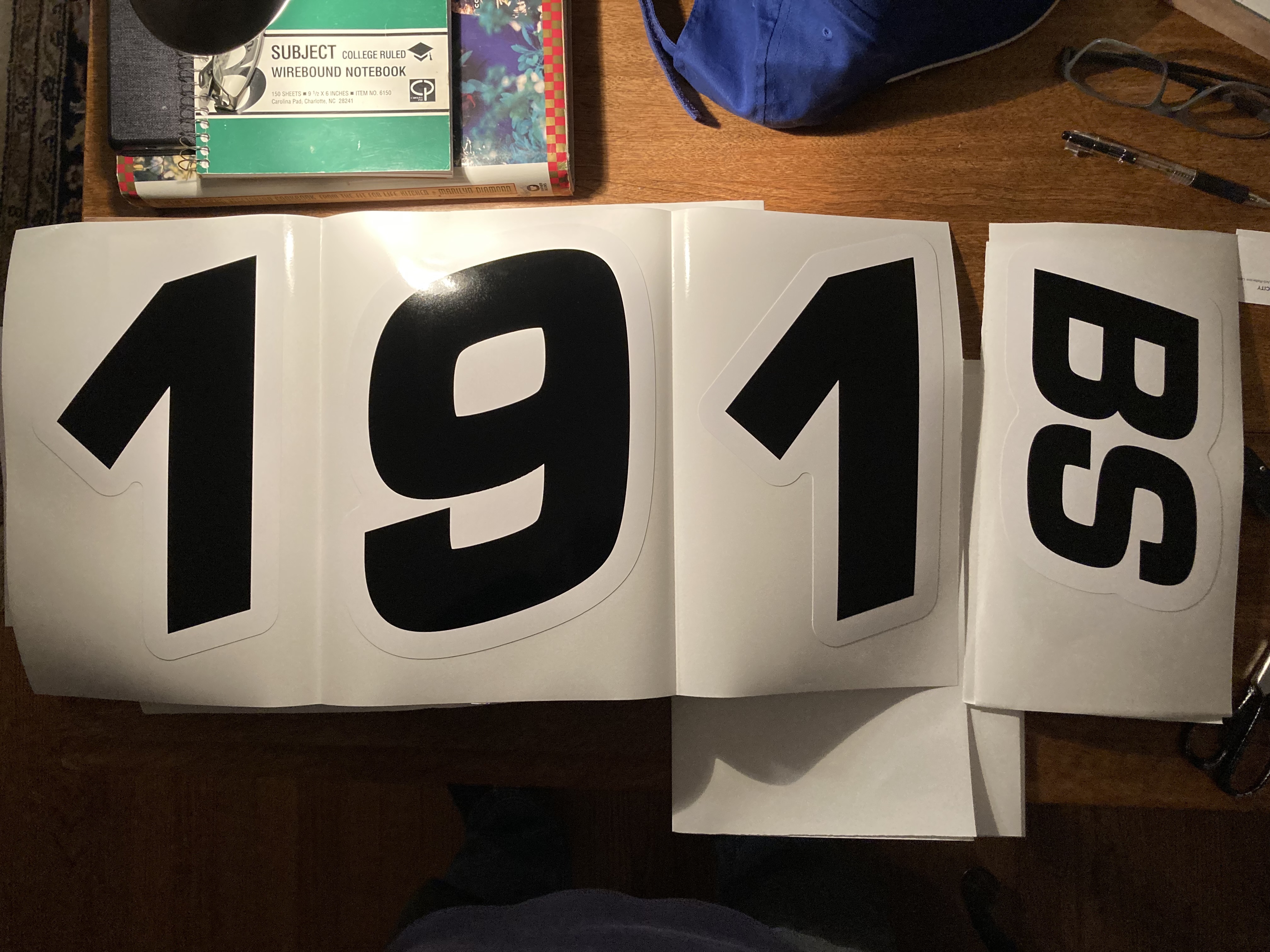
Oh yeah, my numbers came in. I got them from autocrossdigits.com