Tires & Shocks- You’d better believe it!

Last local event of the year, this past Sunday, I was on last year’s Dunlop Star Specs, as the Bridgestone RE71R’s were trash. I also swapped the Ohlins shocks (which need new top mounts) for last year’s Koni single-adjustables. Unf! It was tough sledding in the coldish morning.

Slaloming was awful. The front end didn’t have the fast transient response of before. It took until the 5th and last run before I could slow down, get the timing right and turn in early enough to not get late and hit cones. No trouble entering the slalom on time, it was the following cones that were the problem. By that 5th run I was doing the two slaloms as good as I had last year, but man, it was not the same as this year on the Ohlins. Sure, the tires were also different, but I never noticed much transient response difference when I switched from Star Specs to RE71Rs in the spring. It was going back to the Konis that really made the difference, even though I had the rebound damping set to max. In my humble opinion, you just can’t compete in Street without both a stiff front sway bar and shocks with lots of low-shaft-speed compression damping. Edit- At least not if you are driving the widest and longest-wheelbase car in the class that also has the highest polar moment of inertia, which is a measure of its resistance to rotate.

The second thing was how long I had to wait to put power down out of the corners. I definitely noticed myself waiting longer before I could hit the gas as compared to before, as well as having to be more gradual with the application of power. The RE71Rs multi-task like nobody’s business.

Thirdly, lateral grip was less. [Edit: the data shows the car developed a max of 1.0G in the sweeper that cold morning. 1.15G  was normal this year on that surface with warm RE71R tires.] The good Star Specs, I feel, were about equal in this regard to the worn-out RE71Rs that last time I ran them. I was lucky to salvage 4th of 10 in our very competitive BS class. First was taken by a National Champ from Nashville… second outing in his newly-acquired Corvette.


The Really Weird Thing about Modern American Autocross – Part 2

Recap from Part 1

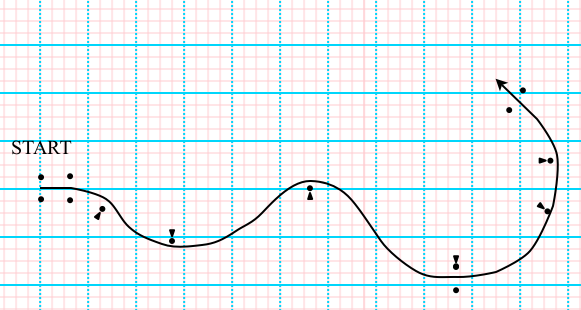
To recap and clarify, I’m attempting to determine whether and how the proper radius around an offset cone changes with the acceleration capability of the car.  The objective, as always in this blog, is to learn how to Save Time. A series of offset cones and the way I usually drive it looks like this:

general case

Setup

The situation I’m modeling, with the aid of spreadsheet math and some graphical solutions, is an endless progression of offset cones with, theoretically, a 90 degree turn required at each cone. (In reality, the turns have to be more than 90 degrees.) The finish is not in play and I’m not discussing  cornering techniques, per se. (If you want to see what I think about cornering techniques, see previous post  All Those Books On  Cornering are Wrong.) To be clear, what I’m going to show is NOT considered by me to be the best way to take a corner.

The figure below shows the area of analysis, namely the 150′ before any particular cone and 75′ after it:

proper path

I assume, for ease of calculation and graphics, that we go wide on the entry, brake down to the curve velocity the tires can handle, and execute the turn before reaching the cone. Sort of like back-siding the cones in a slalom. (This is simplified as compared to advanced cornering techniques, but I think it will be useful. And, best of all, I can calculate the heck out of it.)  Once alongside the cone the car then accelerates at full and constant capability for 75 feet further. The specific area of analysis and various possible paths are shown in the next figure, repeated from Part 1:

time in curve 1

Diagram of the Specific Area of Analysis

Calculations

I’m now going to discuss how the calculations are done. Those not interested can skip down to the results. Go on ahead. I won’t be offended.

First, I choose a radius for the turn. Given the 1.2G lateral capability assumed for all cars, physics sets the speed in the arc.

I graphically set the tangent point from the approach and determine the arc distance.  Then I calculate the time spent in the curve, which is at a constant velocity. (All calculations use the standard equations of motion I learned a long time ago, forgot for many years and had to re-learn. Far as I know they haven’t changed too much.) From here I can go both forward and backward to determine the remaining segment times.

Since I know the speed in the curve and the acceleration capability of the car, I can easily calculate the time to accelerate through the 75 feet and the speed at the exit. So, yeah, I do that.

Here’s where I have to take the teensiest of short-cuts: I assume a constant entry speed, starting at A in the figure above, of 50 mph. The beauty of this is that now I can easily calculate the distance needed to slow the car from the set 50 mph down to the arc speed given a 1.0G braking capability. (If I don’t make the constant entry speed assumption, this gets too tough for my brain and my spreadsheet.) It’s then not hard to determine the time to cover that distance, figure out how far the car traveled at 50 mph and calculate that segment time as well. Add all the segments times together and you get the time from entry to exit, A to C.

Here’s a picture (probably unreadable) of the spreadsheet. In the upper right corner, in the red box,  is the acceleration capability that can be varied. This shot shows 0.4 g. As it changes, the various columns of figures change. Each column starts with a different arc radius, from 5′ to 55′. All velocities are in feet per second in the spreadsheet.

chart1

Spreadsheet Data for 0.4G Acceleration Capability

There will be one number in the Total Time row near the bottom in the figure above that is a minimum. In this case, it’s 5.674 seconds and it corresponds to a 30′ arc radius, both values in red boxes. So, now I know that for a 0.4g car a 30′ radius is best, i.e. Saves The Most Time.

Results

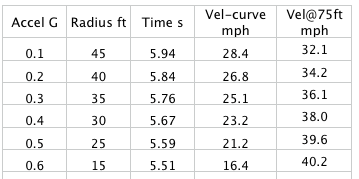
I’ve worked the spreadsheet and the graphics from 0.1g to 0.6g and converted the velocities to miles per hour. The results are below.

Best Corner Radii per Acceleration

Best Corner Radii per Acceleration

Hmm. Take a look at those curve velocities. More on that in a sec.

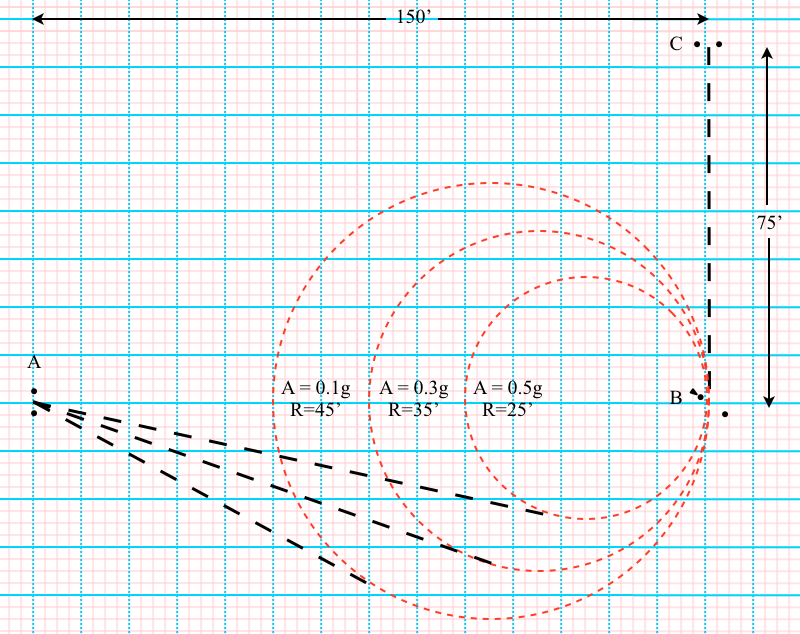
Here is what the three radii, 25′, 35’and 45′ look like with 150′ from A to B:

Example Result Paths

Example Result Paths

Conclusions

  1. Hey, the standard wisdom is right! The slower-accelerating the car the bigger the radius you should take. Holy Toledo Pro-Solo!
  2. I’m a little surprised by how big the radii are., i.e. how far outside the cone you have to aim. This says I’ve been driving too tight.
  3. I find it interesting that the time for a 0.2g HS econobox is not really that much slower than a 0.6g STU Corvette.
  4. Some of these radius speeds are really too low. The 0.6g car is only going 16.4 mph around the 15′ arc. Even for such a powerful car, in reality it will lose too much time trying to accelerate in 2nd gear from this speed. For most engines the RPM will be too low in 2nd gear. If we set a lower bound on the curve speed of 25 mph to keep from having to downshift this would limit almost all cars to no less than a 35′ radius. I almost never see people in powerful cars taking such big radii. What gives? Some factor I’m missing, maybe? Maybe a sliding, trail-braked, decreasing radius arc just looks a lot different and gives the impression of a tighter radius.

Sensitivity

One last thing: how sensitive is the data? What I mean is, how close to the theoretically right radius do you need to be? The answer is: not very. This is good news, especially for me and my driving!

If you take a look at the Spreadsheet Data for 0.4G figure, the time difference between the perfect radius of 30′ and plus or minus 5′ radius on either side is only 0.005 seconds either way. Given that, the difference in acceleration available at the cone from taking a bit larger radius than theoretically optimum could be significant. So, looks like it would always be better to go a little big. This means I’ve really been driving too tight. The difference in initial acceleration in my BS Corvette from between 21 mph and 25 mph is significant.

Whew! I’ve been working on the subject of these two posts for a long time. Glad it’s done. Please let me know if you find any errors.

The Really Weird Thing About Modern American Autocross – Part 1

The really weird and wonderful thing about Modern American Autocross, particularly as opposed to road-racing, and to a greater extent than Rallycross, is that often the driver must decide where the track is and what path to take. This seems to take a peculiar type of brain-power, or at least gobs of experience, in addition to driving skill.

I’ve talked about having to choose the track and path in one of my early posts titled No Corners, No Straights. Now I’m going to try to use a little brain-power to analyze the question:  what radius to take around an offset cone?

It’s also true that the drivers in American autocross are themselves pretty weird, and pretty wonderful. By and large the srsbsns autocrossers are fantastically friendly and helpful to the others coming up in the sport and they share a very strong, fiendishly intelligent camaraderie with each other. This sets a certain tone of friendly challenge where the most common thing is four guys in the same class donate parts, grab tools and pitch in to repair a competitor’s broken car in grid just so they can beat him! A lot has to do with the amateur nature of the sport and the type of folks it attracts. Some people think it strange that we race for  a $3.50 trophy, or maybe a Tee-shirt, but they are missing something important. A lot of the sport’s amateur charm is only possible because there is no large monetary prize at stake.

Of course not everyone in the sport is so cool all the time. For example, I see a clear difference between the srsbsns autocrossers, who I define as those with a burning desire to get to the top echelon of the sport, whether they are there yet or not, and the business-serious drivers. Some of the bad-feeling controversies of late in the sport seem to me fueled by the latter. Not exclusively, by any means, and certainly not in every case. (Those fiendishly intelligent racers are often very quick to tell each other when they are being stupid.) But, by business-serious I mean those that have somehow contrived to make a living in a manner connected to autocross. They used to be just srsbsns racers, but now have a significant monetary stake in what happens so have become business-serious as well. That always skews things, both for individuals and for institutions. (Witness big-time college football.) But, I digress.

I’m going to go out on a limb and assume that historically there has been a movement within American autocross course design. (I could be wrong about this historical movement, but you’ll get my point just the same.) The movement I’m thinking about has been along a continuum from “specified-track” course design to “unspecified-track” course design. Most of us have seen what I call a “specified-track” design one time or another, or at least as a section of a course. This is where two lines of cones are set out to create what looks like the borders of a road-course, like this:

"Specified Track" Course Design

“Specified-Track” Course Design

In a specified-track course, the width of the course is more-or-less constant and there is little choice of line. There are a few clubs around that still do this, but not many. The majority in the sport have moved on to a more challenging type of course design and use specified-track components sparingly, maybe for safety purposes or for variety.

In unspecified-track course design the cones may be few and far between so the choices of path become almost infinite. The driver must decide what line to take based on either knowledge, experience or both. Here’s the same course as above, but with less of a specified track:

Unspecified Track Course Design

Unspecified-Track Course Design

Say you are running the course above. As you approach the pointed cone in the very middle and have to turn right, what radius do you take around it?  Assume it’s a 90 degree angle from approach to departure. Unlike the way it’s drawn above, most people would say, first of all, that you should get the turning done by the time you pass the cone. That makes the cone the exit of the “corner”, not the apex, allowing you to accelerate early down to the gate at the lower right.

Here’s the situation I’ve created in order to analyze this question, except I have you turning 90 degrees left around a pointer cone & gate:


time in curve 1

3 Possible Paths from A to C Around Gate at B

Imagine you are in your car at A. You have the choice to take the small 10′ radius turn, the medium 25′ radius turn,  the big 50′ radius turn or anything in-between. Which path is best? How wide do you take the corner if there is no specified track width to create a limit?

It is commonly believed that the proper path and corner radius is influenced by the acceleration capability of the car. Dennis Grant was a strong proponent of this school of thought. (See his Far North Racing website, the Autocross To Win section.) In a car with a high  power-to-weight ratio that can also get the power down (think Super Street Modified, for example) it is believed you should tend to “drive diamonds” which means tight radii around the cones. In an H-Street econobox that can’t get out of it’s own way you should “maintain momentum” and take a wider arc, so they say. I wanted to see if I could prove the truth of this and get a feel for how much it matters. I’ve never seen such a proof in a book or anywhere on-line.  I’m sure there’s a simulator out there that could crank this out in an instant, but I don’t have access to one. I’ve worked the problem out with a combination of spreadsheet and  graphics. I’ve set it up like this:

-At A all cars are traveling 50 mph and automatically orient toward the chosen radius. They continue at this speed until they must brake for the turn. All cars brake the same (1.0g) and corner the same (1.2g). This is not quite true across the autocross classes (the classes with aero and slicks corner much harder, for instance) but it’s a simplification I had to make.

-Each car brakes at 1g in a straight line until it hits the tangent of the chosen radius. So, a big radius means you have to brake earlier, reducing the time spent at 50 mph. But, a big radius also means you brake less and later because the speed in the curve will be higher, which means you are going faster at B when you hit the gas again. A big radius also means the car will travel a longer path. See how complicated this is?

-The car then travels around the chosen radius at a constant speed dictated by 1.2 g cornering capability. Again, the bigger the radius, the faster the speed and the longer the path.

-At B each car accelerates at it’s capability, from the constant cornering speed dictated by the radius, in a straight line for 75 feet.

-I calculate the total elapsed time from A to C for cars with 2nd gear acceleration capability from .1g (maybe an HS econobox) to .6g, maybe an STU Corvette, for radii that vary from 5 feet to 55 feet.

Results in the next post!


Cars & Classes In The Silly Season

The latest news from Fastrack and SoloMatters has been more about what’s not changing than what is. My car, the standard C5 (that’s Corvette-5th Generation for those not in the trade) is not being moved up and buried in A-Street. So, I’m not being forced to sell my car and buy a C5Z06. Rats! Why did S2000’s have to place 1st & 2nd at Nats in B-Street?

The Acura RXS-S will also not move to STX and the 997 GT3 will not be removed from SSR. Whew! Dodged a couple of bullets there.

On the other hand, it seems that the SEB will put some P-cars (Por-schees, as my wife pronounces it, again, for those not in the trade) into STU, But, we will have to wait until the next Fastrack in December to find out which ones. I wrote a letter with some recommendations. Can’t wait to see if they followed my excellent advice!

Actually, STU is facing other changes as well, like increasing the allowable width of tires for the 4WD boost-buggies to 265mm after much moaning on the internet about how they needed it and, I assume, at least one letter to the same effect. Any new mid-engined or rear-engined (read P-cars) added to the class would be restricted to 255mm. Hmmm. Someone that’s got a 911 with 67% of it’s weight on the rear tires is going to downsize the rears to 255? Not bloody likely.

Actually, I just realized that the notice in Solomatters mentions only mid-engined cars when the original request for comment stated both mid and rear. Maybe just an oversight, but I bet when the list comes out no form of 911 will be on it. Bummer for some people over on the Rennlist autocross forum.

Most assume the 986S Boxster will be in. I also assume the 987 non-S cars as well. The only P-car I think that might get in that can actually hang with the C5 and 350Z if only given 255s is the 987 CS (Cayman S, for those…) but I expect it’s a long-shot. Personally, I would never own that car (don’t trust the engine) but a 981 (base or S) I could talk myself into.

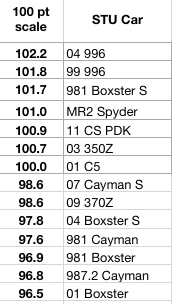
Here’s the results of my rating system for a selection of current and possible future STU cars with mid-engined limited to 255mm. The C5 is set to 100 points and 4WD cars are not listed because I’m clueless about how to rate 4WD. (Some say I’m just clueless all around!)

Update: 350Z added

STU Cars Rated

STU Cars Rated

Wilmington Data Crunch – Part 2: Showcase Turn

The showcase turn was an increasing radius on Day 1, the way most people drove it .  I lost of lot of time in it on my third run. The data can tell us how much.

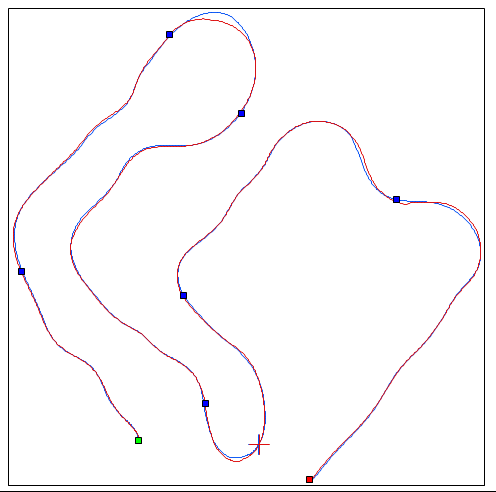
If you recall from Part 1 we are looking at 20Hz GPS data. I don’t have engine parameters, steering angle, brake pressure… just position, velocity and acceleration and what can be derived from those.  For Part 2 I’ve slightly redefined the segments as compared to Part 1. They look like this, with the start being the lower left green dot:

Full 1 Mile GPS Track In 7 Segments

Full 1 Mile GPS Track In 7 Segments

The cross-mark is in the middle of the showcase turn, which is Segment 5. Here’s the segment time data, with Run 3 set as the baseline:

Segment Times- Part 2

Segment Times- Part 2

The Run 1 S5 delta is -00.40, meaning 4 tenths of a second faster (less time) than in Run 3. What happened to lose so much time the third time through this corner?

Continue reading