987.1 Cayman in C-Street: 5th & 6th Events

I put a pair of 295 Yoks on the rear as a fit check and went to my local TAC 6 event with no other changes, including the same tire pressures. It was a disaster, but at least the tires fit!

Way too much oversteer tendency meant that I could not aggressively trail-brake into corners without losing the rear end, which I proceeded to do time after time. If I beat people that’s usually where I do it: on corner entry. I placed a disappointing 4th in C-Street and 22nd overall of 114.

I learned a lot by comparing my data to the winner of CS who was kind enough to give me his data. In return I created a set of charts analyzing the differences corner by corner. Besides my driving mistakes, the data showed that the Cayman has a very slight acceleration advantage over the ND Miata in both 1st and 2nd. Meantime, the Miata seemed to have a slight grip advantage, but that may be due to the limitations of the Cayman oversteer situation. At least I hope so, because this entire enterprise is predicated on the Cayman having a grip advantage inspite of its weight. It may be that I’m running into the reality that lack of front camber is always going to limit peak cornering grip to less than the Miata.

The next event was with the Alabama Region of the SCCA at Barber Motorsports Park outside of Birmingham. Prior to the event I dialed in a healthy amount of toe-in in the rear to cure the oversteer. It worked. The rear was now super-stable and I won CS in front of two ND drivers that beat me the weekend before at TAC 6. I won by over half a second on a 43 second course.

It was too much toe (5/16″ total) because the car would now push powering out of a corner. This car had never done that before. It was also really hot. I had a co-driver (who will drive with me at Bristol) and we confirmed again that you can overheat Bridgestones on a hot afternoon with six runs if you don’t water early.

The Barber Proving Grounds surface is very smooth with consistently high grip. This meant that the present lack of damping wasn’t so critical, i.e. the car wasn’t bouncing badly as is likely to happen at Bristol.

Back home I fabbed a string setup in order to produce an accurate alignment. (I didn’t feel like leaving the car all day with the kids that work at my local alignment shop like they insisted. That’s two shops that can’t figure out how to make an appointment system work, so I decided to do it myself.) Initial results were that the front tires are both pointed to the right!

String Alignment Setup

It took only a single iteration on the strings to get what I wanted. The car is now at zero front toe while straight on the axis, and 7/32nds (measured across 19.5″) total toe-in in the rear, split equally to each side and straight on the axis. (7/32nds = 0.32 degrees per wheel) I know that this is more toe-in than most people use for these mid-engined Porsches. It may get reduced later. But, I like to be very aggressive on trail-braking into corners so rear stability when the rear gets light is needed, as least for my confidence. I’ve driven other Caymans with minimal toe-in and they did not give me the confidence I needed when braking hard while turning.

This is the setup I plan to run at the Bristol Pro-Solo and Tour later this month.

2nd Place @ Dixie Tour

The whole direction of this year’s setup was to do well at Dixie Tour. I’m happy with 2nd place, my first trophy ever at this event.

Here’s the grid for run group 4, the A-Street cars making up the front row:

RG4 Grid Dixie 2016

Dixie Tour Grid- Group 4

Backing up a little bit: I had to increase the rear tire toe-in up to last year’s numbers (about .28 degrees per wheel) rather than the smaller value I tried. I could not get enough back-end stability with a lessor amount of toe-in. This doesn’t bode well for rear tire wear, given that I’m driving to all events.

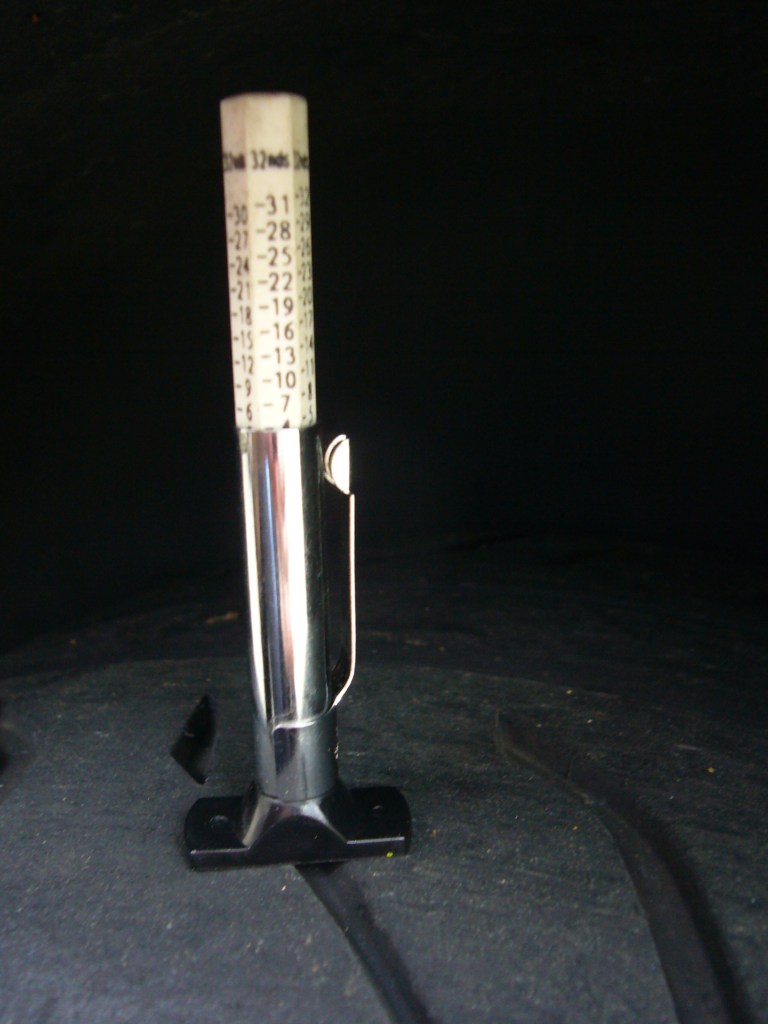
In fact, after 51 runs and about 2,000 miles on the road the rear tread-depth is down to 4/32nds about halfway to the edge from the center. The center measures 6/32nds. (Molded depth is 7.4/32nds.) The fronts measure 6/32nds everywhere. (I travel with zero toe in the front.) I think it’s clear that I need to really increase the pressure during event transits to try get the center to wear faster than the edges. I might think about adjusting rear toe like I do the fronts for the road as well. This wear is crazy fast, but then I only got about 85 runs last year on these tires before they had heat-cycled out of their initial stickiness and were no better than the previous generation of tires.

rear tire 51 runs

4/32n’ds Tread Depth Remain

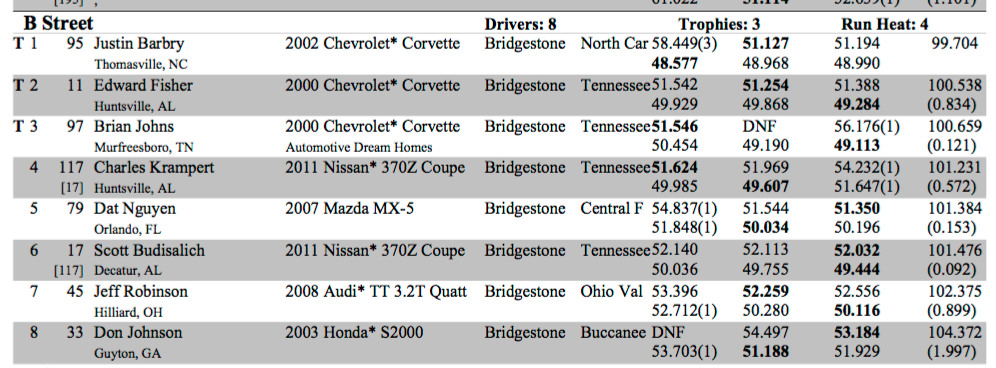
The courses were more open this year and top speeds were faster. In previous years my top speed would be high 50’s… 57mph to 59 mph. This year the data for Day 1 says 62.5mph and Day 2 68.5mph. So, my focus on transient response turns out to have been a little bit misplaced, perhaps. In any case, I was in 2nd at the end of Day 1 and managed to hold on to finish 2nd of eight entrants. Here are the final results:

BS Dixie

B-Street Dixie Tour Results

The three trophy spots were occupied by Corvettes, partly because there was no top driver in an S2000 at the event this year and maybe also because the new generation of tires were not shipping yet this time last year in Corvette sizes. The new generation puts power down better, giving an advantage to the high-power Corvettes. Interestingly, 4th place was taken by a fellow driver from Tennessee Valley Region in a 370Z. Fifth was Dat Nguyen in his Miata MSR. That same car and driver had been 3rd last year and Dat has not gotten slower!


The big news for B-Street, at least in the Southeast, is the new blood coming in. First place was taken by Justin Barbry, who trophied in the 3rd spot in FSP at Nationals last year. His first run on Day 2 really blew away the class. In third place was Brian Johns who was E-Stock National Champion in 2007 and has many Nationals trophies in SSM to his name. So, the bar has been set high in B-Street this year in the Southeast and these guys are just getting to know their cars. We’ll have to see what happens around the rest of the country.

BS lineup Dixie 2016.JPG

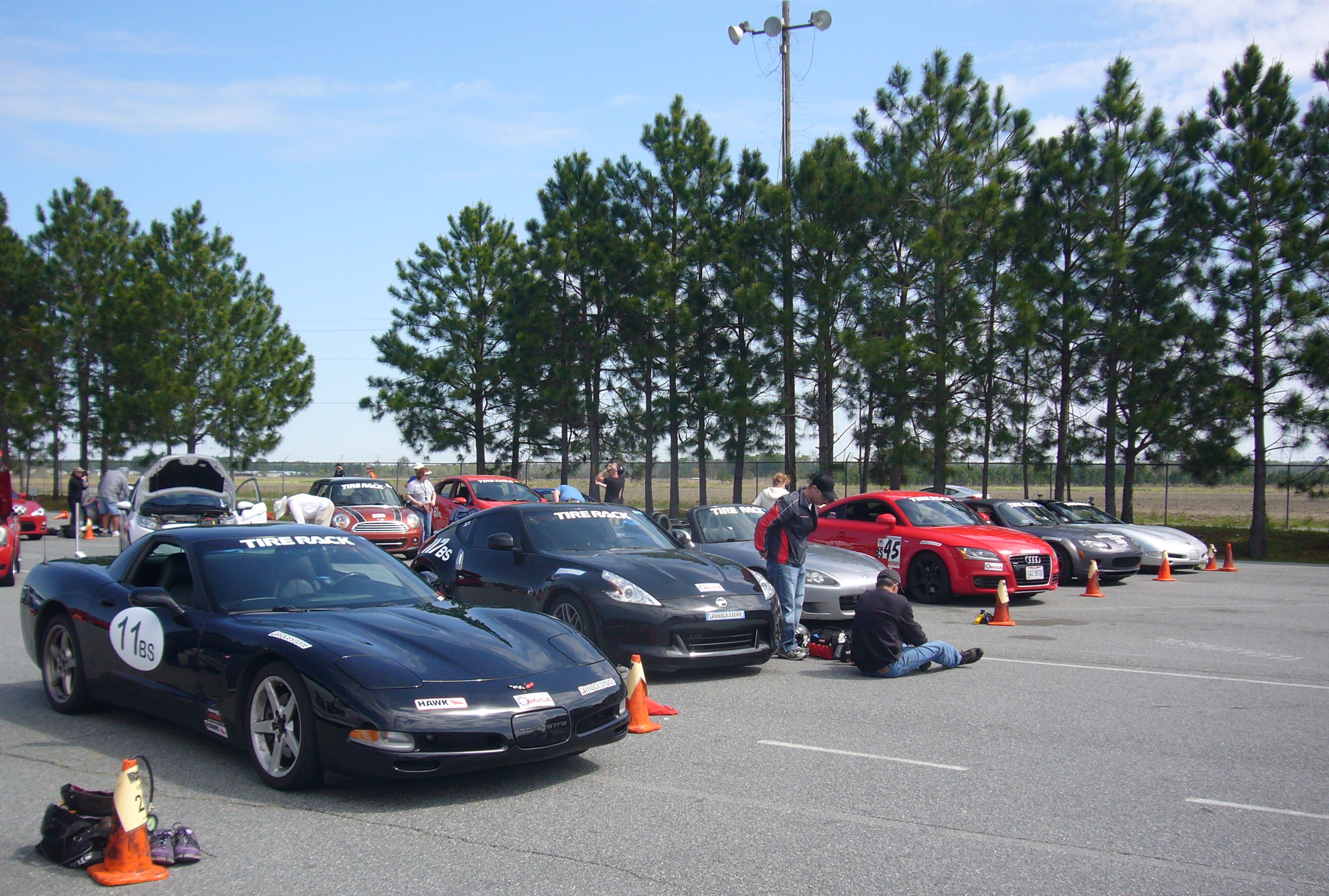
B-Street Lineup at Dixie Tour


TGPR Part 2: Anatomy Of An Agricultural

No one was going to kiss me at the end.

On Sunday I went off at TGPR for the second time in nine years of driving that track during 14 track days in three different cars. Both times were in the Corvette and for exactly the same reason, but not at the same corner. Neither off occasioned any damage, but I’m getting tired of it. I don’t want it to ever happen again. I’m going to analyze what happened so maybe I can learn my lesson. Maybe others can learn something too.

I plan to present data analysis of the cornering technique options at this track, which will have relevance to autocross, but that will follow later. Need to get this done first.

While I consider TGPR to be a very safe track, I know of at least two cars that have gone off and been totaled. These were both PDX-group cars like me, not Time-Trial racers. In neither case was there a serious injury. In both cases, I’m told, the cars went off at very high speed, travelled a long distance from the pavement on wet grass and eventually hit something. In one case it was a drainage culvert, in the other it was a tire wall of some sort, intended to stop a car before it reaches the treed edge of the property. (It worked.)

My incidents were not so bad. In both of my offs I effectively “drove” off the corner, going straight and under control (more or less) into the grass at the edge of the pavement after not being able to make the corner due to insufficient or late braking on corner entry. The first time I was probably going 15 mph when I went off. Not so this time.

Here’s the 1.4 mile track map with the way I number the corners. I went off in corner 1.
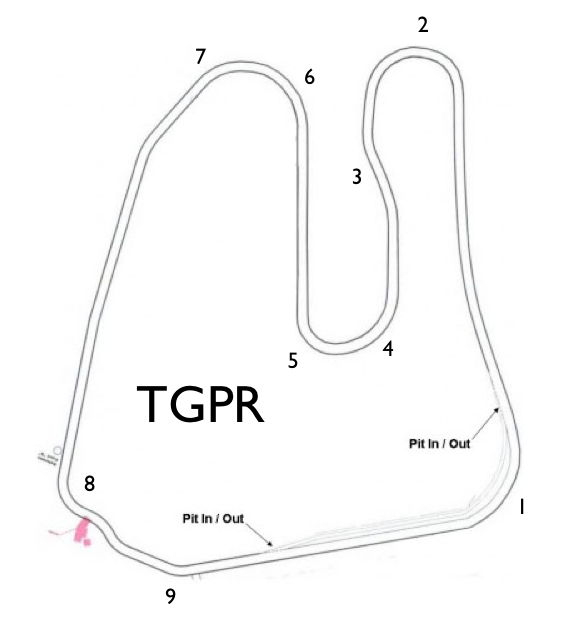
TGPR Track Map

TGPR Track Map

I’d been intentionally driving the corners in slightly different ways during the previous five sessions. I’d study the data in between sessions and compare the different techniques. Each session would consist of two warm-up laps, then two or three fast laps, a lap or two at reduced pace to allow the engine oil temps and tire temps to come down, then two or three more hard laps and then a cool-down before pitting. All this was traffic permitting, of course. I’d then come in, usually before the checkered came out, and study the data.

Using this method I was incrementally reducing lap times while some of the Time-Trialers were saying the track was going away. I don’t know about that, but air temps were increasing as the afternoon went on, so engine power was decreasing in any case.

So, let me stop right here and recognize that there may be many out there who don’t think what I was doing should be happening in a PDX group. Those folks will probably stop reading, thinking, “Well, he finally just pushed it too hard, found either the car’s or his own personal (talent) limit, and went off. Serves him right. Don’t invite him back.”

While I’m not really prepared to argue this point, I will say that I have no data readouts in the car to be a distraction or goad and, in fact, I’d be in favor of ruling out any sort of in-car timer that is visible to the driver, especially the ubiquitous lap-time predictors. On the other hand, ruling out the use of data entirely would be SCCA PDX suicide. New sports cars come with GPS lap data standard, for Heaven’s sake.

I always use point-bys, I always lift when being passed, I never pass without a point-by and generally try to be as polite and safe as possible on track, especially in the vicinity of others. This day we had at most six cars on track, which gave us lots of room. If the full complement of 12 were on the track simultaneously I probably couldn’t have ever put a full fast lap together given the speed disparity from fastest to slowest. (This is an issue almost unique to the PDX/TT format where all the PDX cars run together no matter the skill or speed.)

On the particular lap when I went off my goal was to drive one fast lap using all the “standard” cornering methods as a comparison to all the “non-standard” techniques I’d been using to get faster. Well, I never got that comparison lap.

So, what happened? Afterwards when asked, I said a couple of things: “I think I braked too late and not hard enough.” and “My brake pads had been tapering more and more as the day went on and when I tried to take that corner on a fast lap I didn’t have the braking power I expected on entry.” Let’s see if the data bears out these statements.

Here is a (very poor) overlay of the off along with the trace from an earlier lap:
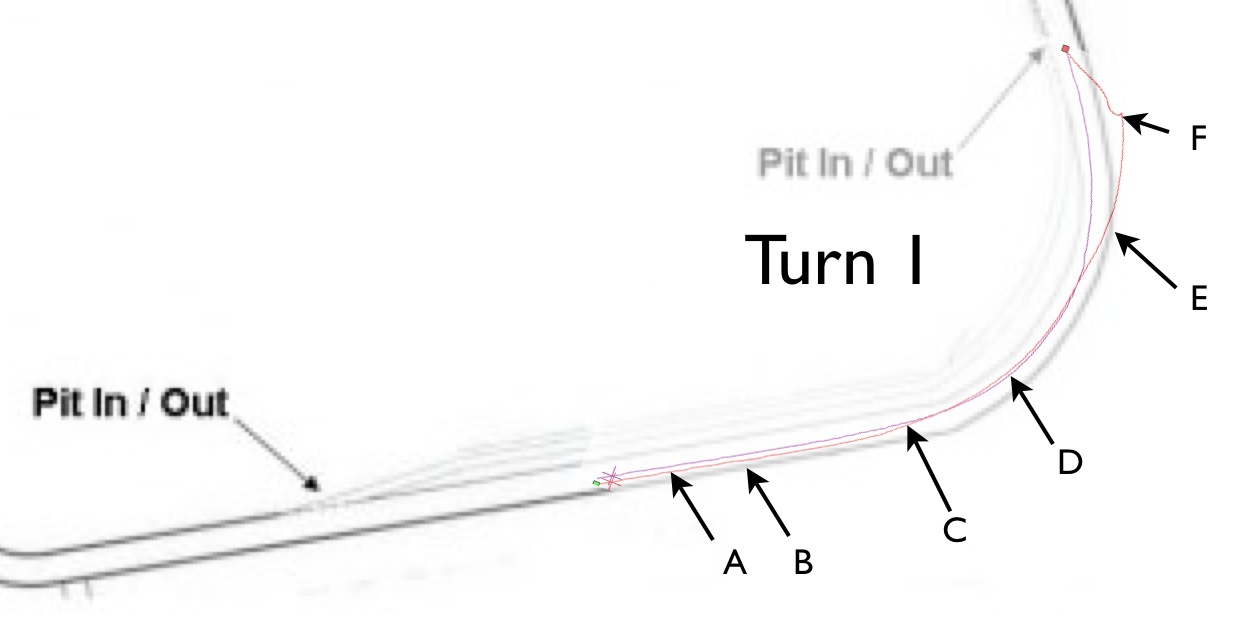
Corner 1 Off vs. Non-Off

Corner 1 Off vs. Non-Off

It doesn’t show up very well, but the off is in red and the non-off in purple. I think you can tell which is which in any case! The inner radius of the corner is marked by a series of cones. If you know what you’re doing you always take the corner right on the cones as there’s just a little bit of banking down there to help out. Outside of the inner one-car-width, the track is flat.

At the entry, the little green dot, I’m generally at 103 to 104 mph if I’d done the previous corner at max and used all the revs in the Pit straight. At F, above, the car velocity became zero. You can see this in the next graph, which has three parameters shown: speed at the top, lateral acceleration in the middle and longitudinal acceleration on the bottom.
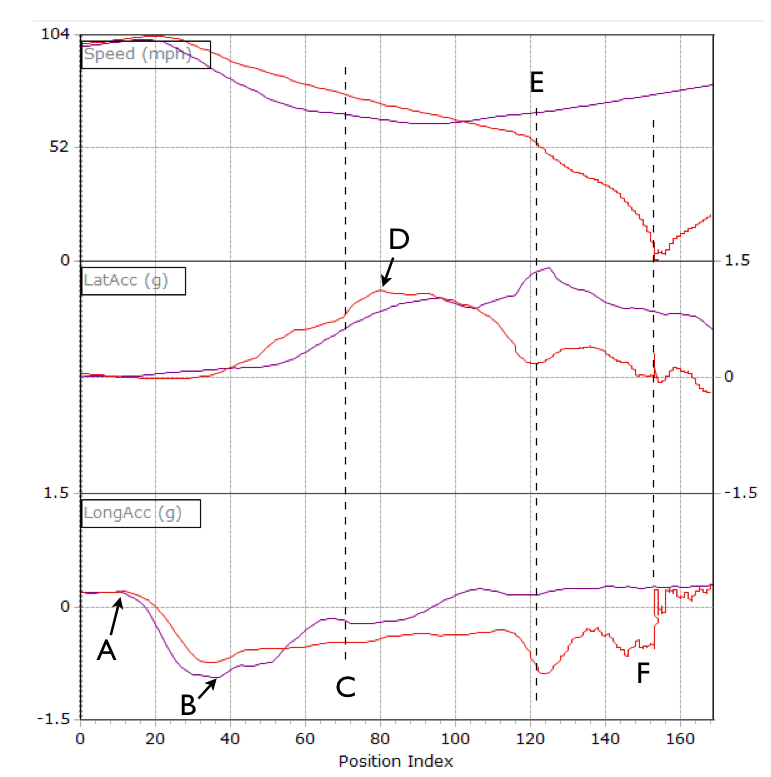
TGPR Off Graph

TGPR Off Graph

After the car stopped, I could see the black flag waving and that no other cars were approaching. I re-entered the track and proceeding around to Pit-In. I’m very sorry that I caused the others to lose some track time.

The first thing I notice in the graph data is that at A I starting rolling off the throttle at essentially the same spot on track on both runs. So, this proves that I didn’t actually brake late.

However, the roll-off seems a bit lazy and looking at the slopes down to B, we can see that the purple (non-off) lap is much steeper. For whatever reason I did not or was not able to slow the car nearly as fast as previously. The purple lap reaches -.93G at B, while the red lap reaches only -.73G. This may have been a careless error or maybe the tapered pads.

By the time I reached C in the top two figures the car was a full 10 mph faster than normal and I knew I couldn’t make the corner. In response, I threw the car hard left into the corner, initiating a slide and depressed the clutch. Who knows? Maybe a miracle will occur!

Upon reflection, I don’t think I’d have done that (turn even harder into the corner) when I was a novice. Most novices will sort of freeze up and just run straight off, arms locked, while pushing the brake pedal down. This is something we may need to train folks not to do, though I’m not quite sure how to teach it. Others, I’m fairly certain, will disagree.

The lateral-Gs peak at D and then descend as the car transitions into the slide. From D to almost E the longitudinal G value is almost a constant negative as the tires are scrubbing off speed and making a lot of noise for what seemed like a long time. The car has yawed a full 90 degrees left. Corner workers are looking up to see what mistake the fool has made.

Not wanting to spin and either stop in the center of the track, where I could be hit by a following car, or to go off backwards, I counter-steer into the slide. The car very slowly (it seemed to take forever) turns back to the right and straightens just before reaching the edge of the track. Lateral Gs drop and Longitudinal Gs increase at E as the tires bite the pavement just before hitting the grass. The car leaves the track surface at around 45 mph.[updated]

Once on the grass the car rotated to the left as it slid. I was just a passenger at this point, as the saying goes. You can see that the car arcs left even on the grass, but I really don’t know why. Wasn’t anything I consciously remember causing. The ground is soft and the tires are biting into the soft surface. The car is fully sliding broadside as it hits a bump at F which brings it to an abrupt halt. I was lucky that no tires de-beaded.

My conclusions:

  1. I definitely drove that corner too hard for the state of my brakes, spurred on by the desire to get some data.
  2. I drove that corner too hard, too late in the day, in the last session, when I was a little bit tired, mentally if not physically.
  3. I did not give due consideration to the loss of track camber if you enter too fast and can’t remain on the cones on the inner radius.

It all comes down to not leaving sufficient margin for the conditions, especially at the end of a long day. No one was gonna kiss me when I finished. No one was gonna pop any champagne. No matter what, I was going home poorer than when I arrived. I was lucky it wasn’t worse.
Wilmington Data Crunch – Part 1: The Big Sweeper

This is part 1 of a series that will look at basic autocross data crunching, using data from my car at the Wilmington Champ Tour last weekend. First up: the big sweeper on Day 1.

The Mile-Long Wilmington Day 1 Course

The Mile-Long Wilmington Day 1 Course

The picture above is the whole track from start (lower left) to finish as recorded by a Vbox Sport with 20Hz GPS. Two runs are shown, Run 1 in blue and Run 3 in red. Run 3 was only 0.135 seconds faster than Run 1 overall, but that was enough to move me from 2nd to 1st for the day. What I found by looking at the data was that there were huge swings in time between the two runs. In other words, mistakes in Run 1 were being offset by better driving in Run 3, but then a mistake in Run 3 would knock it back down again. (Run 2 was mostly a running disaster. I don’t want to talk about it!)

This post will be fairly technical. That’s just the way it is. I’m convinced that most folks can’t get fast in autocross fast without learning from data. It’s really not that hard. It just takes some effort and the money for the electronics, of course. In my case, being Apple people at home, I had to purchase a PC because the V-box software, even though free, only runs on Windows. (I got the cheapest laptop money could buy.)

Continue reading

180-Degree Turn-Arounds Revisited

In a recent post here we talked about saving time in 180 degree turn-arounds by taking the tightest possible circular path. I feel like I owe it to the reader to expand on that discussion as soon as possible because, really, it left out an important consideration.

Earlier this year I competed at the SCCA Georgia Match Tour in Moultrie. The results are here. That course had three 180-degree turn-arounds, all different, and only one of which was the situation discussed in the earlier post, i.e. with the entrance, exit and path tightly constrained. I want to talk about the first of those three turn-arounds because it was the opposite: both the entrance and the exit were wide open and the path from entry to exit was also unconstrained. That is, the driver was free to go wide on the entrance and go wide on the exit and as deep or shallow as desired. You’ll have to take my word for it that this was the case, because the ability to go wide depends not only on how the turn-around is constructed but also on the course design leading into and leading away from the turn-around. In any case, this is the kind of feature one finds on big, National-type courses.

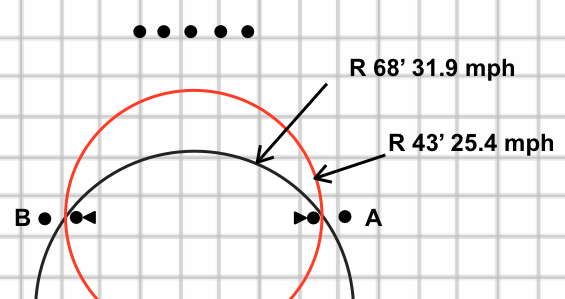
The first turn-around at Moultrie was more like the following figure. You could take any path you wanted from the entrance to the exit, constrained only by a far-away boundary at the rear.

wide180

The red circle is the tight path discussed in the previous post. I didn’t mention it then, but that path takes 3.63 seconds from B to A if the car corners at 1G lateral. What if you enter wide and take the black circle path? That path has a radius of 68 feet. Neglecting for the moment what happens before B and after A, that path takes 2.0 seconds from B to A. Yeah, wow.

The black path is not only shorter from B to A, it’s much faster and that’s why I took it absolutely as wide as I could at Moultrie, as did most other folks.

Of course, that’s not the whole story. Going wide on the entrance costs time. I will stipulate (and you will have to give me the benefit of the doubt) that going wide on the exit did not cost any time, thanks to the higher velocity at the exit, which put the engine at a higher torque point, allowing faster acceleration beyond the exit, with plenty of time to maneuver for the next feature. In any case, let’s say going wide cost .63 seconds. It wasn’t nearly that much, but let’s assume it was. (For one thing, it means I didn’t have to brake as much because the path was going to be a faster one.) Even if it did cost .63 seconds, the wide (black) path still saves one full second over the red “tight” path.

Now we know why we go wide and shallow through almost every “corner” if we can.